
Content Menu
● The Evolution of Bobbleheads and Customization
● How 3D Printing Works for Bobbleheads
● Designing a Bobblehead Model
>> The Neck and Spring Placement
● Selecting the Best 3D Printing Technology
>> FDM (Fused Deposition Modeling)
>> SLS (Selective Laser Sintering)
● Printing the Bobblehead Step by Step
>> 2. Print Individual Components
>> Assembly
● Custom 3D Printed Bobbleheads for Personal and Commercial Use
● Advantages of 3D Printing Bobbleheads
● Challenges and Solutions in 3D Bobblehead Production
● The Role of Artificial Intelligence and 3D Scanning
● Environmental Sustainability in Bobblehead Manufacturing
● The Future of 3D Printed Bobbleheads
● FAQ
>> 1. What is the best material to use for a 3D printed Bobblehead?
>> 2. How long does it take to 3D print a Bobblehead?
>> 3. Can the spring be printed too?
>> 4. Can 3D printed Bobbleheads be painted?
>> 5. Is 3D printing Bobbleheads good for business use?
The idea of printing your own Bobblehead may sound futuristic, but modern 3D printing has made it both accessible and exciting. Once limited to factories and toy producers, Bobblehead creation is now something anyone can do—from individual hobbyists designing gifts to businesses producing custom promotional items.
So, can you 3D print a Bobblehead? The answer is yes—and with the right tools, it's surprisingly achievable. The key lies in understanding 3D design, choosing the right materials, and mastering the finishing touches. In this article, we'll explore every aspect of the process, from digital modeling to post-production, while highlighting how 3D printing is reshaping global Bobblehead manufacturing.

The Bobblehead, also called a “nodder,” began as a handcrafted novelty centuries ago. The first figures appeared in 18th-century Europe and Asia, often made of ceramic with disproportionate heads attached by springs. Over time, they grew into collectibles tied to sports, entertainment, and politics.
In the 20th century, the Bobblehead became a cultural icon thanks to plastic molding and mass production. Major League Baseball popularized it through fan giveaways, turning these small wobbling figures into beloved souvenirs.
But the greatest transformation arrived with 3D printing, also known as additive manufacturing. This technology enabled unprecedented customization—people could now create Bobbleheads of themselves, celebrities, or even pets. What once required sculptors and molds can now be done with digital files and printers. 3D printing reshaped the entire landscape of collectibles, democratizing creativity for everyone.
To successfully produce a Bobblehead with a 3D printer, you must understand the basic process: turning a 3D digital model into a physical object layer by layer. The printer uses filament or liquid resin that solidifies under controlled heat or light, forming your figure from the ground up.
The workflow typically includes five major stages:
1. Designing or scanning the model.
2. Slicing the file into printable layers.
3. Printing the head and body separately.
4. Assembling with a spring connection.
5. Painting and finishing.
Each phase influences quality, precision, and movement—the essence of every Bobblehead lies in that perfect nodding motion.
The first and most creative step involves designing your Bobblehead. This stage defines the final likeness, expression, and proportions.
Designs can start in several ways:
- 3D scanning real people using smartphone apps or professional scanners.
- Manual modeling with software such as Blender, ZBrush, or Tinkercad.
- Automated generators, where you upload a photo to create an instant caricature.
Beginners often use pre-made digital templates that allow easy edits to hairstyles, outfits, or poses before printing.
The most distinctive trait of a Bobblehead is its oversized head—roughly twice the size of the body. This cartoonish exaggeration gives the character its charm and ensures visible motion after assembly. A realistic face combined with a playful body design creates the most appealing results.
Designers must include a small cavity between the neck and head for spring installation. Too deep and the head won't bounce; too shallow and it might fall off. Correct proportioning guarantees smooth “bobbing” that defines the character's personality.
The quality of your Bobblehead depends heavily on the type of printer and materials used. Let's compare three popular printing methods.
This method melts plastic filament layer by layer.
Pros: Affordable, easy to find, suitable for beginners.
Cons: Less facial detail, visible layer texture.
Best materials: PLA for cost efficiency or PETG for strength.
Uses UV light to cure liquid resin with exceptional detail.
Pros: Excellent surface finish and accuracy; ideal for facial details.
Cons: Requires post-curing and gloves for resin handling.
Best applications: Professional-grade or realistic Bobbleheads.
Uses lasers to fuse powdered nylon into solid layers.
Pros: High strength, no supports needed, great for complex shapes.
Cons: Industrial use only; expensive for hobbyists.
Best choice: Durable prototypes or mass customization projects.
Selecting your printer depends on your budget, desired detail, and purpose—whether a simple personal collectible or a professional-quality Bobblehead to sell.
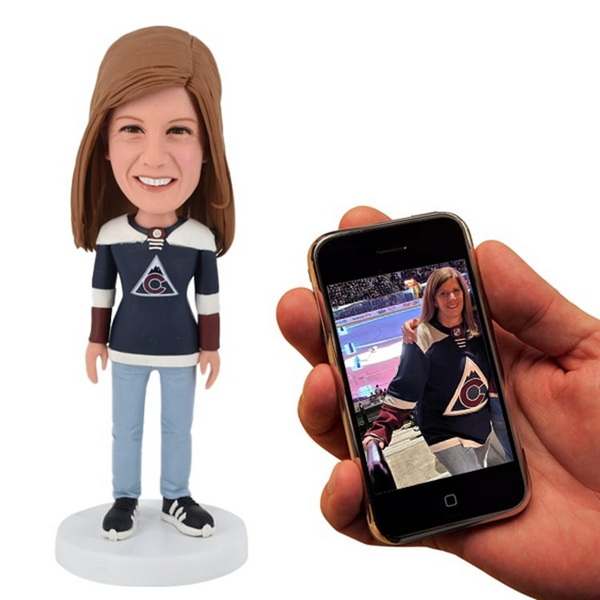
Once your digital model is ready, it's time to bring it to life through printing.
A “slicer” program breaks down your 3D file into printable layers. Adjust settings such as layer height, infill density, and print speed to optimize performance. For Bobbleheads, finer resolution (0.05–0.1 mm) produces cleaner facial features.
Always print the head and body separately to prevent joint misalignment. Use gentle supports under the chin and hands to avoid deformation.
A standard 6-inch Bobblehead can take between 8 and 15 hours depending on printer type. Longer times usually yield smoother textures. Watch early layers carefully to ensure proper bed adhesion.
Once printed, carefully detach support structures using tweezers or pliers. Be patient—hasty removal may break fragile features.
The printed parts now form a raw but visible representation of your final Bobblehead.
Printing creates form; finishing brings life. Post-processing determines how realistic and polished a Bobblehead appears.
For FDM prints, lightly sand with fine-grit sandpaper. Apply filler primer to hide grooves, then sand again to achieve smoothness. SLA prints require washing in isopropyl alcohol followed by UV curing for full hardness.
Use acrylic paints for vibrant color that adheres well to plastics and resin. Professional artists layer base coats, add shading, and finish with a matte or gloss sealant. Airbrush tools give excellent gradients but require practice.
Attach the head to the body using a small metal spring. Insert one end into the neck cavity, the other into the head, then glue carefully with high-strength epoxy. Test movement to ensure the Bobblehead wobbles freely without falling forward.
Finally, spray a clear coat to preserve the color and add resistance against moisture and UV fading. Proper finishing can make a 3D printed Bobblehead look nearly factory-made.
Customization drives the 3D printing boom. Bobbleheads aren't just toys—they've become personalized gifts, corporate icons, and creative marketing tools.
- Personal Gifts: Birthdays, weddings, or graduations featuring tailored outfits and poses.
- Corporate Branding: Companies 3D print Bobbleheads of founders or employees as promotional keepsakes.
- Sports Memorabilia: Players and fans customize figures wearing specific uniforms or achievements.
- Entertainment Collectibles: Film studios and game developers reproduce digital characters directly from CGI models.
This flexibility allows small design studios and manufacturers—particularly those in China—to fulfill global orders efficiently using hybrid production: digital modeling combined with 3D printing and resin casting.
3D printing provides numerous advantages compared with traditional molding techniques:
- Full customization: Every Bobblehead can feature unique faces, expressions, or accessories.
- Faster turnaround: No need to create silicone or steel molds.
- Cost efficiency for short runs: Suitable for small batches or one-off gifts.
- Eco-friendly production: Minimal material waste.
- On-demand manufacturing: Digital files mean zero inventory storage.
Even large-scale manufacturers now integrate 3D printing into their prototyping phases before injection molding, ensuring models are approved accurately before mass replication.
Despite its strengths, creating a perfect 3D printed Bobblehead still presents challenges. Common issues include printing errors, weak joints, and imperfect finishes.
Problem 1: Head balance issues due to oversized design.
Solution: Adjust spring firmness and verify center of gravity during modeling.
Problem 2: Visible layer lines.
Solution: Reduce layer height or apply thicker primer coating before painting.
Problem 3: Resin brittleness.
Solution: Mix flexible resin or use PLA+ filament for increased shock resistance.
Problem 4: Misalignment during spring assembly.
Solution: Pre-drill precise guide holes and dry-fit the pieces before gluing.
Understanding these issues prepares designers for success even before the printer begins.
Emerging AI-based 3D modeling tools are transforming how people design Bobbleheads. Face-scan apps and LiDAR capture instantly translate real-world images into printable 3D geometry. AI programs then enhance skin texture, hair realism, and even facial expressions.
Professional studios use hybrid scanners to record fine details—wrinkles, smiles, and beard stubble—creating Bobbleheads with stunning accuracy. Combined with machine learning, each scan refines itself automatically, reducing design labor and enabling personalized production at global scale.
This integration of AI and 3D printing represents the next frontier for customized collectibles.
Traditional plastic molding consumes energy and produces significant waste. By contrast, 3D printing supports eco-friendly production. Filaments like PLA originate from renewable corn starch and decompose naturally. Modern resins are non-toxic and recyclable.
Manufacturers are also recycling excess powder from SLS printing, reusing 80–90% of leftover materials in new batches. With globalization emphasizing sustainability, 3D printed Bobblehead production aligns perfectly with carbon-reduction strategies and ethical sourcing.
Technology continues to push boundaries. Multicolor, full-body printers can now produce Bobbleheads with vivid skin tones and printed clothing patterns—no paint required. Augmented reality integration may soon allow digital Bobbleheads that animate in smartphone apps, merging physical collectibles with virtual worlds.
As printers become faster and software easier to use, personalized 3D printed Bobbleheads will transition from novelty gifts to mainstream decorative items. Imagine ordering a custom Bobblehead online from a 3D scan and receiving it the next day—this future isn't far away.
So, can you 3D print a Bobblehead? Absolutely—and with more creativity, precision, and accessibility than ever before. 3D printing has evolved beyond experimental prototypes into a genuine production method for artists, hobbyists, and professional manufacturers alike. By combining scanning, modeling, printing, and painting, you can produce truly unique Bobbleheads that capture personality and motion in remarkable detail.
Whether you want to immortalize a sports icon, create humorous corporate gifts, or launch a small collectible business, 3D printing makes it possible. It's not just technology—it's empowerment, artistry, and personalization rolled into one joyful, nodding figure.
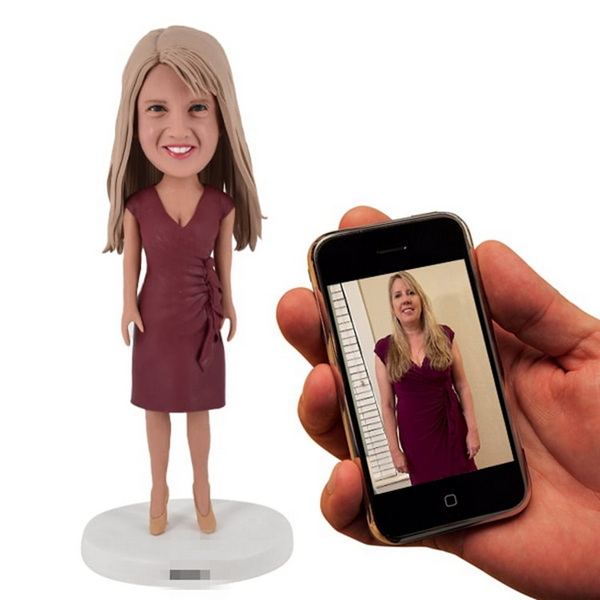
Resin offers the highest detail and smoothness, ideal for professional finishes. PLA filament works best for low-cost, durable personal projects.
A 6-inch Bobblehead generally takes between 8 to 15 hours to print, depending on printer speed, layer thickness, and complexity.
Yes, but it's not recommended. Metal springs provide more flexibility and durability. Printing the spring in plastic often results in stiffness or breakage.
Absolutely. After sanding and priming, you can use acrylic or enamel paints, followed by a protective clear coat to maintain color.
Yes. 3D printing enables on-demand customization, faster turnaround, and reduced inventory costs—perfect for corporate gifts, promotional campaigns, or collectible series.


