
Content Menu
● What Exactly Is a Bobblehead?
● The Physics Behind the Bobblehead's Motion
>> Step 3: Oscillation and Damping
● The Role of Materials in Bobblehead Motion
>> Resin
>> Plastic
>> Ceramic
>> The Spring
● How the Spring Defines the Bobblehead's Character
● How Bobbleheads Are Made: From Concept to Collectible
>> Step 1: Designing the Prototype
>> Step 2: Selecting Materials
>> Step 3: Mold Making and Casting
>> Step 5: Hand Painting and Detailing
● Exploring Bobblehead Use Cases Around the World
>> Corporate and Personal Gifts
>> Collectibles and Cultural Icons
● Are Bobbleheads Powered or Passive?
● Can a Bobblehead Vibrate Too Much?
● The Engineering of Motion Control
● How to Improve Your Bobblehead's Vibration
● Caring for Your Bobblehead Collection
● Why We Love Bobbleheads: A Psychological Perspective
● The Future of Vibrating Bobbleheads
● The Joy of Custom Bobbleheads
● FAQ
>> 1. How long does a Bobblehead usually vibrate after being touched?
>> 2. Why do some Bobbleheads stop moving faster than others?
>> 3. Can I build a motorized Bobblehead at home?
>> 4. What's the best location to place a Bobblehead?
>> 5. Are modern Bobbleheads environmentally friendly?
Across cultures and generations, few novelty items have captured human fascination quite like the Bobblehead. Its oversized head, springy motion, and cheerful nodding never fail to make people smile. Whether it's a sports star nodding from a dashboard or a custom figurine commemorating a loved one, Bobbleheads blend art, humor, and simple mechanics in a captivating way. Yet behind their playful charm lies an interesting mechanical principle: vibration. When a Bobblehead nods, does it truly “vibrate,” or does it simply move due to other forces? To answer this, we must explore the physics, engineering, and design elements that bring these delightful figures to life.
This comprehensive article will uncover everything from how Bobbleheads vibrate to how they are designed, manufactured, and maintained—and even explore what makes people love them around the world.

A Bobblehead (sometimes called a nodder or wobbler) is a figurine characterized by a disproportionately large head connected to the body with a spring or flexible neck joint. The defining feature is movement: when tapped or disturbed, the head oscillates back and forth, often for several seconds before coming to rest.
Typical materials used include resin, plastic, and ceramics, sometimes combined with metal springs or elastic connectors. The intent is to achieve continuous, smooth wobbling rather than random shaking.
Interestingly, the earliest Bobbleheads appeared as Buddhist temple figurines in 17thcentury China and Japan, where they symbolized mindfulness and agreement. By the 20th century, they had evolved into commercial collectibles, especially in the sports and entertainment industries.
What gives the Bobblehead its signature movement is basic oscillation physics—specifically, the concept of a damped harmonic oscillator. Here's how it unfolds every time you tap one:
When you nudge the Bobblehead's head, it moves away from its resting position. This action stores potential energy within the spring.
The spring then pushes the head back toward the equilibrium position. However, because of inertia, the head overshoots this position, continuing to move in the opposite direction.
This backandforth motion continues as oscillation. Over time, frictional forces (air resistance and internal material strain) dissipate the stored energy, slowing the movement until the head gradually returns to rest.
In physical terms, it resembles the formula for a damped oscillator:
f=1/2π×√k/m
where k is the spring constant and m is the mass of the Bobblehead's head.
Thus, a Bobblehead doesn't vibrate on its own; instead, it reacts dynamically to external stimulation such as touch or environmental motion.
Material selection heavily influences how a Bobblehead vibrates and how long it lasts. Each component contributes uniquely to the figure's behavior:
Resin is a preferred material for professional manufacturers because it can hold fine details while maintaining durability. Its weight, however, affects vibration slowdown, making motions more fluid but shorterlived.
ABS and PVC plastics produce lightweight Bobbleheads with energetic movement. Their flexibility allows for longer vibration durations but can feel less premium compared to resin.
Ceramic Bobbleheads have a classic look and are often handcrafted. They vibrate minimally due to their weight and rigidity, serving more as display art than functional toys.
Sometimes overlooked, the spring is the heart of the vibration system. Its length, thickness, and elasticity determine how well the head moves. A longer, softer spring creates gentle oscillation, whereas a tighter spring shortens the motion cycle.
This fine balance transforms a static sculpture into a kinetic, lifelike object.
To fully appreciate Bobblehead vibration, imagine the spring as both a control and communication system. When someone taps the figurine, it translates force into motion, allowing the Bobblehead to “respond” playfully.
A stiffer spring creates sharp, small vibrations. A loose one allows broader, slower swings. For dashboard Bobbleheads, the design prioritizes steady waving movements caused by road vibrations; for shelf models, subtle motion and aesthetic balance are more important.
Manufacturers today use advanced testing equipment to measure spring tension and motion duration. Some even run vibration simulations to ensure that every Bobblehead delivers that satisfying, rhythmic nod consumers expect.
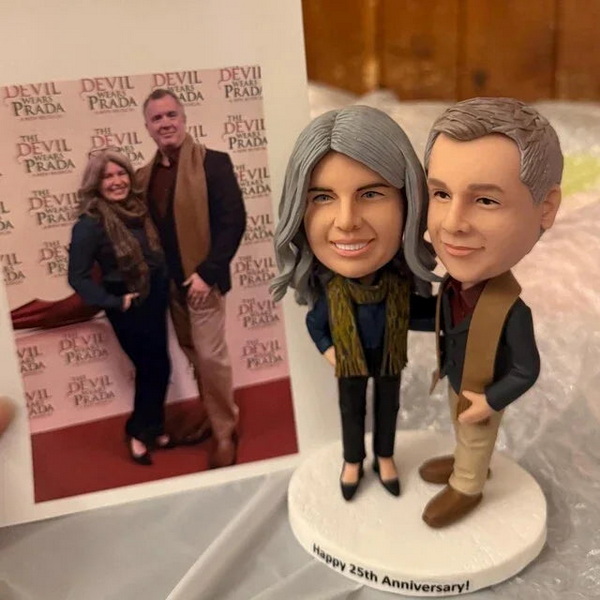
Producing a Bobblehead requires precise craftsmanship combining design, engineering, and artistry.
Designers craft a 3D model based on character sketches. Attention focuses on facial proportions, balance points, and spring alignment. Too heavy a head creates stiffness; too light, and the vibration appears unnatural.
Depending on the budget and purpose, manufacturers select appropriate materials—resin for premium products, PVC for mass markets.
Molds are produced to shape the Bobblehead's parts. Liquid resin or plastic is poured, cooled, and demolded, forming the head, body, and base.
A small hole at the neck allows attachment of a helical spring. Technicians test several spring configurations before gluing or screwing the piece in securely.
Many factories still rely on skilled artisans to paint fine details by hand. This touch gives each Bobblehead a unique personality.
Finally, testers shake each sample to evaluate movement, ensuring that the head nods smoothly, naturally, and for the right amount of time.
Behind that playful nod you see on your desk lies precise calculation and careful adjustment.
Beyond being novelty items, Bobbleheads serve multiple roles across social and corporate spheres.
Brands use custom Bobbleheads for advertising and giveaways. A beer company might release a vibrating mascot, or a sports team might gift a limitededition athlete Bobblehead to fans.
Custom Bobbleheads modeled after executives or employees create humorous, memorable corporate gifts. The head's gentle nod conveys friendliness and recognition.
Teachers sometimes use Bobbleheads to illustrate physics concepts: inertia, simple harmonic motion, and resonance. Seeing equations play out physically enhances understanding.
Some collectors devote entire rooms to display Bobbleheads from across decades. Their vibration, though simple, symbolizes vitality and continuity—qualities people cherish in nostalgia pieces.
Though they seem active, most Bobbleheads are passive. The energy driving their movement comes from external input: a tap, a breeze, car motion, or sound vibration.
However, recent innovations have introduced powered Bobbleheads. These use tiny servo motors or electromagnetic modules to simulate natural nodding and vibration cycles without manual contact. In some cases, the head even syncs with music beats.
These developments bridge the gap between mechanical art and digital entertainment, turning a traditional toy into an interactive collectible.
Yes—but that's not necessarily good. If a Bobblehead receives constant vibration, the continuous stress may fatigue the spring or wear down glue joints.
Factors that accelerate wear include:
- Excessive road vibration in cars.
- Prolonged exposure to strong bass in sound studios.
- Uneven surface or unstable base materials.
For longevity, moderate vibration—brief, periodic motion—is ideal. It keeps the movement lively without damaging structural integrity.
From an engineering standpoint, a Bobblehead functions similarly to systems used in bridges, machinery, or architecture where vibration control is crucial.
The mass–spring–damper model applies universally. Engineers studying how Bobbleheads move gain insight into:
- Energy dissipation.
- Damping coefficient optimization.
- Resonance behavior in small structures.
This simple toy thus embodies broader lessons in physics and design, illustrating complex engineering principles through a joyful, humanized motion.
If your Bobblehead no longer nods as energetically as before, you can restore its smooth motion using a few simple techniques.
1. Adjust the Spring: Gently stretch or replace the spring to increase elasticity.
2. Balance the Head: Ensure weight distribution remains even on both sides.
3. Reduce Friction: Clean dust or residue from the neck area.
4. Secure the Base: A stable foundation prevents energy loss during vibration.
5. Check for Adhesive Wear: Loose glue joints can reduce vibrational transmission.
With these small fixes, your Bobblehead can once again nod happily for years.
Collectors treat their Bobbleheads like miniature works of art. The following practices help keep them in excellent condition:
- Avoid direct sunlight: UV rays fade paint and degrade resin.
- Keep humidity stable: Excess moisture can rust metal parts.
- Shield from constant vibration: Continuous shaking weakens the spring over time.
- Use display cases: They protect from dust and accidental bumps.
- Clean with care: Soft brushes or air blowers remove dust without scratching.
Handled properly, Bobbleheads can last decades, maintaining both functional movement and sentimental value.
The attraction to Bobbleheads goes beyond novelty. Psychologists note that their groovy, repetitive movement creates a feeling of predictable rhythm, which our brains find soothing.
The gentle vibration almost feels like nonverbal communication—a gesture of agreement or friendliness. When people watch a Bobblehead, they instinctively smile, mirroring its nodding behavior. This interaction activates empathy and amusement simultaneously.
Moreover, owning Bobbleheads with personal resemblance—such as wedding or family figurines—enhances emotional attachment. The nodding motion reinforces the sense of identity and shared experience, transforming a simple toy into meaningful memorabilia.
Modern manufacturing and technology continue to redefine what a Bobblehead can do. Upcoming trends include:
- Smart Bobbleheads: Integrated with Bluetooth, responding to voice commands or music tempo.
- Solar-Powered Motion: Sustainable vibration powered by sunlight or ambient light.
- 3DPrinted Bobbleheads: Custom on-demand production allowing online customization of every detail.
- Augmented Reality Pairing: Virtual versions that move in sync with physical Bobbleheads through smartphone apps.
- SoundReactive Springs: Springs equipped with microsensors that move precisely to audio frequencies.
These innovations extend the theme of vibration from simple mechanics to smart interactivity, ensuring Bobbleheads remain relevant in both modern décor and collector culture.
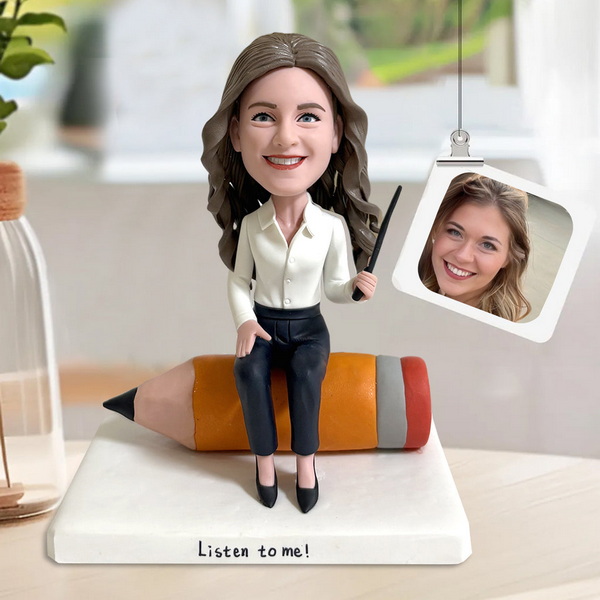
Personalization has turned Bobbleheads from novelty gifts into emotional artifacts. You can now order custom models themed after professional roles—engineers, doctors, teachers—or even beloved pets.
Customers often specify:
- Preferred head size ratio for realistic vibration.
- Material, finish, and color combinations.
- Background accessories, such as mini tools or nameplates.
- Desired vibration style (quick shake or slow nod).
Manufacturers fine-tune spring flexibility to match each design, achieving perfect harmony between aesthetics and motion.
Custom Bobbleheads not only vibrate; they tell personal stories that continue to move—literally and emotionally.
So, does a Bobblehead vibrate? Technically, yes—though not continuously, and not like a motor. Instead, it harnesses basic physics: energy transfer, spring elasticity, and damping effects. Each gentle nod is a miniature demonstration of motion science and artistic design working together.
From historical origins to modern smart designs, the fascinating world of Bobbleheads reflects how even the simplest inventions can carry depth and delight. Their rhythmic vibration connects science, craftsmanship, humor, and emotion into one tiny, expressive motion. Whether displayed in homes, cars, or offices, a Bobblehead is more than decoration—it is a tangible symbol of joy in motion.
Typically, a Bobblehead vibrates for 3–10 seconds, depending on spring strength, head weight, and environmental conditions.
This usually happens when the spring is too stiff or when the head is overly heavy. Replacing the spring or reducing weight restores smooth, lasting vibration.
Yes, with a small servo motor or vibration motor connected to a battery source, you can create a selfvibrating Bobblehead for continuous motion.
Ideally on stable yet slightly vibrating surfaces—car dashboards, desks, or shelves that occasionally receive gentle motions.
Many manufacturers now use recyclable plastics and ecoresins, reducing environmental impact while preserving the playful vibration everyone loves.


