
Content Menu
● Step 1: Define the Bobblehead Concept
● Step 2: Capture or Create the 3D Head
● Step 3: Design the Body and Base
● Step 4: Add the Spring Cavities and Clearances
● Step 5: Hollow and Shell the Head
● Step 6: Choose Printing Technology and Material
● Step 7: Prepare the Model in a Slicer
● Step 8: Print the Bobblehead Components
● Step 9: Clean, Sand, and Prime the Parts
● Step 10: Paint the 3D Printed Bobblehead
● Step 11: Install the Spring and Assemble the Bobblehead
● Step 12: Testing, Adjustment, and Replication
● Using 3D Printed Bobbleheads in Business and Branding
● Practical Tips for Successful Bobblehead Projects
● FAQ
>> 1. Do I need advanced 3D modeling skills to make a Bobblehead?
>> 2. Can I use a fully printed spring instead of a metal spring?
>> 3. What size should a 3D printed Bobblehead be?
>> 4. How can I prevent the paint from chipping on my Bobblehead?
>> 5. Is it possible to scale up a Bobblehead design for mass production?
A Bobblehead is one of the most entertaining and expressive objects you can create with 3D printing. Instead of a static figurine, a Bobblehead adds motion and personality: the oversized head tilts and nods with every touch, turning a simple model into a living caricature. 3D printing makes it possible to design, customize, and manufacture a Bobblehead of yourself, a friend, a pet, or a mascot without relying on massproduction factories.
This article integrates the full workflow into one complete guide: how to design a 3D printed Bobblehead head and body, how to engineer the spring mechanism, and how to handle slicing, printing, postprocessing, painting, and final assembly. It is written so that hobbyists, designers, and small manufacturers can all follow the same logical process and adapt it to their own Bobblehead projects.

3D printing gives you creative control over every part of a Bobblehead. You can decide the pose, proportions, outfit, expression, base text, and even the mechanical behavior of the bobble itself. Instead of buying a generic licensed figure, you can create a Bobblehead that is unique to a specific person, team, or brand.
For businesses, 3D printed Bobbleheads can serve as prototypes before investing in injection molds or as lowvolume custom gifts, awards, and promotional items. For individual makers, they are a perfect way to learn digital sculpting, engineering tolerances, and painting on a small, fun object that shows clear results.
Before opening any software, clarify the Bobblehead concept. Decide who or what the Bobblehead represents, why it is being created, and what style you want.
Key concept choices include:
- Realistic vs. cartoonish proportions for the Bobblehead head and body.
- Formal attire, sports uniforms, work clothes, or fantasy costumes.
- Standing, sitting, or action pose on the base.
Planning this concept ensures later decisions in modeling, printing, and painting stay consistent and focused on the same Bobblehead personality.
The head is the centerpiece of a Bobblehead, so it deserves careful attention. You can obtain the head model in several ways, each with its own learning curve and advantages.
Common approaches:
- Use 3D scanning or photogrammetry to capture a real person's face as a mesh, then clean and stylize it for Bobblehead proportions.
- Sculpt a head from scratch in a 3D modeling program, starting from a basic sphere or template and exaggerating the eyes, cheeks, and chin.
In either case, you want an oversize head compared to the body, with simplified but recognizable features so that the Bobblehead looks like the subject without becoming too fragile or complex to print.
A good Bobblehead body supports the head visually and mechanically. It should reflect the character's role without distracting from the face, and the base must ensure stability.
Practical design tips:
- Keep limbs somewhat thick and stylized to avoid fragile thin parts that can snap.
- Use a simple, wide base—round or rectangular—with enough mass to avoid tipping when the head moves.
- Include optional details such as logos, names, or dates on the base for commemorative Bobblehead versions.
By designing the body and base at the same time, you can ensure the overall composition looks balanced when viewed from all angles.
The difference between a simple figurine and a Bobblehead is the wobbling head. To achieve this motion, the digital model must include interior cavities for the spring and appropriate clearances.
Key modeling considerations:
- Create a cylindrical or slightly conical cavity inside the bottom of the head where the spring will be glued.
- Mirror a compatible cavity on the top of the torso or neck area, aligned with the head's center of mass.
- Leave enough empty space around the neck area so the head can tilt in any direction without colliding or scraping constantly against the body.
This step transforms the model from a solid statue into a mechanical system where geometry and motion must work together.
Most 3D printed Bobbleheads do not use a fully solid head, because that would waste material, increase print time, and put extra stress on the spring. Hollowing the head solves all of these problems.
Typical shelling practice:
- Apply a consistent wall thickness inside the head, such as 1.5–2.5 mm for filament prints or thinner for highdetail resin prints.
- Keep the area near the neck slightly thicker, since it bears the repeated motion around the spring joint.
- Add small drain holes if you use resin printing so uncured resin can escape during cleaning.
A lighter head reacts more smoothly when the Bobblehead is touched and reduces fatigue on both the spring and the adhesive joints.
Selecting the right 3D printing technology and material is crucial for a successful Bobblehead. Different technologies suit different levels of detail, durability, and budget.
Common choices:
- Filament printing (FDM): suitable for larger Bobbleheads or rough prototypes; uses materials like PLA, PETG, or ABS, with visible layer lines that can be sanded and primed.
- Resin printing (SLA/DLP/MSLA): ideal for highdetail Bobblehead faces and small accessories; produces smooth surfaces but requires extra steps for washing, curing, and ventilation safety.
Your decision should reflect the final use of the Bobblehead—display piece, gift, or sample for mass production—as well as your available equipment and finishing preferences.
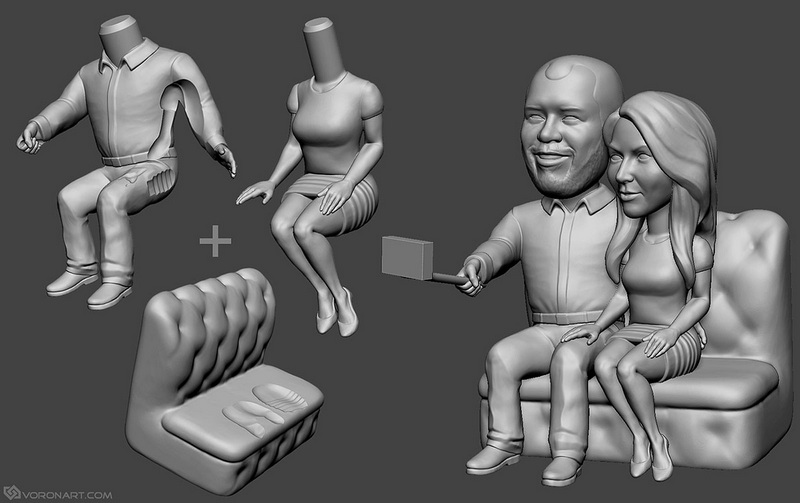
Once the Bobblehead models are ready, slicing software converts them into printer instructions. This stage determines how strong and detailed the prints will be.
Important slicing parameters:
- Orientation of the head and body to minimize supports on the most visible surfaces, especially the face.
- Layer height, with finer layers for small facial details and coarser layers for large internal parts or bases.
- Infill patterns and percentages for the body and base, balancing strength and material use.
- Support structures under overhangs like the chin, nose, or outstretched arms.
A careful preview of layers and supports helps avoid failed prints and reduces postprocessing work on your Bobblehead later.
With slicing done, the head, body, base, and any accessories for the Bobblehead can be printed. Each part may require different settings or orientations depending on shape and detail.
General printing advice:
- For filament printers, ensure good bed adhesion and stable temperatures to prevent warping or layer separation, especially on taller Bobblehead heads.
- For resin printers, verify exposure times and support density so delicate nose, ears, and hair sections print correctly.
- Print test versions of the head at a reduced scale if you want to refine proportions or adjust the size of the spring cavity before committing to a fullsize Bobblehead.
Consistent monitoring during the first layers prevents wasted time and material caused by early adhesion failures.
Fresh from the printer, a Bobblehead usually looks raw and unfinished. Postprocessing ensures the surface is smooth and ready for painting.
Typical steps:
- Remove supports carefully, especially around the face and fingers, to avoid chipping or gouging the Bobblehead.
- Sand the surface with progressively finer grit to reduce layer lines and blend small imperfections.
- Apply a suitable primer to reveal remaining flaws and create a uniform surface that grips paint evenly.
For industrial users, additional finishing techniques such as blasting or polishing can be used, drawing on the same materialtreatment expertise used in other precision components.
Painting transforms a plain 3D print into a lively Bobblehead that truly resembles a person or character. Many builders use miniaturegrade acrylic paints designed for plastic surfaces.
A systematic painting approach works best:
- Start with base coats for skin, hair, clothing, and the base itself.
- Add shading, highlights, and subtle color variations to give depth to cheeks, clothing folds, and accessories.
- Use ultrafine brushes for eyes, eyebrows, eyelashes, and tiny logos on the Bobblehead base.
- Finish with a clear protective coat—matte, satin, or gloss—depending on the desired look and handling conditions.
Careful painting not only improves aesthetics but also reinforces the perception of quality and value, especially for Bobbleheads intended as gifts or display pieces.
After the paint has fully cured, it is time to turn the figure into a functioning Bobblehead by installing the spring and assembling all parts.
Assembly points to consider:
- Choose a spring with enough stiffness to hold the head upright but enough flexibility to allow a visible bobble.
- Test the spring length before gluing: too long, and the Bobblehead head may droop; too short, and movement will be stiff.
- Use a strong adhesive suitable for plastic or resin to fix the spring inside both the head and the neck cavity, then allow proper curing time.
Once assembled, gently tap the head; a welltuned Bobblehead should nod freely and return gracefully to a centered position without scraping the torso or base.
The first completed Bobblehead acts as both a finished product and a working prototype. It reveals what went right and what needs adjustment in future prints.
Things to evaluate:
- Balance and stability when the Bobblehead is placed on different surfaces.
- Spring behavior during repeated movement—whether it remains centered and robust.
- Surface durability and paint resistance to gentle handling or dusting.
With each iteration, you can refine shell thickness, spring geometry, and design details. That experience carries over if you decide to move from individual 3D printed Bobbleheads to smallrun molds or hybrid manufacturing for larger projects.
Custom Bobbleheads do more than decorate shelves; they can reinforce brand identity and create memorable touchpoints with customers or partners. Personalized figures of founders, key staff, or mascots make effective corporate gifts, trade show giveaways, and award items.
Some companies use 3D printed Bobbleheads as rapid prototypes when collaborating with fullscale manufacturers. The printed Bobblehead confirms proportions, pose, and expression before committing to tooling and largevolume production. In this scenario, the same logical precision used in industrial abrasives or refractories—controlling material behavior, surface quality, and tolerances—helps produce Bobbleheads that look consistent across batches.
To get reliable results when 3D printing a Bobblehead, it helps to follow a few overarching best practices.
Helpful guidelines:
- Begin with small test prints of the head to check likeness and printability before detailing the entire Bobblehead.
- Keep backup copies of every design iteration, including separate versions for different head sizes or base styles.
- Standardize spring sizes and cavity dimensions so multiple Bobblehead designs can share the same mechanical components.
- Plan the project timeline with room for redesign, reprinting, and repainting, especially for timesensitive gifts or campaigns.
Following a disciplined approach saves time and reduces frustration, while still leaving room for creative experimentation with each new Bobblehead character.
3D printing has opened a new pathway for creating personalized Bobblehead figures that combine digital design, mechanical motion, and artistic finishing. By breaking the process into clear stages—concept, modeling, cavity design, printing, postprocessing, painting, and assembly—you can reliably produce Bobbleheads that look professional and feel satisfying to handle.
Whether used as personal keepsakes, prototypes for mass production, or distinctive branded gifts, 3D printed Bobbleheads show how creativity and manufacturing precision can work together. A single Bobblehead embodies not only a likeness but also a complete workflow—from raw material to finished, nodding character—that reflects the maker's skills and attention to detail.
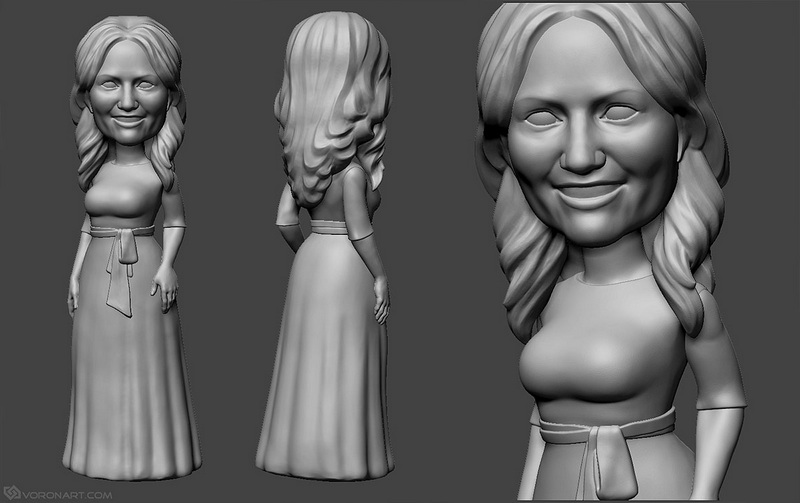
Not necessarily. You can start with simple base models or scan data and make small adjustments instead of sculpting a Bobblehead completely from scratch. Basic familiarity with scaling, hollowing, and cutting cavities is usually enough for a first project.
Yes, it is possible to print a plastic spring for a Bobblehead, but metal springs generally last longer and give more consistent motion. Printed springs work best on lighter heads and may require more testing to find the right thickness and length.
Many makers choose heights between 12 and 20 cm so the Bobblehead has enough space for facial detail and an effective bobble. Smaller figures can be printed, but the spring mechanism and head cavity become more difficult to design and assemble.
Use a primer compatible with your printing material, apply thin paint layers, and seal the finished Bobblehead with a clear protective coat. Avoid harsh chemicals and rough handling, and store the Bobblehead away from direct sunlight and extreme temperatures.
Yes. A welldesigned 3D printed Bobblehead can serve as the master reference for molding and casting or other manufacturing methods. Before scaling up, confirm that the design prints consistently, the spring mechanism works reliably, and all features are appropriate for the intended production process.


