
Content Menu
● Understanding Bobblehead Style
● Basic Bobblehead Proportions
● Step By Step: Drawing The Bobblehead Head
● Designing The Bobblehead Face
● Drawing Hair And Head Accessories
● Building The Bobblehead Body
● Adding Clothing, Props, And Themes
● Creating A Dynamic Bobblehead Pose
● Line Art, Inking, And CleanUp
● Coloring And Shading Your Bobblehead
● Turning Real People Into Bobblehead Drawings
● Adding Backgrounds And Presentation
● FAQ
>> 1. How big should the head be in a Bobblehead drawing?
>> 2. Do I need to know full anatomy to draw a Bobblehead?
>> 3. How can I make my Bobblehead look like a real person?
>> 4. What software is good for drawing digital Bobbleheads?
>> 5. Can I use a Bobblehead drawing as a reference for a real Bobblehead toy?
Drawing a Bobblehead is a fun way to practice character design, caricature, and cartoon proportions while creating a bigheaded, smallbodied figure that feels playful and expressive. With a few simple rules about head size, body balance, and facial exaggeration, anyone can sketch a Bobblehead style character that looks ready to wobble on a shelf.[1][2][3][4]

A drawn Bobblehead is basically a caricature with an oversized head sitting on a simplified, miniaturized body. This “big head, small body” structure mimics real Bobblehead dolls and makes the character instantly recognizable as a Bobblehead.[5][3][6][1]
- A Bobblehead drawing usually has a head that is as large as, or larger than, the entire body height.[4][1]
- The body of a Bobblehead is simplified, with short limbs and fewer details, while the face and hair carry most of the personality.[3][1]
Getting Bobblehead proportions right is the key to making your drawing feel like a Bobblehead instead of a generic cartoon. Cartoon and chibi tutorials often use “headstall” measurements, which are perfect for planning a Bobblehead body.[1][2][4]
- Many chibi and bobblestyle characters are 2–3 heads tall; for a strong Bobblehead look, keep the body about one head tall or less.[7][2][4]
- Use the head as the main unit of measurement, then fit the torso and legs underneath so the Bobblehead head dominates the silhouette.[4][1]
- Keep arms and legs short and chunky; tiny limbs plus a large head are common in chibi and Bobblehead drawings.[8][1]
The head is the star of a Bobblehead drawing, so start there and treat it as the foundation for everything else. Large, clearly defined head shapes make it easier to place facial features and keep the Bobblehead style consistent.[10][3][1]
1. Draw a large circle or rounded shape for the skull of the Bobblehead.[3][2]
2. Add a vertical center line and a horizontal eyeline; these guidelines help you place features around the Bobblehead face.[11][3]
3. Adjust the outline to match your character's head shape—round, square, or long—keeping edges soft and slightly exaggerated for the Bobblehead feel.[10][2]
Facial features carry most of the likeness in a Bobblehead, just like in caricature and chibi drawing. Emphasizing eyes, eyebrows, and mouth while simplifying smaller details creates a readable, expressive Bobblehead face.[5][1][3]
- Place eyes larger and slightly lower than in realistic portraits to keep the Bobblehead face cute and approachable.[1][3]
- Use eyebrows and mouth shapes to show the main emotion—big smiles, raised brows, or focused expressions work well for Bobbleheads.[3][10]
- Simplify the nose and jawline with smooth curves rather than sharp angles to keep the Bobblehead face soft and stylized.[1][2]
Hair and headgear strongly influence how a Bobblehead reads because the head is so large. Simple, bold hair shapes and clear silhouettes make the Bobblehead instantly recognizable even in small images.[2][1][3]
- Draw the volume of the hair first as big, clear blocks around the Bobblehead head, then add strands and details on top.[1][2]
- Use strong, simplified shapes for hats, helmets, headphones, or crowns so the Bobblehead outline remains clean.[3][1]
- Avoid excessive tiny details on hair; a few wellplaced highlights and locks are enough for a readable Bobblehead style.[8][1]
Once the head feels right, build a compact, simplified body underneath that supports the Bobblehead style. Think of the body as a small, stylized base that shows pose and clothing without competing with the head.[4][3][1]
- Start with a simple egg, bean, or trianglewithroundededges shape for the torso of the Bobblehead.[2][1]
- Add short cylinder or tube shapes for arms and legs, keeping them roughly one head length or less.[7][1]
- Use a wireframe or stickfigure pose first to check balance and gesture, then “wrap” the Bobblehead body around it.[6][3]
Bobbleheads often represent jobs, hobbies, or fandoms, so clothes and props are essential. A wellchosen outfit and one or two props can fully explain who the Bobblehead is supposed to be.[14][15][3]
- Use simple folds and large shapes to draw jackets, uniforms, dresses, or sports gear on the Bobblehead body.[1][3]
- Add one or two key props—microphone, guitar, basketball, laptop—that signal the Bobblehead's hobby or profession.[8][3]
- Keep proportion rules: small hands, short arms, and big props often look extra cute in Bobblehead style.[2][1]
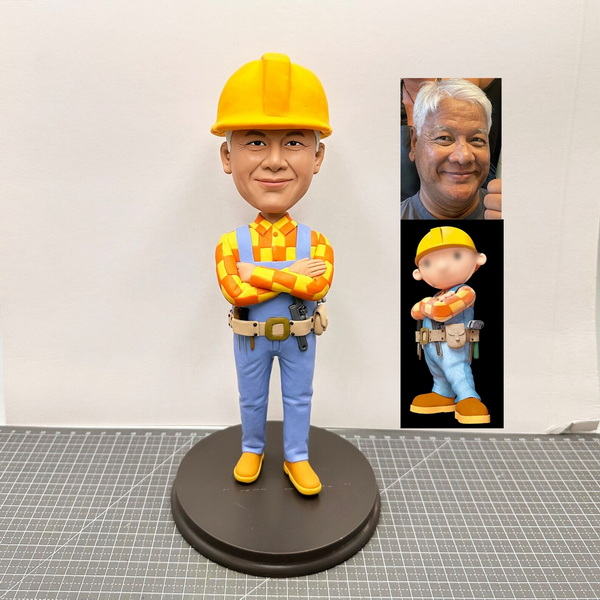
Although real Bobblehead dolls are physically static, drawings can exaggerate motion and attitude. A strong pose gives your Bobblehead drawing more personality and makes the big head feel lively instead of stiff.[4][8][3][1]
- Use leaned hips, bent knees, and asymmetrical shoulders to avoid stiff, straightup Bobblehead poses.[2][1]
- Angle the head slightly or draw it in a threequarter view so the Bobblehead feels more threedimensional.[11][2]
- Make sure the center of gravity still looks believable; the large Bobblehead head should sit over a stable stance.[4][2]
After the sketch is solid, clean lines and inking bring your Bobblehead drawing to a polished, printready state. Smooth contours and consistent line weight help preserve the cute, toylike Bobblehead look.[4][3][1][2]
- Trace over your rough Bobblehead sketch with confident, unbroken lines, simplifying bumps and messy construction marks.[3][1]
- Use slightly thicker lines for the outer contour of the Bobblehead and finer lines for interior details like facial features and clothing seams.[10][2]
- Erase or hide the underlying sketch so only the clean Bobblehead line art remains.[1][3]
Color brings your Bobblehead drawing to life and makes the big head and small body combination stand out. Even simple flat colors can look professional if you handle skin tones, hair, and clothing consistently across the Bobblehead.[2][3][1]
- Start with flat base colors for skin, hair, clothing, and props across the entire Bobblehead.[1][2]
- Add simple celshading or soft shading along one light direction, focusing on cheeks, under the chin, and folds in clothes.[2][1]
- Use highlights sparingly on hair and shiny surfaces to keep the Bobblehead stylized rather than overly rendered.[3][1]
Bobblehead drawings often start with real people—friends, celebrities, or company staff—translated into bigheaded caricatures. Learning to simplify and emphasize key traits helps you design a recognizable Bobblehead without copying a photo exactly.[5][10][3]
- Identify distinctive features: hairstyle, glasses, beard, jaw shape, or smile lines that will define the Bobblehead face.[5][10]
- Exaggerate a few traits (bigger eyes, taller hair, wider grin) while keeping the overall head outline and hair silhouette recognizable in Bobblehead form.[10][3]
- Use a threequarter head angle if possible, since it often shows more facial structure and looks dynamic in Bobblehead caricature.[11][3]
A simple background or base can make your Bobblehead drawing feel like a finished illustration or mockup for a real Bobblehead doll. The goal is to support the Bobblehead without distracting from the main character.[4][3][2][1]
- Draw a simple platform, circular base, or nameplate under the Bobblehead feet to imitate a physical Bobblehead stand.[4][3]
- Use subtle gradients, shapes, or patterns behind the Bobblehead to suggest environment (stage lights, office setting, sports field) without heavy detail.[2][1]
- Leave enough white space so the large Bobblehead head remains the primary focus of the composition.[3][1]
Learning how to draw a Bobblehead teaches control over proportions, caricature, and simplified anatomy while giving you a playful style you can use for gifts, fan art, or product concepts. By starting with an oversized head, carefully placing expressive facial features, and building a compact body and pose beneath it, you can create Bobblehead drawings that feel lively, cute, and ready to wobble off the page.[6][3][1][2]
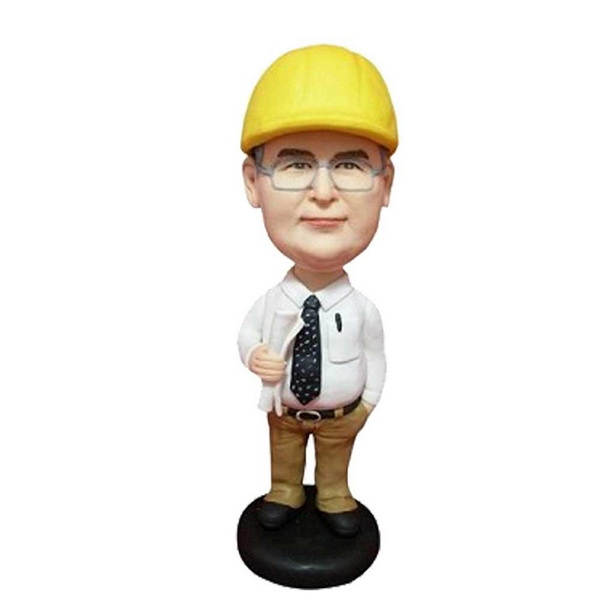
Many artists use 2–3 “heads tall” proportions for chibi and bobblestyle characters, with the head taking up about half the total height or more. The more you want the drawing to feel like a Bobblehead, the larger the head should be relative to the small body.[7][4][3][1][2]
You do not need advanced anatomy, but basic knowledge of head structure and simple body joints helps keep your Bobblehead believable. Many chibi and Bobblehead tutorials focus on simple shapes and consistent proportions rather than complex muscles or bones.[4][1][2]
Start from clear photo references, then exaggerate only a few key traits—such as hairstyle, glasses, or smile—while preserving overall head shape and hair silhouette. Big eyes, a slightly larger mouth, and a simplified jawline help turn a portrait into a recognizable Bobblehead caricature.[5][10][6][3]
Any digital art program that supports layers and brushes—such as Clip Studio Paint, Photoshop, or popular tablet apps—works well for Bobblehead drawings. These tools make it easy to separate sketch, line art, and color layers while experimenting with different Bobblehead poses and outfits.[3][1][2]
Yes, many custom Bobblehead makers and 3D artists can use a clear front and side drawing as a design reference. A wellplanned Bobblehead illustration that shows head proportion, outfit, and base details can guide sculptors or modelers during production.[15][16][17][3]
[1](https://tips.clip-studio.com/en-us/articles/4877)
[2](https://www.clipstudio.net/how-to-draw/archives/155423)
[3](https://tips.clip-studio.com/en-us/articles/3918)
[4](http://www.zebtoonz.com/proportions.htm)
[5](https://www.reddit.com/r/learntodraw/comments/2l3pgp/how_to_draw_a_normal_character_as_a_chibi/)
[6](https://www.youtube.com/watch?v=QVf3uX_CBNQ)
[7](https://www.youtube.com/watch?v=ygWBopE8Z-U)
[8](https://forums.tapas.io/t/the-art-of-chibification/41572/9)
[9](https://www.youtube.com/watch?v=hDG31WXiVQs)
[10](https://www.tomrichmond.com/how-to-draw-caricatures-head-shapes/11/03/2008/)
[11](https://www.youtube.com/watch?v=Dr3WIaNsffU)
[12](https://www.youtube.com/watch?v=xTQzip4ZjVo)
[13](https://www.tiktok.com/@asaame_/video/7012842804602768667)
[14](https://coupleofthings.net/blogs/coupleofthings/how-to-personalize-a-bobblehead-to-make-it-extra-special)
[15](https://coupleofthings.net/blogs/coupleofthings/behind-the-scenes-how-custom-bobbleheads-are-made)
[16](https://www.amazingbobbleheads.com/page/howitworks)
[17](https://www.instructables.com/3D-Printing-your-own-full-color-bobblehead-using-1/)
[18](https://www.reddit.com/r/photoshop/comments/19555mf/how_do_i_edit_to_get_these_cartoonish_bobble_head/)
[19](https://www.youtube.com/watch?v=TH9HDqwzYWA)


