
Views: 222 Author: Mia Publish Time: 2026-01-13 Origin: Site
Content Menu
● Understanding the 3D Printed Bobblehead
● Planning Your 3D Printed Bobblehead Project
● Capturing or Creating the Head for Your Bobblehead
● Cleaning and Preparing the Head Model
● Designing the Bobblehead Body and Neck
● Hollowing the Head for Bobble Movement
● Adding Spring Holes and Tolerance to the Bobblehead
● Choosing or Designing a Bobblehead Spring
● Slicing and 3D Printing Bobblehead Parts
● Cleaning, Sanding, and Painting the 3D Printed Bobblehead
● Assembling the 3D Printed Bobblehead
● Testing and Tuning the Bobble
● Creative Ideas for 3D Printed Bobbleheads
● Maintaining a 3D Printed Bobblehead
● FAQ
>> 1. Do I need a 3D scanner to make a 3D printed Bobblehead?
>> 2. What is the best material for a 3D printed Bobblehead?
>> 3. How do I choose the right spring for my 3D printed Bobblehead?
>> 4. Can I paint my 3D printed Bobblehead, and what paints should I use?
>> 5. How long does it take to make a 3D printed Bobblehead from start to finish?
Making a 3D printed Bobblehead is one of the most satisfying projects for any designer, maker, or hobbyist who wants a personalized, moving figurine. With free 3D tools, affordable printers, and parametric springs, you can design, print, and assemble a custom Bobblehead that actually bobbles, using your own head model or any character you like.[1][2][3]

A 3D printed Bobblehead combines digital modeling, spring engineering, and physical assembly so the head can wobble freely on the body. The key Bobblehead parts are a hollow head, a solid body with a neck post, and a spring system that connects the two while allowing controlled motion.[4][2][3]
- Many 3D printed Bobblehead projects separate the head and body into different STL files so they can be printed with different orientations and settings.[2]
- Tutorials often use a pre-made spring model or a parametric Bobblehead spring generator that lets you adjust diameter, length, and number of coils.[5][3]
Before you start modeling or printing, plan your Bobblehead design, tools, and workflow so the project runs smoothly.[1]
- Decide whether your 3D printed Bobblehead will use a realistic scanned head, a stylized cartoon head, or a simple geometric head.[7][4]
- List the software and hardware you will use for your Bobblehead, such as a 3D scanner or scanning app, a modeling tool (Tinkercad, Meshmixer, Blender), a slicer, and your 3D printer.[2][1]
The head is the most important visual part of any Bobblehead, so getting a good 3D model is essential.[4][1]
- One approach is to scan yourself or a friend, using a phone-based 3D scanning app or a dedicated 3D scanner to capture a head model that can be turned into a Bobblehead.[8][4][7]
- If you prefer a stylized look, you can sculpt a Bobblehead head directly in modeling software or build it from primitive shapes, then refine facial features for a fun caricature style.[9][2]
Once you have a head model for your 3D printed Bobblehead, clean it up and prepare space for the spring.[2][4]
- Guides recommend using Meshmixer, 123D Design, or similar tools to remove background noise, fill holes, and smooth surfaces on the Bobblehead head model.[4]
- After cleanup, you typically cut a cylindrical cavity into the bottom of the Bobblehead head where the spring will sit, keeping enough wall thickness to remain strong but light.[2][4]
A 3D printed Bobblehead body must support the head and spring while matching your chosen style or character.[1][2]
- Tutorials show how to block out a Bobblehead body from simple boxes and cylinders, then shape shoulders, torso, and legs in Tinkercad or similar beginner-friendly software.[2]
- The Bobblehead neck and upper body need a flat or slightly rounded top area and a spring hole or post aligned with the head cavity so the spring sits straight.[3][2]
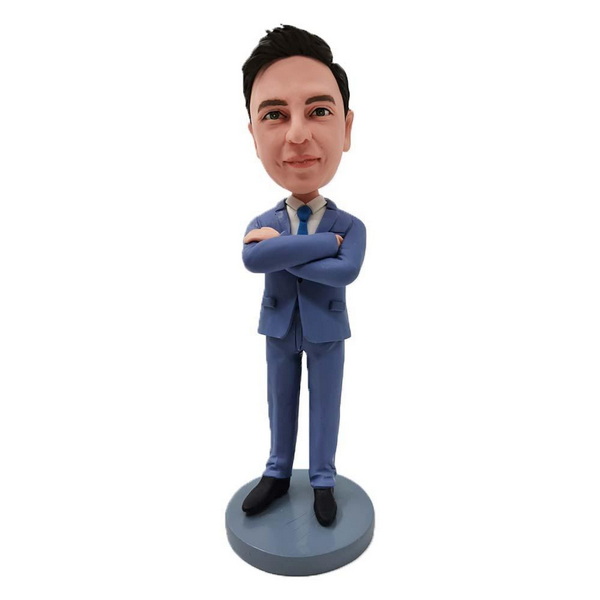
Hollowing is what turns a solid head model into a functional Bobblehead head.[2]
- Detailed tutorials show using “shell” operations and Boolean subtraction to create an internal cavity in the Bobblehead head while preserving enough thickness for strength.[2]
- You can cut away part of the face area from the “hole” object so the shell operation hollows only the interior, leaving the Bobblehead face intact.[2]
For a Bobblehead to bobble smoothly, the spring holes in the head and body must be sized and aligned correctly.[3][2]
- In one popular workflow, the spring has a diameter of around 14.5 mm, so the holes are modeled around 15 mm to allow clearance and a good press fit, a concept known as tolerance.[3][2]
- Tutorials often use cylinders and alignment tools to center the spring hole on the Bobblehead neck and then cut matching cavities in both head and body pieces.[2]
The spring is the heart of the Bobblehead mechanism, and 3D printing allows both traditional and parametric spring designs.[5][3]
- Some makers buy metal springs from hardware stores and then model suit able holes in the Bobblehead head and body to fit these standard parts.[4]
- Others use printable, parametric Bobblehead springs where you can adjust coil count, wire thickness, and height to match head weight and desired bobble behavior.[10][5][3]
Once the Bobblehead head, body, and spring are modeled, they must be sliced and printed with settings that balance quality and strength.[1][2]
- Step-by-step guides highlight the importance of choosing appropriate layer height, infill percentage, and support placement to preserve fine Bobblehead details while keeping print time reasonable.[2]
- Some makers print the spring with many perimeters and without supports to ensure flexible but strong coils for the Bobblehead.[10][2]
Raw 3D prints often need post-processing to look like a finished Bobblehead.[12][1]
- Many Bobblehead makers lightly sand layer lines and then prime the surface before painting with acrylic paints to achieve smooth skin tones and clothing colors.[12][1]
- Hand painting facial features such as eyes, eyebrows, and mouth carefully helps the 3D printed Bobblehead capture personality and expression.[12]
Now the Bobblehead head, body, and spring come together in the final assembly stage.[4][2]
- In some workflows, the spring is glued into the head cavity first, using a small dab of glue and pressing until the spring end is flush and centered.[4][2]
- Shims or small printed inserts can be added to the body's spring hole to fine-tune how the head sits, ensuring the Bobblehead is upright and free to bobble without scraping.[2]
After assembly, small adjustments can improve how a 3D printed Bobblehead moves.[5][2]
- Makers test the Bobblehead by gently tapping the head and watching the oscillation; changing spring length or coil stiffness can make the bobble faster or slower.[10][5]
- If the Bobblehead head scrapes the shoulders or chest, you can trim the spring, adjust shims, or lightly sand contact points to restore clean bobble motion.[2]
Once you master the process, a 3D printed Bobblehead can become a fun, customizable platform for many themes.[13][1]
- Popular projects include Halloween Bobbleheads, “mini-me” Bobbleheads of makers themselves, and Bobblehead mascots designed to sit on top of 3D printers.[11][13][5]
- 3D printed Bobbleheads can also be used as promotional gifts, workshop projects, or teaching examples that introduce kids to modeling, printing, and simple mechanics.[13]
A 3D printed Bobblehead needs occasional care to keep bobbling smoothly and to preserve paint.[14][2]
- Light dusting with soft brushes and avoiding long-term direct sunlight helps keep 3D printed Bobblehead plastics and paints from fading or becoming brittle.[15][14]
- If a 3D printed Bobblehead spring or joint loosens over time, small repairs with glue or adjustment shims can restore stable, satisfying movement.[10][2]
Making a 3D printed Bobblehead blends creativity with practical engineering, from capturing a head model and designing a body to calculating spring tolerances and assembling the final figure. Thanks to free 3D software, detailed tutorials, and customizable Bobblehead springs, nearly anyone with a basic printer can design and print a personalized Bobblehead that genuinely nods, shakes, and responds to motion. With careful cleanup, painting, and occasional maintenance, your 3D printed Bobblehead can become a unique gift, a fun mascot, or a long-lasting display piece that keeps bobbling for years.[3][12][1][2]
No, a 3D scanner is not strictly required; many 3D printed Bobblehead projects use stylized heads modeled directly in software like Tinkercad or Blender. However, scanning your face or body with a mobile app or dedicated scanner can create a highly personalized Bobblehead with realistic features.[7][8][1][4][2]
Most makers use common FDM filaments like PLA or PETG for 3D printed Bobblehead parts because they are easy to print and finish. For higher detail and smoother surfaces, some projects use resin printers, then add a separate metal or 3D printed spring to complete the Bobblehead mechanism.[10][12][1]
The spring for a 3D printed Bobblehead should match the head weight and desired bobble movement; parametric spring models let you adjust coil count, diameter, and wire thickness. Guides recommend testing different spring settings or using printable parametric Bobblehead springs so you can refine flexibility and stability before final assembly.[3][10][5]
Yes, 3D printed Bobbleheads can be primed and painted using acrylic paints, which adhere well to PLA and similar filaments. Many makers lightly sand prints, apply a primer, then build up colors and details in thin layers to keep the Bobblehead surface smooth and expressive.[12][1]
Time varies, but one full Bobblehead workflow—modeling, printing, painting, and assembly—can often be completed in one to two days of focused work. Beginners may need more time to learn modeling and tuning the Bobblehead spring, while experienced makers can re-use templates to produce new Bobbleheads faster.[16][13][1][2]
[1](https://all3dp.com/2/3d-print-bobblehead-3d-printer-all-you-need-to-know/)
[2](https://www.instructables.com/3D-Printed-Bobblehead/)
[3](https://www.printables.com/model/282561-parametric-bobblehead-springs)
[4](https://www.instructables.com/3D-Printing-your-own-full-color-bobblehead-using-1/)
[5](https://www.youtube.com/watch?v=5cWb99a7tlI)
[6](https://www.youtube.com/watch?v=mZKA3nQ9KCc)
[7](https://www.youtube.com/watch?v=H6k35Ujheuw)
[8](https://www.youtube.com/watch?v=ohu7SEmTeE0)
[9](https://kk.org/cooltools/maker-update-bobbleheads-burrs/)
[10](http://www.3dprinty.xyz/project/108)
[11](https://www.youtube.com/watch?v=3HwXJQMGgsQ)
[12](https://www.reddit.com/r/3Dprinting/comments/1nx14p5/sculpted_printed_and_painted_a_functional/)
[13](https://acceleratekid.com/event/3d-workshop/)
[14](https://grainraincraft.com/tips-to-protect-resin-figurine-crafts-collectibles/)
[15](https://www.pioneerplastics.com/blog/protect-your-memorabilia-with-uv-protected-display-cases/)
[16](https://www.instructables.com/3D-Printed-Bobblehead-High-Resolution-Full-Body-Sc/)
[17](https://www.youtube.com/watch?v=ctRtwxuY7WA)


