
Content Menu
● What Is A Bobblehead And Why Mold It?
● Materials And Tools Needed For Bobblehead Molding
>> Common Materials For A Bobblehead
>> Basic Tools For Bobblehead Molding
● Step 1: Design Your Bobblehead
● Step 2: Sculpt The Bobblehead Master
>> Sculpting The Bobblehead Body
>> Sculpting The Bobblehead Head
● Step 3: Plan The Bobblehead Mold
● Step 4: Build The Mold Box And Pour Silicone
>> Building The Mold Box For A Bobblehead
>> Pouring Silicone Around The Bobblehead Master
● Step 5: Create The Second Half Of The Bobblehead Mold
● Step 6: Casting Resin Bobblehead Parts
>> Preparing The Bobblehead Mold
● Step 7: Hollowing The Bobblehead Head For The Spring
● Step 8: Attach The Bobblehead Spring And Assemble
>> Installing The Spring In The Bobblehead Head
>> Connecting The Bobblehead Body
● Step 9: Painting And Finishing Your Bobblehead
● Step 10: Quality Control And Packaging For Bobbleheads
● Tips For Better Bobblehead Molding Quality
● Using Photos, Videos, And Content To Market Your Bobblehead Production
● FAQ
>> 1. How long does it take to mold a custom bobblehead?
>> 2. Which material is best for a durable bobblehead?
>> 3. Why are the head and body molded separately on a bobblehead?
>> 4. Can I use 3D printing in the bobblehead molding process?
>> 5. How can I reduce bubbles in a bobblehead resin casting?
Bobblehead molding is a combination of creative sculpting and precise mold-making that turns a simple idea into a bouncing, character-filled figurine. Whether you want a custom sports bobblehead, a promotional bobblehead, or a fun personal gift, understanding the bobblehead molding process helps you get better quality and more consistent results.
A well-planned bobblehead mold allows you to reproduce the same design in large quantities while preserving the details of the original sculpture. Once your master is finished, every additional bobblehead becomes easier and more cost-effective to produce. For manufacturers and exporters, especially in the gift and collectibles sector, a robust bobblehead molding workflow is the foundation for stable, scalable orders.

A bobblehead is a small figurine with an oversized head connected to the body by a spring or flexible joint so that the head “bobbles” when touched or moved. The charm of a bobblehead comes from its exaggeration: big head, expressive face, and fun bouncing motion that draws attention on desks, dashboards, and display shelves.
Molding a bobblehead instead of hand-making each piece individually offers several advantages:
- You can mass-produce custom bobblehead designs for teams, brands, promotional events, and souvenirs.
- The bobblehead shape, size, and surface details remain consistent from piece to piece.
- Once the master mold is created, the cost per bobblehead decreases significantly.
- You can standardize materials, colors, and packaging for international orders.
For a professional factory, a mature bobblehead molding process means shorter lead times, fewer defects, easier quality control, and better customer satisfaction.
Before you mold a bobblehead, you need to prepare both sculpting materials for the master and technical materials for the mold and castings.
- Sculpting clay: Polymer clay or oil-based modeling clay is used to create the original bobblehead master.
- Silicone rubber: A two-part silicone is used to make flexible bobblehead molds that capture fine detail and release parts easily.
- Resin or plastic: Polyurethane or epoxy resin is typically used to cast the final bobblehead head and body. Some large-scale factories use plastic injection for very high volumes.
- Metal spring: A steel spring connects the bobblehead head and body, providing the characteristic bouncing motion.
- Paints and primers: Acrylic paints, primers, and clear coats are used for finishing and protecting the bobblehead surface.
- Sculpting tools: Knives, loop tools, spatulas, and fine carving tools help shape detailed bobblehead features.
- Mixing cups and sticks: Used to prepare precise ratios of silicone and resin for bobblehead molds and castings.
- Mold box or container: A box built from plastic, wood, or foam board holds the bobblehead master while silicone is poured.
- Clamps or rubber bands: Keep two-part bobblehead molds tightly closed during casting.
- Sandpaper and files: Used for cleaning, trimming, and smoothing the cast bobblehead surfaces before painting.
- Safety equipment: Gloves, masks, and ventilation to handle resin and paints safely during bobblehead production.
Every molded bobblehead starts with a clear design that defines the character, pose, and style. Without a solid design, the final bobblehead can look unbalanced or lack personality.
Key design decisions for a bobblehead include:
- Character type: Sports players, company mascots, celebrities, movie characters, or personalized portrait bobbleheads.
- Proportions: An oversized head, stable body, and base large enough to keep the bobblehead standing upright.
- Pose and accessories: Arm positions, items held in the hands, uniforms, helmets, tools, or branded objects that reinforce identity.
- Base design: Simple round or square base, or custom base with logos, team names, or event dates.
Many designers sketch the bobblehead from front, side, and back views or use 3D software to visualize proportions before sculpting. A clear design makes it easier to transfer details into the bobblehead mold and ensures that the finished bobblehead looks exactly like the approved concept.
The sculpted master bobblehead is the original, hand-made or digitally produced model from which all future copies are made. This master defines the final shape, detail level, and character of the bobblehead.
The body of a bobblehead must be stable enough to support the oversized head and spring.
- Build a simple internal armature from wire or aluminum foil to support the bobblehead body and prevent sagging.
- Apply clay gradually to form legs, torso, arms, and base, checking balance at every stage so the bobblehead does not tip over.
- Keep the neck area clearly defined and strong because this is where the bobblehead spring will connect to the body.
- Simplify small, fragile projections that might break easily, such as very thin fingers or tiny accessories.
The head is the main visual focus of a bobblehead, and it is usually sculpted separately from the body.
- Roughly form the oversized bobblehead head shape, then refine the jawline, cheeks, and skull.
- Add facial features like eyes, nose, mouth, and eyebrows, as well as hair texture, beards, hats, or helmets.
- Exaggerate key traits slightly to make the bobblehead more recognizable and expressive.
- Ensure enough internal thickness so that later the head can be hollowed or designed with a cavity for the spring.
Once sculpting is complete, polymer clay masters are normally baked or cured according to the manufacturer's instructions. A fully hardened bobblehead master is easier to handle during mold-making and less likely to deform.
Good planning before pouring silicone reduces mistakes and ensures a clean, detailed bobblehead mold.
Most professional bobblehead makers separate the project into two molds:
- One bobblehead mold for the head.
- One bobblehead mold for the body and base.
This separate approach allows the head to move freely on the spring and simplifies casting.
When planning the mold:
- Analyze undercuts: Complex shapes, deep cavities, and overhangs can trap resin or block demolding.
- Decide on a parting line: The line where the two halves of the bobblehead mold meet should avoid cutting through highly detailed areas like faces or logos.
- Add registration keys: Small bumps or shapes in the mold help both halves align perfectly so that each bobblehead comes out symmetrical.
A well-planned mold design minimizes air pockets, reduces flashing, and increases the lifespan of the bobblehead molds.
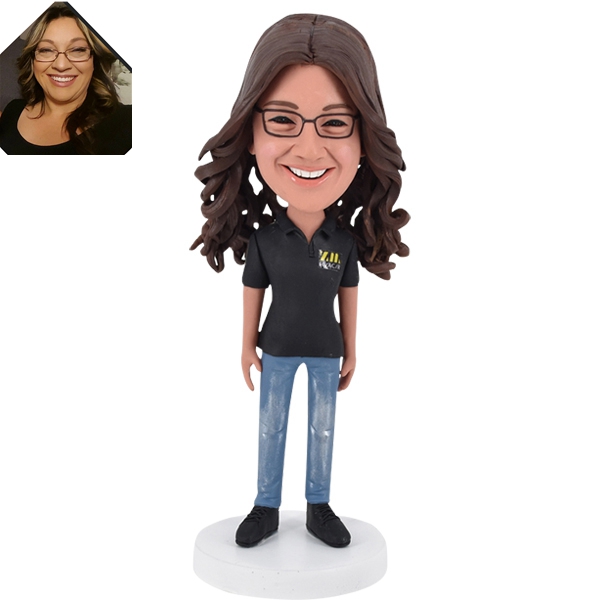
The mold box holds the bobblehead master and liquid silicone in place while it cures.
- Choose a box size that leaves a few centimeters of space around the bobblehead master on all sides.
- Build the box from plastic, wood, foam board, or interlocking bricks and seal the corners to prevent leaks.
- Embed the bobblehead master halfway in clay (for a two-part mold) and smooth the surface to define the parting line.
- Add small cone-shaped channels or pins for pouring resin and venting air when the bobblehead is cast.
- Mix the two-part silicone thoroughly according to the specified ratio, avoiding over-mixing that introduces excess bubbles.
- Pour the silicone slowly from one corner of the box in a thin stream, letting it rise gradually around the bobblehead.
- Gently tap or vibrate the mold box to help bubbles escape from detailed areas of the bobblehead.
- Let the silicone cure completely; curing time varies but often takes several hours or overnight.
After curing, you will have the first half of your bobblehead mold, capturing one side of the master.
To complete the two-part bobblehead mold:
- Flip the mold box and remove the base clay, leaving the bobblehead master and the first silicone half exposed.
- Apply a suitable mold release agent on the cured silicone surface to prevent the new silicone from bonding to it.
- Rebuild or adjust the mold box walls if needed to match the new pouring direction.
- Mix and pour the second batch of silicone over the exposed side of the bobblehead master.
When the second half cures, carefully separate the two halves and remove the master bobblehead. Now you have a complete two-part bobblehead mold for either the head or the body. Repeat the process for the other part so you end up with two complete molds: one for the bobblehead head and one for the bobblehead body.
Once the bobblehead molds are ready, you can cast multiple copies quickly and consistently.
- Clean any dust or leftover clay from inside the silicone mold cavities.
- Apply a mold release that is compatible with your resin to protect the bobblehead mold and make demolding easier.
- Align and clamp the mold halves tightly, ensuring that the registration keys lock into place so the bobblehead cast remains accurate.
- Measure and mix the resin carefully, following the manufacturer's instructions for ratio and mixing time.
- Pour the resin slowly through the sprue channel, allowing air to escape through vents. For complex bobbleheads, you may tilt the mold or gently shake it to help trapped air rise.
- Let the resin cure fully. Some fast-setting resins cure in minutes, while others require longer; do not remove the bobblehead early or the part may warp.
- Once cured, open the mold carefully and remove the bobblehead head or body casting. Trim excess material (sprues and vents) with a knife or cutter.
By repeating this process, you can produce many identical bobblehead castings using the same molds, ideal for bulk orders and export.
A classic bobblehead needs space inside the head for the spring to move without obstruction. Depending on your production method, this can be handled in different ways.
- If you use 3D modeling, you can design the bobblehead head as a hollow shell with a defined cavity and spring seat.
- If you cast the head solid, you can drill or carve a cavity after casting, making sure the walls remain thick enough for strength.
- You should also drill or form a small cylindrical hole inside the head to anchor the spring securely with glue.
The cavity must be large enough so the bobblehead head can swing and bounce without hitting the sides of the body or base. A clean internal design improves the overall bobble effect and gives the bobblehead a playful, dynamic feel.
Now you transform the figurine into a true bobblehead by installing the spring.
- Select a spring that matches the size and weight of your bobblehead head; a spring that is too stiff will barely move, while a spring that is too soft may wobble excessively.
- Insert one end of the spring into the cavity or recess inside the head and glue it in place using a strong adhesive or epoxy.
- Hold the spring in the correct position until the adhesive sets so that the head remains centered when bobbling.
- Drill or form a corresponding recess in the bobblehead body's neck or chest area where the other end of the spring will attach.
- Apply adhesive to the body end of the spring and fix it into the recess at the desired angle.
- Once the glue has cured, gently tap the head to test the bobble motion and adjust if necessary.
This assembly step determines how the bobblehead behaves in real use, so it is worth testing several times to ensure smooth, satisfying movement.
Painting brings the bobblehead to life and adds character, brand identity, and visual appeal.
- Clean the bobblehead head and body castings to remove dust, oil, or mold release.
- Lightly sand seams and any rough edges so the bobblehead surface is smooth and ready for paint.
- Apply a primer suited to resin or plastic to improve paint adhesion and color vibrancy.
- Use acrylic paints to add skin tones, clothing colors, logos, numbers, and facial features. Many professional bobbleheads are entirely hand-painted for better detail and shading.
- Apply a clear coat or varnish to protect the bobblehead from scratches and UV fading.
You can also add decals for complicated logos or fine text that would be difficult to paint by hand. Well-finished bobbleheads stand out in photos, catalogs, and online listings.
For a manufacturing or export company, quality control and packaging are as important as the bobblehead molding steps themselves.
Key quality checkpoints:
- Check the bobblehead head and body for bubbles, warping, or incomplete filling.
- Confirm that the spring is firmly attached and that the bobble motion is smooth and not restricted.
- Inspect paintwork for color accuracy, clean lines, and consistent details across the batch.
- Verify that the base text, logos, and names are spelled correctly and placed in the right position.
Packaging considerations:
- Use custom boxes with foam inserts or blister packs to protect the bobblehead during transport.
- Include branding elements such as printed boxes, labels, and certificates to increase perceived value.
- For export orders, test packaging to ensure bobbleheads can survive long-distance shipping without damage.
Strong quality control and secure packaging help your bobbleheads arrive safely and impress customers on first unboxing.
To improve the quality and durability of each bobblehead and its mold, consider the following tips:
- Choose silicone with good tear resistance so the bobblehead molds can handle repeated demolding.
- Keep consistent mixing ratios and timing for silicone and resin; small variations can cause soft spots or brittle areas.
- Control workshop temperature and humidity to keep curing times stable and surface finish smooth.
- Use vent channels and well-positioned sprues to allow resin to flow easily into every part of the bobblehead mold.
- Record standard operating procedures for every stage so that every batch of bobbleheads meets the same standard.
For large runs, you may also produce multiple identical bobblehead molds to increase capacity and reduce wear on each individual mold.
If you are a professional factory, visual content is a powerful tool to showcase your bobblehead capabilities to global buyers.
Useful content ideas:
- Workshop photos showing sculptors, painters, and finished bobbleheads lined up on racks.
- Close-up shots of bobblehead heads, faces, uniforms, and bases to highlight detail and quality.
- Short process videos demonstrating sculpting, silicone mold pouring, resin casting, and final assembly.
- Time-lapse clips of hand painting a bobblehead from primer to final clear coat.
- Explainer videos about how a custom bobblehead order moves from concept to finished product.
By combining technical bobblehead molding knowledge with clear visual evidence of your process, you can build trust and attract more international customers looking for a reliable bobblehead supplier.
Molding a bobblehead is a structured process that begins with a strong design and carefully sculpted master, then moves through silicone mold-making, resin casting, spring installation, and detailed painting. When each step is controlled and standardized, you can produce bobbleheads that not only look accurate and expressive but also bobble smoothly and remain durable in daily use. For manufacturers and exporters, mastering bobblehead molding, improving quality control, and presenting the process through photos and videos creates a competitive advantage in the global bobblehead and promotional gift market.
Contact us to get more information!
A full custom bobblehead project, from design to finished product, can take anywhere from one to four weeks. The exact time depends on design complexity, approval rounds for the sculpt, and production quantity. Once the bobblehead molds are complete, each additional piece can usually be cast, finished, and packed in a relatively short time.
Most professional bobbleheads are made from resin or hard plastic because these materials capture fine details and hold paint well. Silicone is used only for the bobblehead mold, not for the final product. For high-volume orders, some factories use plastic injection, while smaller or mid-sized runs often rely on resin casting for flexibility and detail.
The head and body of a bobblehead are molded separately so that a spring can be installed between them to create the bobbling motion. Separate molds also make it easier to avoid undercuts, improve casting quality, and repair or replace parts individually if needed. This modular structure is one of the main reasons bobbleheads can be produced efficiently at scale.
Yes, 3D printing integrates very well with bobblehead molding. You can design and print a digital bobblehead master, then use that print to create silicone molds for mass production. This method allows precise control of facial features, logos, and proportions while still benefiting from the speed and cost advantages of traditional bobblehead molding and casting.
To reduce bubbles in a bobblehead casting, mix resin slowly, pour in a thin stream, and gently tap or vibrate the mold to help air escape. If available, use vacuum or pressure equipment to further minimize bubbles, especially for very detailed bobblehead designs. Good vent placement and mold design also play a big role in reducing trapped air.
1. https://www.bbobbler.com/how-are-bobble-heads-made/
2. https://litzone.app/news/bobbleheads-how-they-re-made
3. https://www.instructables.com/3D-Printed-Bobblehead/
4. https://coupleofthings.net/blogs/coupleofthings/behind-the-scenes-how-custom-bobbleheads-are-made
5. https://www.youtube.com/watch?v=Gbo7jlWTO2o
6. https://mlmjhysc.com/announce/show.php?itemid=436


