
Views: 222 Author: Mia Publish Time: 2026-11-23 Origin: Site
Content Menu
● Why Original Packaging Matters for a Damaged Bobblehead
>> Carrier Inspection May Still Be Required
● What Counts as Original Bobblehead Packaging?
● What to Do Immediately If Your Bobblehead Arrives Damaged
>> 1. Stop Unpacking Once You Notice the Problem
>> 2. Photograph the Shipment Clearly
>> 3. Handle Broken Pieces Safely
>> 4. Contact the Seller Promptly
● Should You Repair a Damaged Bobblehead Before Reporting It?
● How Long Should You Keep the Original Packaging?
● What If You Already Threw Away the Packaging?
● Keep the Evidence, but Do Not Automatically Reuse Damaged Packaging
● Distinguish Product Damage From Gift Box Damage
>> The Presentation Box Is Damaged
>> Only the Shipping Carton Is Damaged
● A Better Damage Report Can Reduce Repeated Questions
● Extra Precautions for Wholesale and Personalized Batch Orders
>> Keep Each Damaged Unit Traceable
>> Separate Observation From Suspected Cause
>> Use Damage Findings to Improve Future Orders
● How Top Arts & Crafts Can Help With Your Inquiry
>> 1. Do I Need to Keep the Packaging If the Bobblehead Is Completely Broken?
>> 2. Are Photographs Enough for a Damaged Bobblehead Claim?
>> 3. Must I Return the Damaged Bobblehead Before Receiving a Replacement?
>> 4. Does an Undamaged Outer Box Mean the Damage Is My Fault?
>> 5. Can I Throw Away the Packaging After the Seller Approves a Refund?
Do I Need to Keep the Original Packaging If My Bobblehead Arrives Damaged? Yes. If your bobblehead arrives damaged, keep the original packaging, the figure, and any broken pieces until the seller and any carrier handling the claim confirm that inspection is complete and retention is no longer required.
That includes more than the gift box. Save the outer shipping carton, protective inserts, wrapping, shipping label, and other packing materials. Photograph their condition before making unnecessary changes.
Keeping the packaging does not guarantee a refund or replacement. However, it preserves evidence that may help establish what happened and support an appropriate resolution.
At Top Arts & Crafts Co., Ltd., we manufacture and retail personalized bobbleheads, polyresin crafts, and polymer-clay gifts. From a manufacturing perspective, the packaging and damaged figure should be evaluated together—not as two unrelated items.
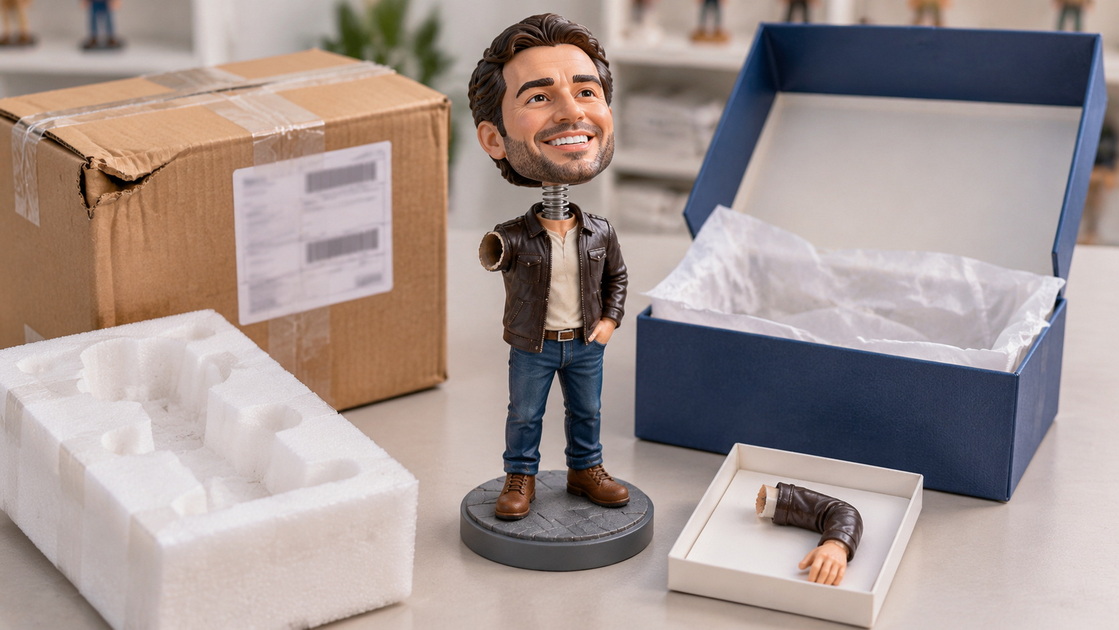
Packaging provides context that photographs of a broken figure alone cannot show.
A cracked base, detached head, or broken motorcycle handlebar might involve impact, movement inside the box, pressure on a delicate component, or an assembly issue. The damaged part alone rarely proves the cause.
The packaging can help answer several questions:
- Was the outer carton crushed or punctured?
- Did the insert hold the figure securely?
- Was a fragile accessory touching the carton?
- Did the figure shift within its protective cavity?
- Was there visible moisture exposure?
- Were multiple products able to contact each other?
These observations support investigation. They should not be treated as conclusive proof that the carrier, manufacturer, or recipient caused the damage.
Major carriers publish instructions asking customers to retain damaged contents and original packaging. They may request photographs, an inspection report, or a physical inspection.
Submitting photographs does not automatically mean you can discard everything afterward.
Ask whether the claim still requires the physical shipment, particularly before recycling the carton or returning the figure.
Keep all packaging layers that arrived with the product.
| Item to retain | Why it may matter |
|---|---|
| Outer shipping carton | Shows external damage and identifies the shipment |
| Shipping label | Connects the package to its tracking record |
| Protective insert | Shows how the figure was positioned and supported |
| Bubble wrap, paper, or foam | Helps document cushioning and separation |
| Inner product carton | May show movement or compression inside the shipment |
| Presentation box | May be part of the purchased gift product |
| Packing slip | Helps identify the order and quantities |
| Broken components | Supports assessment of damage and possible remedies |
Do not assume an undamaged-looking box is irrelevant. Concealed damage can occur without an obvious hole or crushed corner.
Likewise, an intact gift box does not replace the outer shipping carton as evidence.
Pause before removing more wrapping or rearranging the contents.
If safe, photograph the figure where it sits inside the packaging. This records the relationship between the damage and the protective materials.
Do not recreate the original arrangement later and present it as an untouched opening photograph. If items have already been moved, explain that honestly.
Use good lighting and keep the original image files.
Capture:
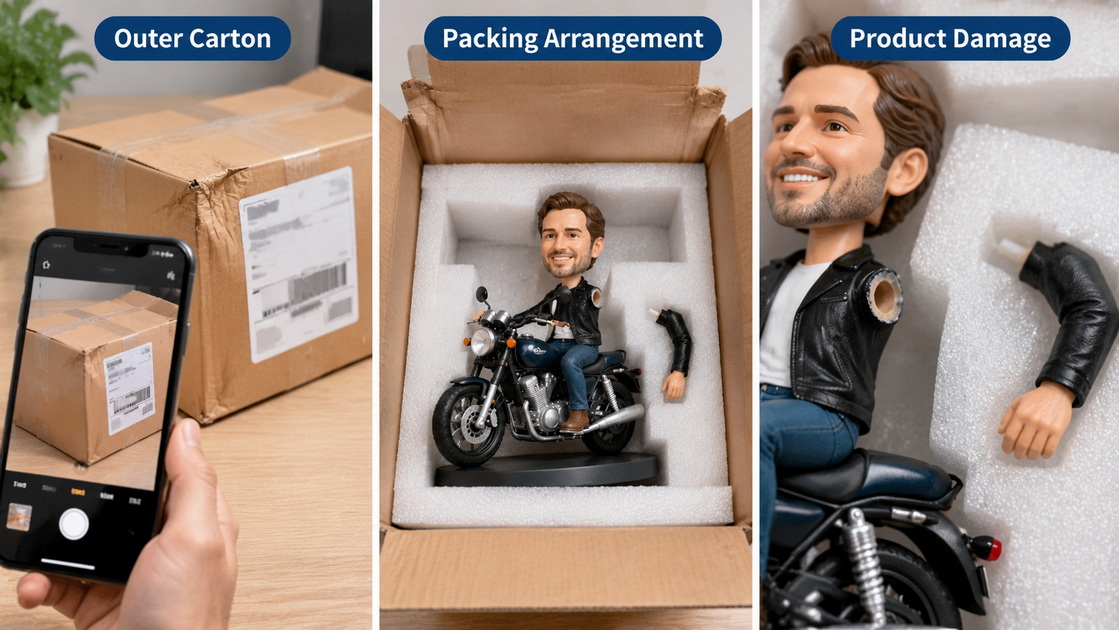
1. The entire outer carton from several sides.
2. Any crushed, torn, wet, or punctured areas.
3. The readable shipping label.
4. The opened carton and internal packing arrangement.
5. The complete bobblehead.
6. Close-ups of each damaged area.
7. Detached parts beside the figure.
Avoid filters that change the appearance of cracks or surface damage.
An unpacking video can provide useful context, but it does not replace clear photographs or retained packaging.
Keep children and pets away from fragments.
Do not run your fingers along a broken edge or pull on a loose spring. If safe to do so, place detached pieces in a separate protective container and identify which figure they belong to.
Preserve the evidence without risking injury. If contamination, sharp debris, or other hazards make storage unsafe, ask the seller or carrier for instructions and document the issue.
Send the order number, delivery date, tracking number, damage description, and photographs.
Report the issue as soon as reasonably possible. Seller notification periods and carrier claim deadlines vary by service, route, and applicable terms.
Do not apply a deadline found on another country's carrier page to your shipment.
Avoid gluing, repainting, bending, or disassembling the figure before the damage is documented and the seller provides instructions.
A repair attempt can change the evidence and complicate assessment.
For example:
- Adhesive can obscure a fracture.
- Repainting can hide the original surface condition.
- Pulling a spring can change alignment.
- Removing an accessory can create additional damage.
- An unsuitable repair can affect appearance or motion.
A detached head is not automatically a simple glue repair. Bobblehead performance depends on the attachment, spring position, head weight, and surrounding clearance.
If you prefer a repair rather than a replacement, ask whether it is appropriate and obtain written agreement on the method and its effect on the resolution.
Retain it throughout the investigation and any required inspection.
Before disposal, obtain written confirmation that the seller and any involved carrier no longer require the packaging or damaged contents.
Do not use a fixed number of days as a universal rule.
| Claim stage | Recommended action |
|---|---|
| Damage discovered | Retain the product, fragments, and packaging |
| Photographs submitted | Continue retaining everything |
| Inspection requested | Follow the authorized inspection instructions |
| Replacement offered | Confirm whether evidence must still be retained |
| Refund issued | Check whether an associated carrier claim remains open |
| All relevant retention requirements released | Dispose of materials safely |
A replacement arriving does not necessarily mean the carrier investigation has ended.
Keep digital records after physical disposal, including correspondence and the final resolution.
Contact the seller anyway.
Explain what was discarded and provide the evidence still available. Missing packaging can weaken a carrier claim or prevent a requested inspection, but you should not assume that every possible remedy is automatically unavailable.
Useful remaining evidence may include:
- Photographs taken during delivery or opening.
- A saved tracking number.
- The order confirmation and payment record.
- Images of the damaged figure.
- Messages sent when the damage was discovered.
- A retained gift box or protective insert.
Do not substitute another carton and describe it as the original.
Seller remedies, carrier compensation, and legal rights are separate questions. Their application depends on the circumstances, purchase terms, and jurisdiction.
This distinction is easy to overlook: packaging can remain valuable as evidence while no longer being suitable for transportation.
A crushed carton or deformed insert may not protect the figure during a return journey.
Before shipping anything back:
1. Obtain return authorization and the correct address.
2. Confirm who arranges and pays for transport.
3. Ask whether the original packaging must accompany the return.
4. Request instructions for replacing or reinforcing damaged protection.
5. Photograph the return packing before sealing.
6. Retain the tracking record and proof of handover.
Do not send the parcel to an address copied from the original label without confirmation. A dispatch location may not accept returns.
A custom bobblehead order can involve different types of loss.
Document the affected component and whether the figure remains stable. Avoid repeatedly testing the bobble motion if the neck or spring attachment appears compromised.
If a branded or personalized presentation box formed part of the order, photograph it separately.
Explain why the box matters—for example, it may be intended for a corporate presentation or retail sale. The appropriate remedy may differ from replacing the figure.
Photograph the carton and inspect the product carefully.
External damage does not automatically establish product damage. Equally, a quick glance is not enough to rule out a loose accessory or cracked base.
Report observations accurately without exaggerating the condition.
A concise report helps the seller identify what happened and what information is missing.
Use this template:
Subject: Bobblehead Arrived Damaged — Order [Order Number]
My order was delivered on [Date] under tracking number [Tracking Number].
The damage affects [Specific Component]. The outer carton is [Observed Condition], and the inner packaging is [Observed Condition].
I have retained the figure, detached pieces, shipping carton, label, and protective materials. I have not attempted repairs.
Attached are photographs of the packaging arrangement, shipping label, complete figure, and damaged areas.
Please confirm the next steps, whether an inspection or return is required, and how long I should retain everything.
The intended event date is [Date, If Relevant].
Include an event deadline early, but do not assume a remake can arrive in time. Ask for a realistic production and delivery plan.
For bulk buyers, the biggest documentation problem is often losing the connection between a damaged figure and its original carton.
Assign an internal reference to each affected unit.
Record the carton number, order line, personalization identifier, damage description, and related image filenames.
Do not combine fragments from different figures. Similar-looking parts can make later assessment difficult.
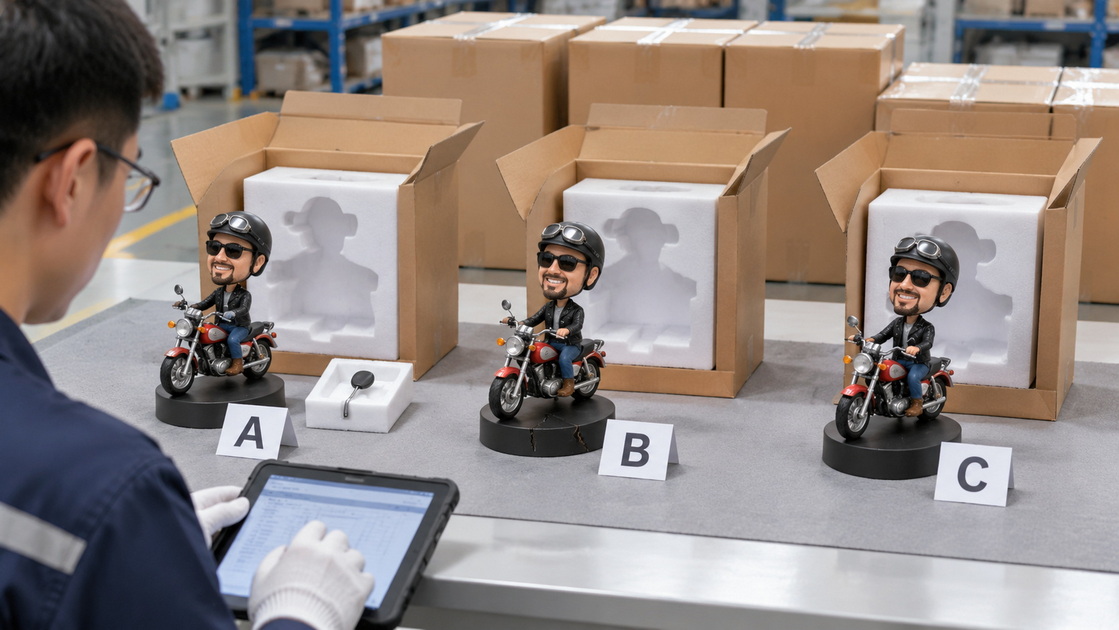
Write "mirror detached when the inner box was opened," rather than "carrier broke the mirror," unless the cause has been established.
Distinguish the number inspected from the number received. Finding three damaged units in an initial inspection does not establish that every unopened unit is damaged.
Ask the supplier to review whether failures involve:
- Insufficient clearance around accessories.
- Pressure on the head or neck.
- Movement inside the insert.
- Weak attachment points.
- Inadequate separation between units.
Agree on corrective action and any further packaging validation. Simply adding more cushioning may not resolve a support or clearance problem.
Top Arts & Crafts Co., Ltd. supplies personalized bobbleheads and customized resin and polymer-clay gifts for individual and wholesale customers worldwide.
Yes, if it is safe to retain. Severe damage does not remove the possibility of inspection. Keep the fragments separately protected and ask for instructions if sharp pieces make storage unsafe.
Not always. Photographs support assessment, but a carrier may still require physical inspection. Keep the original packaging until the relevant parties confirm it is no longer needed.
That depends on the seller's procedure, the agreed remedy, and applicable requirements. Do not arrange an unsolicited return. Obtain written instructions covering the address, packaging, shipping costs, and inspection needs.
No. The condition of the carton alone does not establish responsibility. Internal movement, product support, assembly condition, and other evidence may need evaluation.
Ask first. The seller's resolution and the carrier's investigation may follow different timelines. Obtain confirmation that no further inspection or retention is required.
1. UPS. "Supporting Documents Required for UPS Claims." Official guidance describing proof of value, photographs of the damaged item and packing arrangement, shipping-label images, exterior-package photographs, and possible physical inspection. [ups]
2. UPS. "What Do I Need as Evidence for a Claim?" Official claims guidance instructing customers to retain original packaging and contents for damage cases. [ups]
3. FedEx. "How Do I File a Claim?" Official instructions stating that original packaging should be kept for inspection and not discarded until the claim is resolved. [fedex]
4. FedEx. "File a Claim." Explains supporting documentation, inspection requirements, and retention of original packaging and contents. Requirements should be checked against the relevant shipment and service. [fedex]
5. FedEx. "Inspection Report—Customer Version." Documents container condition, internal packaging, product damage, photographs, and retention of merchandise and original packaging. The form is intended for the shipment categories specified within it. [fedex]
6. UPS Supply Chain Solutions. "Cargo Claims." Relevant to wholesale freight receiving: recording external irregularities, retaining packaging, documenting damage, and protecting cargo against further loss. These cargo procedures should not be substituted for parcel-service terms. [ups]


