
Views: 222 Author: Mia Publish Time: 2026-01-16 Origin: Site
Content Menu
● Tools and Materials You Need
● Add Lifelike Facial Features
● Shape the Hair and Accessories
● Create the Bobblehead Spring
● Attach the Spring and Test the Motion
● Dry the Bobblehead Thoroughly
● Paint and Detail the Bobblehead
● Advanced Options for a Home Bobblehead
● FAQ
>> 1. How long does a home Bobblehead project usually take?
>> 2. Which clay is best for a DIY Bobblehead?
>> 3. How can a Bobblehead be made to look like a specific person?
>> 4. Can a Bobblehead be built without a metal spring?
>> 5. Is special equipment needed for a 3D printed Bobblehead?
Making a Bobblehead of a person at home is a fun way to turn a loved one, a friend, or even yourself into a nodding, collectible figurine. With simple materials like airdry clay, wire, paint, and a spring mechanism, a custom Bobblehead can be created on a kitchen table or in a home studio without advanced equipment. A wellplanned DIY Bobblehead project can become a unique gift, a memorable decoration, or a special keepsake for any occasion.

A Bobblehead is a figure with an oversized head attached to the body using a flexible connector such as a spring or coiled wire, allowing the head to wobble whenever it is tapped. A homemade Bobblehead of a person follows the same principle: a separate sculpted head is mounted on a spring above a stable body so the Bobblehead reacts playfully to movement. Because of the exaggerated head and expressive face, a Bobblehead is perfect for capturing a person's personality in a humorous way.
To make a Bobblehead at home, gather craft materials that are easy to shape, dry, and paint. Choosing the right materials will make your Bobblehead stronger, lighter, and easier to finish.
- Airdry clay or lightweight modeling clay for the Bobblehead head and body
- 18gauge wire or similar craft wire for the Bobblehead spring
- Pencil or thin dowel to wrap the Bobblehead coil spring
- Clay tools or household tools (toothpicks, butter knife, spoon) for shaping the Bobblehead
- Acrylic paints, brushes, and water cup for coloring the Bobblehead
- Strong craft glue or tacky glue for securing the Bobblehead spring
- Cardboard or wooden base to support the finished Bobblehead
- Reference photos of the person whose Bobblehead you are creating
Planning helps the final Bobblehead feel more personal, more balanced, and closer to the real person. Before touching the clay, spend a little time defining the look and pose of your Bobblehead.
- Decide the Bobblehead pose: standing, sitting, or holding an object such as a ball, book, or tool.
- Identify distinctive features such as hairstyle, glasses, beard, or favorite jacket that the Bobblehead must include.
- Print or display clear front and side photos of the person so the Bobblehead head is easier to sculpt accurately.
- Think about the character: serious, smiling, or funny expression, and reflect that in your Bobblehead design.
Start the project by forming the body and base of the Bobblehead. The body must be stable and properly sized for the oversized head and spring.
1. Roll a ball of clay and shape it into a pear or cylinder to form the Bobblehead torso.
2. Model legs and feet that give the Bobblehead a low center of gravity so it stands solidly on its base.
3. Add arms and hands in the chosen pose, such as crossed arms, hands on hips, or holding a small accessory like a phone or ball.
4. Press the body onto a flat cardboard or wooden base, making sure the Bobblehead stands upright from every angle.
5. Smooth the surface and clean up lines so the Bobblehead body looks neat and ready for painting.
Leave a small flat or slightly indented area at the top of the body where the Bobblehead spring will later be installed. This flat spot will help the spring sit straight and keep the Bobblehead head from tilting too much.
The head is the heart of a person Bobblehead, so spend extra time shaping it. A good Bobblehead head is expressive, slightly exaggerated, and light enough to wobble freely.
- Roll a larger ball of clay than you think you need, because the Bobblehead style uses an oversized head.
- Form a basic faceshaped oval and smooth its surface to prepare for facial details.
- Lightly mark guideline lines for eyes, nose, and mouth to keep the Bobblehead face balanced.
- Slightly enlarge the forehead and cheeks to match the cartoonlike Bobblehead style.
Some makers hollow the Bobblehead head into a pinchpot shape to reduce weight and improve the bobbling motion. To do this, gently press a thumb into the bottom of the head and carefully thin the walls from the inside. A lighter head helps the Bobblehead wobble longer and more smoothly after each tap.
Use the person's photos to sculpt a recognizable Bobblehead face. Even small details can help transform a generic head into a true personal Bobblehead.
- Press shallow eye sockets using a spoon or rounded sculpting tool, keeping them around the midline of the head.
- Add brow ridges and eyelids with small cylinders of clay blended into the Bobblehead face.
- Build the nose from a separate clay piece and smooth it between the eyes, shaping nostrils with a stylus or toothpick.
- Form lips using thin rolls of clay, creating the Bobblehead mouth between them and deciding whether the character is smiling or neutral.
- Attach ears as small flattened ovals held in line with the eyes and just above the jawline.
Adjust cheeks, chin, and jawline to echo the real person while keeping the playful Bobblehead proportions. If the person has special features such as dimples, a big smile, or a strong jaw, subtly exaggerate them to give the Bobblehead more charm and personality.
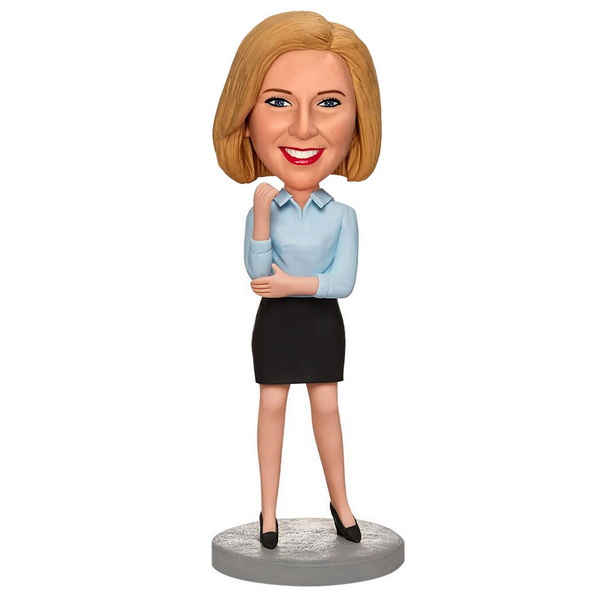
Hair and accessories often make a Bobblehead instantly recognizable. Use simple shapes and clear silhouettes instead of tiny, fragile details.
- For short hair, build up general volume around the scalp and carve texture lines with a tool.
- For long hair, add strands or sections that flow over the shoulders or back while keeping them thick enough not to break.
- Include signature accessories like glasses, hats, headbands, or earrings that match the person's usual style.
- Add small clothing details around the neck and shoulders, such as a collar, tie knot, or scarf, to connect the Bobblehead head with the body design.
Carefully check the balance: a very heavy hairstyle or large hat can affect the way the Bobblehead head wobbles, so keep added elements relatively light and close to the head.
The spring transforms a static figure into a true Bobblehead. A wellmade spring gives a smooth, satisfying wobble instead of a stiff or jerky movement.
1. Cut a length of 18gauge wire or similar sturdy wire.
2. Wrap the wire tightly around a pencil or thin dowel to form an even coil spring.
3. Leave a straight tail of wire at both ends of the coil so it can be anchored into the Bobblehead head and body.
4. Slide the coil off the pencil and gently compress or stretch it until you like the length and tension.
You can experiment with different coil lengths and thicknesses to see how they affect the wobble. A shorter, tighter spring makes the Bobblehead more stable but less bouncy, while a longer, looser spring makes the Bobblehead wobble more but may require extra care to keep the figure balanced.
Correct spring installation is essential for smooth, satisfying Bobblehead movement. At this stage the Bobblehead is still unpainted, which makes adjustments easier.
- Use a pencil or tool to poke a vertical hole in the top of the Bobblehead body.
- Insert one tail of the wire coil into this hole and gently press the clay around it so the spring stands straight.
- Create a matching hole in the bottom of the Bobblehead head for the upper tail of the spring.
- Temporarily connect the Bobblehead head and body and gently tap the head from different angles to test wobbling action.
- Adjust the spring length, tilt, or depth until the Bobblehead nods in a smooth, natural way without hitting the shoulders.
If the movement is too stiff, stretch the spring slightly or carve a little extra clearance around the neck area so the Bobblehead head can move freely. If it is too loose, compress the spring or shorten the coil until the Bobblehead feels stable again.
Before painting, let the Bobblehead dry fully to avoid cracks and peeling paint. Patience at this stage will give you a stronger, longerlasting Bobblehead.
- Place the Bobblehead components on a clean, flat surface in a dry, ventilated area, away from direct sunlight and heat sources.
- Allow airdry clay Bobbleheads to rest for several days so the clay can harden completely, especially on thicker parts like the head and base.
- Avoid moving or bending the Bobblehead parts while they dry to prevent warping or cracking.
- Check for any small cracks and fill them with a little fresh clay or filler, then let them dry again.
Once dry, the Bobblehead should feel firm and no longer cool or flexible to the touch, which means it is ready for painting and final assembly.
Painting is where the Bobblehead begins to look like the real person. Good color choices and clean lines will make your custom Bobblehead stand out.
- Apply a primer or base coat over the Bobblehead to help colors adhere evenly.
- Block in main areas of color: skin tone, hair, clothing, and shoes on the Bobblehead.
- Add facial details such as iris, pupil, eyelashes, eyebrows, and facial hair using fine brushes or paint pens for precision.
- Paint clothing details like logos, stripes, buttons, or patterns that match the person's favorite outfit, making the Bobblehead more recognizable.
- Enhance the Bobblehead with shading and highlights to give the face, hair, and clothes more depth.
- Finish with a clear sealer or varnish to protect the Bobblehead from scratches, moisture, and dust.
Small retouches around the nose, eyes, and mouth can dramatically improve the likeness of the Bobblehead and give it more life. Take your time on the eyes; they often decide whether the Bobblehead really feels like the person.
Home crafters who want more precision or a different style can mix other techniques into their Bobblehead project. These approaches still keep the core idea of a nodding Bobblehead but change the materials or tools.
- Use 3D modeling and 3D printing to create the head and body, then attach a traditional spring to finish the Bobblehead.
- Build a paperbased Bobblehead head using crumpled paper, foil, or foam and cover it with paper mache for an ultralightweight design.
- Create a flat, cartoonstyle Bobblehead using printed photos and cardboard, attaching the face with a simple wire hinge.
- Combine sculpted clay with printed elements such as logos, text, or small accessories to add branding or special themes.
These advanced methods are useful when you want to make multiple copies of the same Bobblehead, design a promotional Bobblehead, or explore more experimental artistic looks.
A wellmade Bobblehead should be safe to handle and stable on display, especially if it is used in a child's room or a busy office environment.
- Avoid very thin necks or fragile joints; reinforce critical Bobblehead areas with extra clay or internal wire.
- Use nontoxic, waterbased paints and glues when creating Bobbleheads for children's rooms or for frequent handling.
- Keep very small accessories or detachable Bobblehead parts away from toddlers to reduce choking risks.
- Add felt or foam under the Bobblehead base to protect furniture and prevent sliding or scratching.
- Place the Bobblehead on a stable shelf or inside a display case to reduce the chance of falls.
By taking these precautions, your custom Bobblehead will last longer and stay looking good, even when it is tapped and played with frequently.
Making a Bobblehead of a person at home combines basic sculpting, wire bending, and painting into one creative, rewarding project. With careful planning, a welldesigned spring, and thoughtful facial details, anyone can create a personalized Bobblehead that captures a person's character in a charming, nodding figure. Whether used as a birthday present, office decoration, family keepsake, or promotional gift, a handmade Bobblehead adds humor, warmth, and personality to any space.
Contact us to get more information!
Most home Bobblehead projects require a few hours of sculpting and assembly plus several days of drying before painting. Painting and sealing the Bobblehead can add another day, so a comfortable schedule is about one week from start to finish if you work in short sessions.
Airdry clays designed for crafts are popular for DIY Bobblehead projects because they do not require a kiln and are easy to sand and paint. Lightweight airdry clay also keeps the Bobblehead head and body from becoming too heavy, which improves stability and wobble.
Using clear front and side reference photos and drawing guidelines on the head helps place the eyes, nose, and mouth accurately for the Bobblehead. Paying attention to hairstyle, glasses, facial hair, and clothing details allows the Bobblehead to feel instantly recognizable to friends and family.
Yes, some simple Bobblehead crafts use flexible wire coils, memory wire, or even paper hinges for flat cartoonstyle designs. However, a sturdy metal spring or wellmade wire coil usually gives the Bobblehead a more satisfying and durable wobble that lasts over time.
For a 3D printed Bobblehead, having access to 3D modeling software, a 3D scanner, or a consumer 3D printer is helpful, but you can also use an online 3D printing service. After printing, the head and body are still assembled with a spring and handpainted, much like a traditional DIY Bobblehead, so the creative finishing steps remain the same.
1. https://crystalbridges.org/blog/diy-build-your-own-bobbleheads/
2. https://www.activaproducts.com/fox-bobblehead
3. https://www.wikihow.com/Sculpt-a-Face
4. https://www.facebook.com/groups/454814441971724/posts/1747363876050101/
5. https://www.youtube.com/watch?v=RTf6WU_Ko_E
6. https://www.instructables.com/Sculpt-a-Human-Head/
7. https://www.instructables.com/3D-Printed-Bobblehead-High-Resolution-Full-Body-Sc/
8. https://www.ultimatepapermache.com/fast-and-easy-diy-face-sculpting-form
9. https://www.bobbleheads.com/how-to-build-a-bobblehead
10. https://www.youtube.com/watch?v=RN9QVyJWMaE


