
Views: 245 Author: Mia Publish Time: 2026-09-17 Origin: Site
Content Menu
● Why Your Custom Bobblehead May Not Look Like the Photo
>> The Source Photo May Not Show Enough Detail
>> The Product Style May Be Different From Your Expectation
>> Small Changes Matter More in a Face
● Custom Bobblehead vs Photo: What Is a Reasonable Expectation?
● How to Submit Better Photos for a More Accurate Bobblehead
>> Provide Three Essential Angles
>> Use Clear and Current Images
>> Add Written Notes for Important Features
● What to Do If Your Custom Bobblehead Does Not Look Right
>> Step 1: Compare It With the Approved Information
>> Step 2: Take Clear Comparison Photos
>> Step 3: Contact the Seller Before Making Changes Yourself
>> Step 4: Ask for a Practical Resolution
● The Best Protection: A Clear Proof Approval Process
>> Why Real Product Images Matter
● How Top Arts & Crafts Controls Likeness and Craft Quality
● The Hidden Issue: Photo Distortion Can Change the Sculpture
>> How to Avoid Photo Distortion
● Customer Photo Privacy and Data Handling
● Returns, Remakes, and Personalized Product Policies
● Order a Better Custom Bobblehead
>> 1. Why does my custom bobblehead not look exactly like my photo?
>> 2. What photos should I send for a personalized bobblehead?
>> 3. Can I request a revision before my bobblehead is shipped?
>> 4. What should I do if the bobblehead arrives damaged?
>> 5. Are custom bobbleheads refundable?
A custom bobblehead should feel personal. When a customer uploads a meaningful photo—perhaps for a wedding, anniversary, retirement, birthday, or corporate gift—they expect the finished figurine to capture the person's recognizable features, hairstyle, expression, and style. If the custom bobblehead does not look like the person in the photo, the cause is usually not one single mistake. It is often a gap between the photo quality, the chosen artistic style, the approval process, and the final hand-sculpted result.
At Top Arts & Crafts Co., Ltd., we manufacture and export personalized bobbleheads, polyresin crafts, and polymer-clay custom gifts for global retail, wholesale, and custom-order customers. From a production perspective, the most successful orders begin with clear photos and clear expectations. The most difficult orders often start with one blurred image, conflicting requests, or an assumption that a hand-sculpted figurine will reproduce every photographic detail exactly.
This guide explains why custom bobblehead likeness can vary, what customers can do if they are unhappy with the result, and how buyers, retailers, and suppliers can build a better photo-to-figurine process.
A handmade custom bobblehead is a stylized, three-dimensional portrait—not a direct print of a photograph. Good suppliers manage that difference through photo standards, style clarity, proof approval, skilled sculpting, and final quality control.
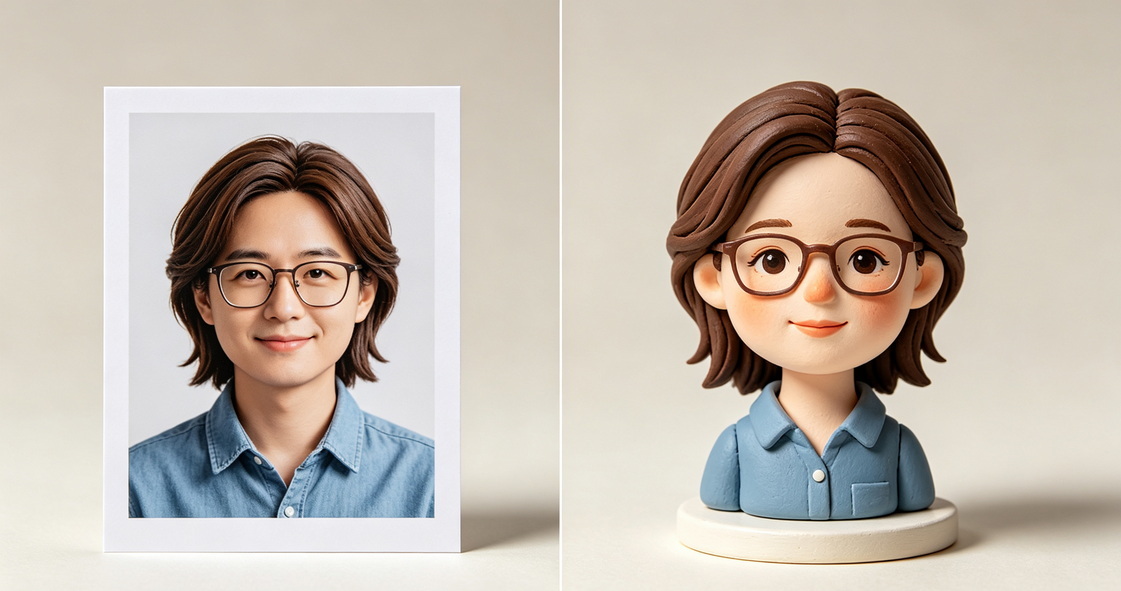
A custom bobblehead is created from reference images, then translated into a physical figure. The artist must interpret a two-dimensional photo into a three-dimensional head, face, hairstyle, body pose, outfit, and accessory set.
That creates several points where likeness can change.
The finished bobblehead can only be as accurate as the visual information provided. A single low-quality photo may not show:
- The true face shape.
- Nose bridge and profile.
- Jawline.
- Eye shape.
- Hair volume and hairline.
- Skin tone under neutral light.
- Glasses, earrings, beard, or other defining features.
- The person's usual expression.
- The difference between a shadow and a facial feature.
A dark, filtered, side-angle selfie can make it difficult for even an experienced sculptor to determine the person's true proportions.
Not every custom bobblehead uses the same visual language. Some are:
- Semi-realistic: Designed to resemble the person while retaining a handmade collectible look.
- Cartoon-style: Intentionally simplified, with larger eyes, softer facial details, or exaggerated proportions.
- Caricature-style: Deliberately playful, with certain features emphasized.
- Traditional bobblehead-style: A larger head, smaller body, and simplified details for movement and visual balance.
If a buyer expects a photorealistic portrait but orders a cartoon-style bobblehead, the product may feel "wrong" even if the artist followed the intended template well.
In a custom figure, tiny changes can strongly affect recognizability:
| Facial Detail | Why It Matters |
|---|---|
| Hairline | Defines face framing and apparent age |
| Eyebrow shape | Changes expression quickly |
| Eye spacing | Affects overall facial balance |
| Nose shape | Important in profile and three-quarter views |
| Jawline | Helps distinguish face shape |
| Glasses | Often a key identity feature |
| Beard or moustache | Can change perceived likeness significantly |
| Smile shape | Affects personality and emotional recognition |
| Skin tone | Must be interpreted consistently under different lighting |
A supplier may correctly reproduce an outfit and hairstyle but still miss the likeness if the eyes, face shape, or expression do not match the approved reference.
The two main keywords in this topic—custom bobblehead and photo likeness—are related, but they are not identical.
A photo records one moment under a specific light, angle, lens, expression, and filter. A custom bobblehead is a crafted interpretation made to be viewed from multiple angles, transported safely, and attached to a moving spring mechanism.
| Factor | Photo | Custom Bobblehead |
|---|---|---|
| Format | Two-dimensional image | Three-dimensional hand-sculpted object |
| Detail level | Can show pores, shadows, and fine texture | Uses simplified sculpting and paint details |
| Perspective | Depends on camera angle and lens | Must look balanced from several viewing angles |
| Expression | Captures one exact moment | Interpreted into a stable crafted expression |
| Scale | Full face detail can be enlarged digitally | Facial details are limited by physical figure size |
| Style | Can be realistic, filtered, or edited | May be semi-realistic, cartoon, or caricature |
| Approval | Usually immediate | Requires mockup, sculpting, and production stages |
| Durability | Digital or printed | Must survive handling, packing, and shipping |
The goal should be recognizable likeness within the chosen product style, not a guarantee that a hand-sculpted miniature will match every pixel of a photograph.
This distinction should be explained before the order is placed. Personalization research has found that consumers expect brands to provide personalized interactions, while many become frustrated when those expectations are not met. In custom products, clear expectation-setting is therefore part of quality management, not merely customer service.
The easiest way to improve custom bobblehead likeness is to provide better reference material before sculpting begins.
For the best result, submit:
1. Front-facing photo: Face looking directly at the camera.
2. Left-side photo: Clear view of hair, nose, ear, and profile.
3. Right-side photo: Confirms profile balance and hairstyle details.
If possible, add a fourth image showing the person smiling naturally.
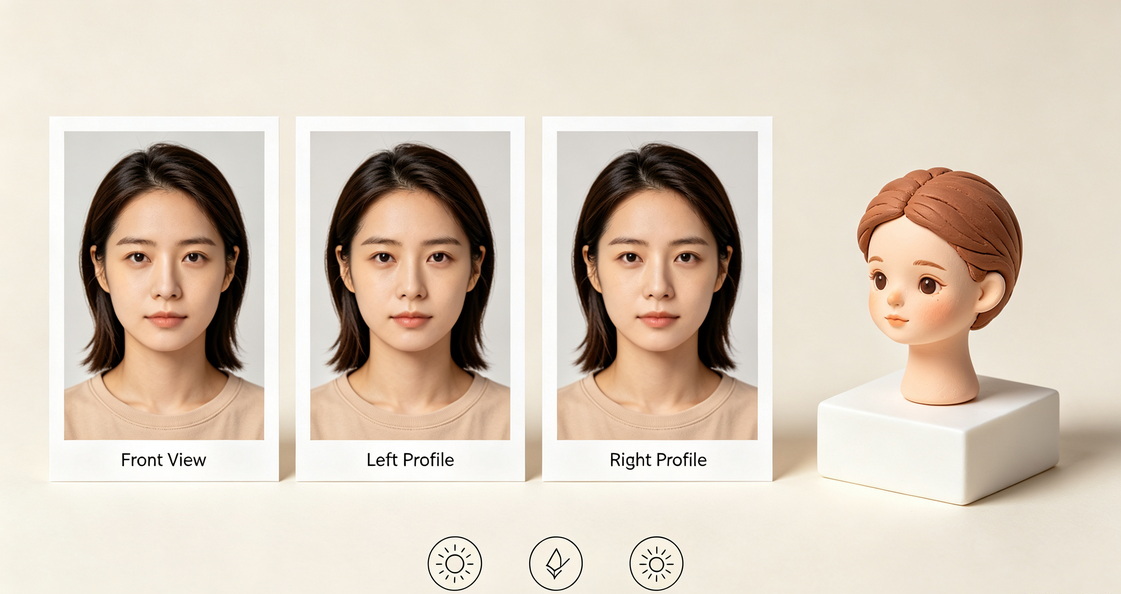
The best photos are:
- Taken in natural, even light.
- High resolution.
- Free from beauty filters.
- Free from sunglasses or hats unless those items must appear on the figurine.
- Taken at eye level.
- Recent enough to represent the person's current appearance.
- Focused on the full face and hairstyle.
- Not heavily edited by social-media apps.
Avoid photos that are:
- Blurry or pixelated.
- Taken in strong backlight.
- Cropped too tightly.
- Obscured by hair, hands, masks, or objects.
- Captured from extreme angles.
- Combined into a collage.
- Taken from a long distance.
- Filtered so heavily that skin tone and facial proportions are unclear.
Photos do not always communicate what matters most. Add simple written instructions such as:
- "Please include her side-swept fringe."
- "He normally wears rectangular black glasses."
- "Please keep the short grey beard."
- "Use a gentle closed-mouth smile."
- "The bride's veil should sit behind the bun."
- "The groom's suit is dark navy, not black."
- "Please include the small silver necklace."
- "The figurine should look semi-realistic, not cartoon-like."
Etsy's buyer guidance for personalized items also encourages customers to follow seller instructions, provide the information requested for personalization, and discuss timing or specific requirements with the seller.
If you receive a bobblehead that does not meet your expectation, act quickly and communicate with evidence.
Review:
- The photos you submitted.
- The written customization notes.
- Any mockup, sketch, digital proof, or sculpting preview.
- The selected product style.
- The approved outfit, pose, accessories, and base text.
- The seller's listing photos and style description.
This helps separate a genuine production issue from a difference in expectation.
Take photos of the figurine from:
- The front.
- The left side.
- The right side.
- A close-up of the face.
- A full view including hairstyle, outfit, and accessories.
Then place the submitted reference photo beside the figurine image when explaining the concern. Focus on specific differences, for example:
- "The hair should be shorter on the sides."
- "The glasses are missing."
- "The beard is darker and fuller than shown."
- "The face shape is too narrow."
- "The veil is attached in the wrong position."
- "The bobble spring is loose."
Avoid general statements such as "It looks bad." Specific feedback gives the seller a practical basis to assess correction options.
Do not repaint, glue, cut, or alter the bobblehead before contacting the seller. Alteration can make it harder to evaluate the original workmanship and may affect the available remedy.
Send:
- Your order number.
- Clear photos of the issue.
- The original reference photos.
- The approved proof, if one exists.
- A short list of specific corrections requested.
- Your event date, if the order is time-sensitive.
Depending on the order stage and the nature of the issue, a supplier may offer one of several solutions:
| Situation | Potential Resolution |
|---|---|
| Error found before final production | Revise the sculpture, paint, outfit, or accessory before shipment |
| Minor visible difference | Partial correction, repainting, replacement accessory, or partial refund according to policy |
| Major mismatch with approved specification | Remake, replacement, credit, or another agreed remedy |
| Shipping damage | Replacement part, replacement product, or claim process depending on evidence and policy |
| Expectation differs from selected art style | Supplier explanation, possible goodwill solution, or future-order adjustment |
The appropriate result depends on what was promised, what was approved, whether the result materially differs from the reference, and whether the issue can be corrected safely.
Practical advice: The fastest resolutions happen when customers provide clear reference photos, approve the design direction early, and describe concerns with specific visual examples.
For premium custom orders, wholesale programs, wedding bobbleheads, and private-label projects, a structured approval process is the strongest way to reduce dissatisfaction.
1. Order review: Check the photos, product style, wedding date, accessories, outfit details, and personalization notes.
2. Photo-quality check: Ask for replacement images if the original photos are unclear.
3. Style confirmation: Confirm whether the customer wants semi-realistic, cartoon, or caricature styling.
4. Mockup or concept approval: Share a visual direction before detailed production begins.
5. Sculpture review for complex orders: For high-value, bulk, or detailed wedding designs, use a photo checkpoint before final paint.
6. Final QC: Check face, hair, paint, accessories, base, bobble movement, and packaging before dispatch.
7. Shipment confirmation: Provide tracking and estimated delivery information.
Top Arts & Crafts Co., Ltd. provides custom bobblehead, wholesale, and personalized-gift services. For complex projects, we recommend that customers and B2B buyers confirm important appearance details early, especially facial style, hair, wedding attire, accessories, base text, and packaging requirements.
A supplier's product images should show actual finished work rather than only idealized renderings. Etsy requires sellers to use original photos of the actual finished product for listings, and for personalized items, the first image must show a finished customized item similar to what buyers will receive. Computer-generated mockups may be used in additional listing images, but should not replace the main representation of the real product.
For buyers, this is a useful general standard. Look for:
- Multiple angles of real figurines.
- Close-up face details.
- Different customer examples, not one perfect sample.
- Real wedding outfits and accessories.
- Customer review photos where permission is available.
- Clear disclosure when images are digital mockups.

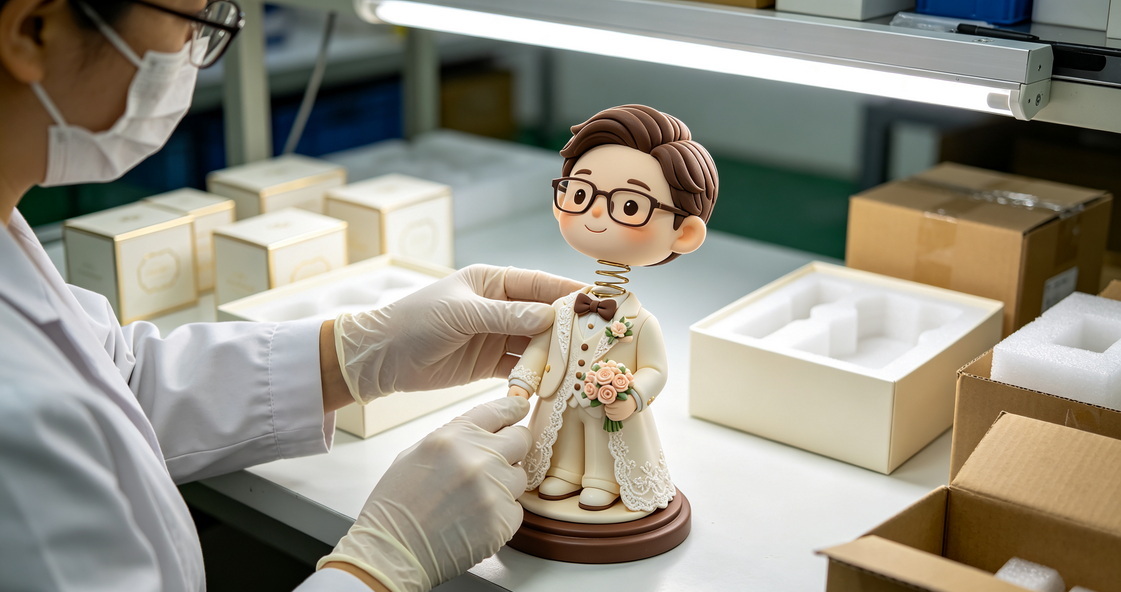
At Top Arts & Crafts Co., Ltd., our work involves translating customer photos into handcrafted personalized bobbleheads made with polymer clay, polyresin, and related craft materials. For bulk and custom projects, the quality process should focus on both artistic accuracy and physical durability.
- Confirm the correct person, pose, outfit, and accessory list.
- Review facial proportions against the selected reference images.
- Match hairstyle direction, length, color, and major features.
- Check paint coverage and color consistency.
- Verify glasses, veils, bouquets, rings, pets, signs, and other small accessories.
- Test bobble-head movement and spring attachment.
- Confirm stable head-to-body connection.
- Check that the base stands flat.
- Inspect for cracks, paint chips, loose components, or sharp edges.
- Use protective packaging designed for fragile handmade products.
For B2B customers, consistency matters across more than one order. A retailer may receive one excellent sample but later see variations if the production instructions are not documented. We recommend creating an approved master sample, photo-style guide, color guide, accessory guide, and inspection checklist before a wholesale rollout.
One industry issue that is rarely discussed is smartphone camera distortion.
Many front-camera selfies are taken at a short distance using wide-angle lenses. This can make the center of the face, especially the nose, appear larger while changing the apparent width of the forehead, cheeks, and jawline. A sculptor who follows one distorted selfie too literally may produce a figurine that looks unlike the person in real life.
- Use a back-camera portrait taken from about one to two meters away.
- Ask another person to take the photo.
- Avoid ultra-wide-angle modes.
- Provide multiple angles, not one selfie.
- Include one natural-light photo without beauty filters.
- Add a recent full-face photo for proportion reference.
This simple step often improves the artist's ability to create a balanced and recognizable custom bobblehead.
Personalized products require customer photos. For sellers serving EU customers, photo handling should be treated seriously because facial images can constitute personal data.
A responsible workflow should define:
- Why photos are collected.
- Who can access the files.
- How files are transmitted.
- How long photos are retained.
- Whether photos may be used for marketing.
- How customers can request deletion where applicable.
- How supplier, retailer, and fulfillment partners handle the data.
Retailers should obtain customer permission before using finished-product photos or reviews in advertising. Etsy's policy also requires seller permission before a buyer's review photo is used as a listing image.
Personalized products are often treated differently from standard goods because they are made to a customer's specifications. In the EU, consumers generally have a 14-day right to withdraw from distance purchases, but goods made to order or clearly personalized are generally excluded from the standard withdrawal right.
That does not mean a seller can ignore quality issues. If a personalized bobblehead is damaged, materially different from the agreed specification, or not as described, consumer-protection and contractual obligations may still apply.
A clear policy should explain:
- The photo-submission requirements.
- The art style and expected level of likeness.
- What approval stages are included.
- How customers report defects.
- The evidence needed for a claim.
- The time limit for reporting transit damage.
- Whether revisions, partial corrections, remakes, or refunds are available.
- Who pays for return shipping if a return is required.
- How personalized-photo data is handled.
Trust-building practice: Make the approval and resolution policy visible before checkout. A clear policy reduces disputes and helps customers understand what will happen if a correction is needed.
A custom bobblehead should be a lasting keepsake, not a stressful surprise. Better photos, clear instructions, realistic style expectations, and an approval checkpoint can dramatically improve likeness and reduce remake risk.
Top Arts & Crafts Co., Ltd. supports personalized bobblehead orders, custom wedding figurines, bulk gifts, wholesale programs, and OEM/ODM projects for global buyers. If you need a custom design, prepare clear front, left, and right photos, describe the style you want, and identify the details that matter most.
A bobblehead is a hand-sculpted three-dimensional interpretation of a photo. Differences can result from unclear reference images, camera distortion, the selected art style, limited miniature-detail scale, incomplete instructions, or an error in production. Multiple clear photos and a proof process provide the best protection.
Send one clear front-facing photo, one left-side photo, and one right-side photo in natural light. Include a smiling photo if expression is important. Avoid filters, sunglasses, heavy shadows, extreme angles, blurry images, and photos taken from very close range.
That depends on the seller's workflow and the stage of production. Ask before ordering whether a mockup, sculpture preview, or photo-approval stage is included. For complex wedding, corporate, or wholesale orders, agree on the number of revisions and approval points in writing.
Take clear photos of the damaged product, all sides of the package, the shipping label, and internal protective materials. Contact the seller promptly with your order number and evidence. Do not attempt repairs until the seller has reviewed the claim, because unauthorized changes may complicate the resolution.
Policies differ by seller and jurisdiction. In the EU, made-to-order or clearly personalized goods are generally excluded from the standard 14-day withdrawal right, but that does not remove remedies for products that are damaged, not as described, or materially different from the agreed order.
1. [McKinsey — The Value of Getting Personalization Right or Wrong Is Multiplying]
Used for consumer expectations and frustration related to personalization. [mckinsey]
2. [Etsy — Listing Image Requirements]
Used for guidance on accurate product imagery, real finished products, personalized-item images, and buyer-review-photo permissions. [etsy]
3. [Etsy — How to Request a Personalized or Custom Item]
Used for general buyer guidance on personalization information, photo submission, seller instructions, and needed-by dates. [help.etsy]
4. [Your Europe — Returns and the Right of Withdrawal]
Used for the EU 14-day withdrawal principle and the exception for made-to-order or clearly personalized goods. [europa]
5. [European Commission — Consumer Rights Directive]
Used for EU consumer-rights context regarding distance contracts and withdrawal rights. [commission.europa]
6. [ECC Net — Online Shopping Rights]
Used for additional consumer-rights context and personalized-goods withdrawal exceptions. [eccnet]


