
Views: 291 Author: Mia Publish Time: 2026-11-24 Origin: Site
Content Menu
● What Are Custom Family Sculptures?
● Choose Between Family Figurines, Bobbleheads, and Symbolic Sculptures
● Why Personalized Family Figurines Make Meaningful Gifts
● Compare Materials and Production Methods
>> Digitally Modeled and 3D-Printed Figurines
● How to Prepare Photos for a Custom Family Sculpture
>> Supply Clear References for Each Person
>> Explain Which Details Matter Most
● An Overlooked Design Issue: People Must Look Right Together
● Approve Your Family Sculpture in Stages
>> Stage 1: Confirm the Written Brief
>> Stage 2: Review the Sculpt or Digital Preview
>> Stage 3: Review Color and Finishing
>> Stage 4: Confirm the Finished Assembly
● What Determines the Price and Delivery Schedule?
● Quality Checks Before Shipping and After Delivery
● Wholesale Family Sculptures Need More Than a Bulk Discount
● How to Display and Care for Family Sculptures
● Create a Family Keepsake With Top Arts & Crafts
>> 1. Can You Create a Family Sculpture From Separate Photographs?
>> 2. How Realistic Will the Faces Look?
>> 3. Can Pets Be Included in Personalized Family Figurines?
>> 4. Is Polymer Clay Better Than Resin for Family Sculptures?
>> 5. Can a Family Bobblehead Have Several Moving Heads?
Custom family sculptures turn photographs, shared interests, and familiar expressions into three-dimensional keepsakes. Whether you are commissioning a grandparents' anniversary gift or developing a personalized product collection, the best result starts with a clear brief—not simply a favorite photograph.
A successful family figurine should feel recognizable, suit its intended setting, and remain practical to manufacture, package, and display.
At Top Arts & Crafts Co., Ltd., we specialize in personalized bobbleheads, polyresin crafts, and polymer-clay custom gifts for individual and wholesale customers worldwide. Our manufacturing perspective is straightforward: meaningful details matter, but those details must work within the chosen size, material, and construction.
This guide explains how to choose a family sculpture, prepare useful references, assess craftsmanship, and avoid common ordering mistakes.
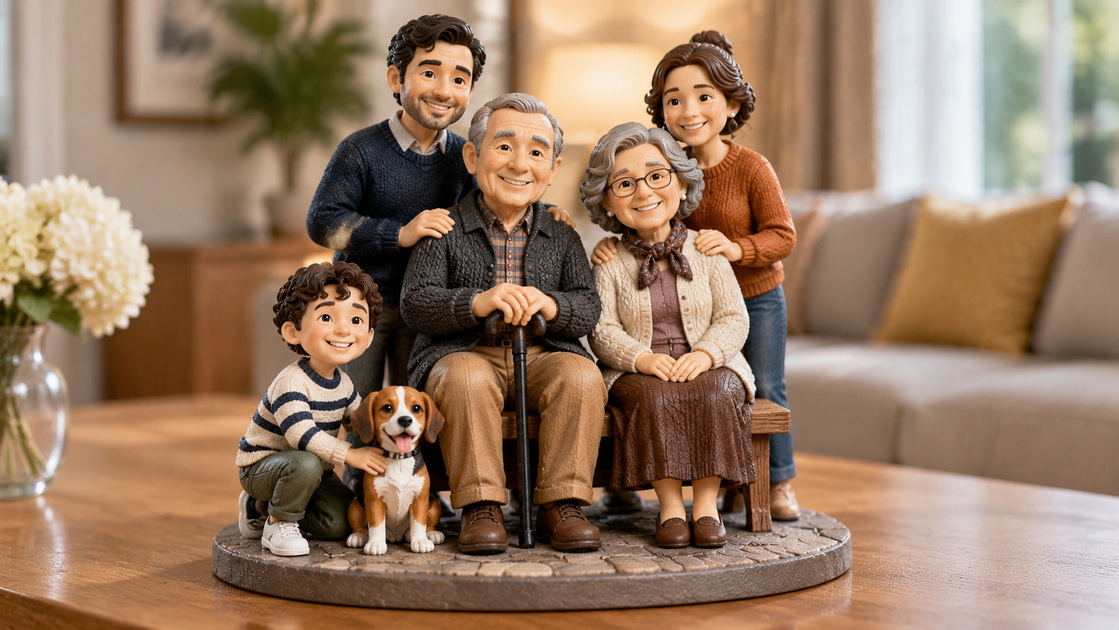
Custom family sculptures are three-dimensional representations created around a particular family or group.
They may depict parents and children, grandparents, siblings, partners, chosen family, or pets. Some aim for realistic proportions. Others use simplified features or playful oversized heads.
Unlike a generic decorative family statue, a personalized sculpture can incorporate identifiable details:
- A familiar hairstyle or expression.
- Clothing associated with a special occasion.
- Relative heights and characteristic poses.
- A pet's markings.
- A meaningful object or activity.
- A name, date, or short message on the base.
The goal is not necessarily photographic realism. It is an agreed interpretation that communicates the people and relationships behind the commission.
Before comparing prices, decide which visual language suits the recipient.
| Format | Main characteristic | Suitable applications | What to clarify |
|---|---|---|---|
| Realistic family figurine | Natural proportions and portrait-focused detail | Formal portraits and anniversary gifts | Achievable likeness at the chosen scale |
| Stylized family sculpture | Simplified proportions and expressive features | Home décor and contemporary keepsakes | Which details remain recognizable |
| Family bobblehead | Oversized heads with a moving-head mechanism | Playful gifts and informal celebrations | Head movement, spacing, and stability |
| Symbolic family sculpture | Abstract or non-portrait representation | Decorative collections and understated gifts | Personalization beyond names or engraving |
A bobblehead is not simply a realistic figurine with a spring added. Head size, weight, clearance, and balance require appropriate construction.
If several moving heads share one base, discuss whether they could strike each other or nearby accessories.
A custom sculpture can preserve something more specific than a standard gift: how a family wants to remember a particular stage of life.
That might be a child's favorite costume, a grandparent's garden chair, or the dog that appears in every holiday photograph.
Common occasions include:
- Weddings and significant anniversaries.
- Birthdays and retirement celebrations.
- Mother's Day and Father's Day.
- Family reunions.
- New-home celebrations.
- Multigenerational portraits.
- Thoughtfully planned remembrance gifts.
Choose the subject with the recipient's preferences in mind. A humorous caricature may delight one person and feel inappropriate to another.
For remembrance commissions, confirm the intended tone, inscription, and family approval before production. Emotional significance should guide the design rather than become a promise that the object will produce a particular psychological benefit.
Material affects appearance, development, repeatability, and handling. However, a material name alone does not establish quality.
Polymer clay is a workable modeling material that hardens through the curing process specified for its formulation.
It allows direct shaping and can suit individual portraits, expressive clothing, and small personalized details.
Different formulations have different characteristics. Correct curing and suitable construction matter, particularly around thin features.
Ask the supplier how delicate elements are supported and whether the approved finish includes paint, colored clay, or both.
Polyresin products use a resin-based casting system, often with fillers. Casting can be useful when an approved design or shared component will be reproduced.
For wholesale projects, discuss molds, assembly, decoration, and the distinction between common bodies and individually personalized features.
Do not assume every resin figure uses the same formulation or has the same durability.
Digital production creates another route from references to a physical object. However, "3D printed" does not describe one universal material or finish.
Ask about the printing process, visible surface texture, color application, post-processing, and fragile features.
A manufacturer may combine methods—for example, digital development followed by a physical master and casting. Confirm the actual production route rather than relying on a broad technology label.
| Purchasing priority | Question to ask |
|---|---|
| One highly individualized gift | How much of the figure is newly developed? |
| Repeat production | Which components are shared or molded? |
| Fine facial detail | Can you show close-ups at a comparable size? |
| Safe handling | How are small accessories and joints constructed? |
| Consistent appearance | What reference sample controls production? |
No material is universally the most realistic, strongest, or most sustainable. Compare the finished specification and supporting evidence.
Good references reduce uncertainty. A single attractive photograph may still hide important information.
Where available, provide:
1. A sharp front-facing portrait.
2. A three-quarter or side view.
3. A full-body reference for proportions and clothing.
4. A group photograph showing relative heights.
5. Separate images of important accessories or pets.
Use photographs with natural lighting and limited distortion. Heavy filters, sunglasses, and distant faces can obscure features.
Label images consistently so the sculptor can match each person to the brief.
List a few defining characteristics rather than treating every pixel as equally important.
For example:
- Keep the grandmother's glasses and short curls.
- Use the child's striped jumper.
- Preserve the dog's white chest marking.
- Remove an unwanted object from the original photograph.
If separate photographs show different ages or hairstyles, identify which version should control.
Do not expect the maker to infer those choices.
Individual portrait approval is only part of a family sculpture project.
A group can contain recognizable faces yet still feel wrong because the heights, head sizes, eye lines, or spacing do not work together.
This becomes particularly important when combining photographs taken at different times or from different camera angles.
Before detailed finishing, approve the complete composition:
- Relative heights and body proportions.
- Seated versus standing positions.
- Who faces or touches whom.
- Visibility of every face.
- Pet size and placement.
- Overall base dimensions.
For example, a seated grandparent may be the visual center without being the tallest element. A child positioned too far forward may appear disproportionately large.
Request a clear group-layout preview, not only separate facial close-ups.
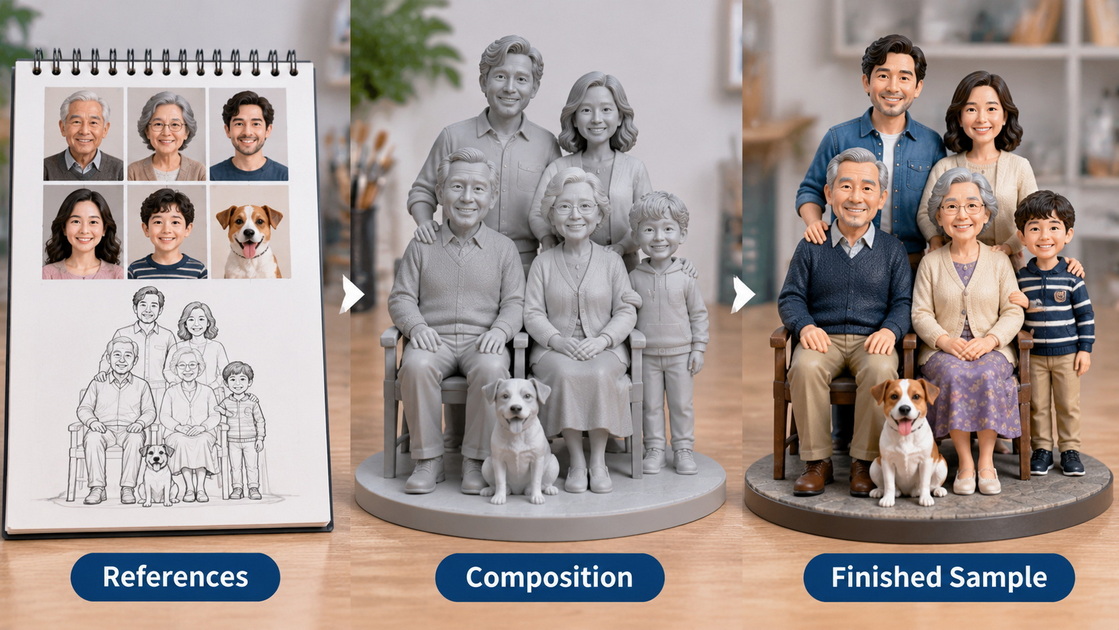
A staged approval process makes decisions easier to understand and reduces avoidable rework.
Record the number of people and pets, style, dimensions, clothing, pose, inscription, materials, and packaging.
Clarify what the quoted price includes and what requires additional development.
Check facial structure, hairstyle, body pose, group composition, and visible accessories.
Ask whether the preview represents an intermediate stage or the final achievable detail.
Check skin-tone interpretation, clothing colors, pet markings, and inscription spelling.
Screen settings and lighting affect perceived color. For commercial programs with important brand colors, agree on a more controlled reference method.
Inspect stability, attachment points, surface condition, and any moving-head mechanism.
Approval should identify exactly what has been accepted. A face approval should not silently become approval of every accessory and packaging detail.
Agree on revision limits, additional charges, and deadlines before work begins.
The number of people matters, but complexity is equally important.
A family in simple standing poses may require less development than a smaller group riding bicycles or holding intricate objects.
Common cost and schedule factors include:
- Number of unique portraits.
- Original versus existing body designs.
- Pets and complex accessories.
- Sculpture dimensions.
- Material and production route.
- Revision rounds.
- Personalized inscriptions.
- Packaging development.
- Shipping destination and service.
Ask for separate estimates for development, approval, production, and transport.
An advertised making time may exclude the period spent waiting for customer feedback. For a fixed celebration date, work backward from delivery and include reasonable contingency.
Avoid relying on a last-minute dispatch promise without understanding the remaining steps.
A family sculpture should be assessed as a complete object, not only a photograph of smiling faces.
Review these areas:
| Inspection area | What to check |
|---|---|
| Identity | Correct people, pets, clothing, and inscription |
| Finish | Unwanted marks, visible defects, and agreed color treatment |
| Assembly | Secure connections and no unexpected loose parts |
| Stability | Base sits properly on the intended display surface |
| Delicate details | Fingers, glasses, ears, and accessories are appropriately supported |
| Packaging | Protective support without pressure on vulnerable features |
For a bobblehead, assess the agreed motion without forcefully bending the head or spring.
After delivery, inspect gently and photograph any damage. Retain the original packaging while the seller assesses a shipping problem.
Do not attempt repairs before documenting the condition and requesting instructions.
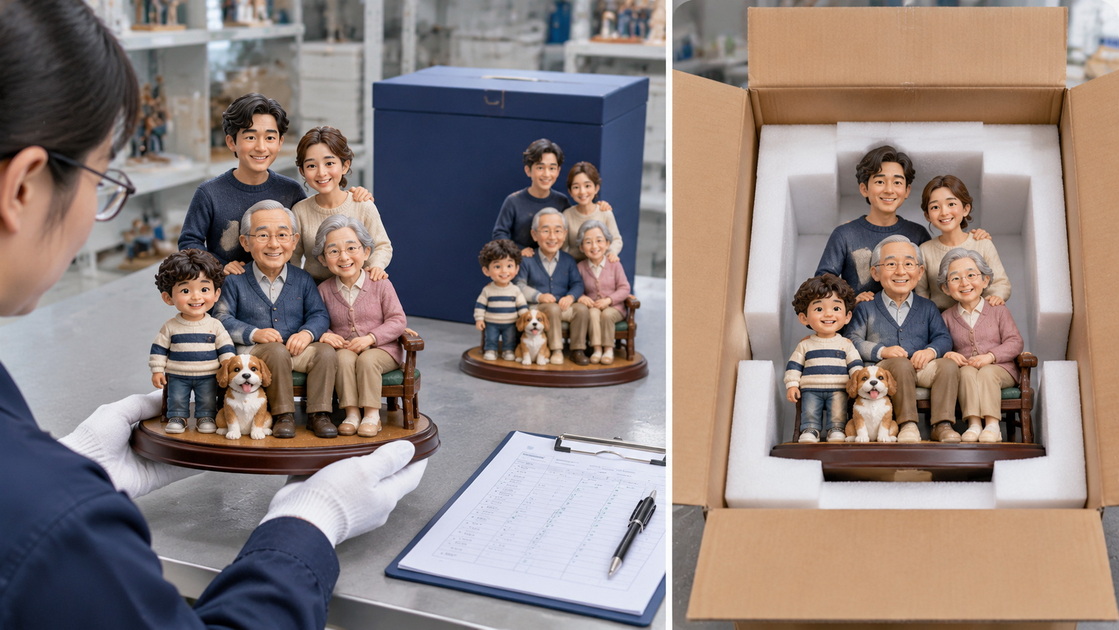
For retailers and personalized-gift businesses, each order may contain different people, photographs, and messages.
That creates a coordination challenge even when every sculpture uses the same base.
Use a structured order system linking:
- Order reference.
- Approved customer photographs.
- Person and pet identifiers.
- Design version.
- Inscription.
- Approval status.
- Packing label and destination.
Define who resolves conflicting instructions and who authorizes changes.
Protect portrait files appropriately. Agree on access, retention, deletion, and whether any images or finished designs may be used in promotional materials.
Do not assume an order grants permission to publish a family's photographs, especially when children are pictured.
Follow the maker's instructions for the complete finished object, including its coating, adhesives, and accessories.
As a cautious default:
- Display indoors on a stable surface.
- Avoid direct sunlight and concentrated heat.
- Lift from a secure base rather than an arm or head.
- Remove dust gently with a soft brush.
- Avoid harsh cleaners.
- Do not immerse the sculpture unless expressly permitted.
- Keep fragile decorative pieces away from rough play.
Even when a base material tolerates water, paint, joints, and accessories may require different care.
No responsible supplier should promise that every personalized figurine will remain unchanged forever.
The strongest family sculpture projects combine emotional relevance with clear production decisions.
Choose a style the recipient will appreciate, provide useful photographs, approve the full composition, and confirm how the finished piece will be protected.
Top Arts & Crafts Co., Ltd. supplies personalized bobbleheads, polyresin crafts, and polymer-clay custom gifts for individual and wholesale customers worldwide.
It may be possible, depending on image quality and the intended design. Provide relative heights and clear instructions about ages, hairstyles, and poses. Approve the combined composition rather than assuming separate photographs will automatically fit together.
Likeness depends on reference quality, sculpture size, production method, and artistic interpretation. Request examples comparable to your project. "Custom" does not automatically mean photorealistic, so agree on the expected style before ordering.
Discuss this during quotation. Supply clear images showing the animal's face, body proportions, markings, and intended pose. Confirm whether the pet is integrated into the base or supplied as a separate element.
Neither is universally better. Polymer clay can suit individually sculpted work, while casting can support repeated components. Compare the actual design, construction, finish, and quantity rather than relying on material labels alone.
It can be designed that way, but spacing, weight, and clearance need attention. Confirm which heads move and review the complete assembly. Closely positioned heads or accessories may require changes to the layout.
1. My3Dselfie. "Unveiling the Beauty of Family Sculptures." Original article reviewed for its themes of family memories, personalized figurines, decorative use, and gift occasions. Unsupported historical examples and promised spiritual, financial, or academic effects were not carried into this version. [my3dselfie]
2. Polyform Products / Sculpey. "Clay for Sculpting: A Comprehensive Guide." Technical background on polymer clay, curing, formulation differences, and following product-specific processing instructions. This source does not establish which clay brand Top Arts & Crafts uses. [sculpey]
3. Polyform Products / Sculpey. "Polymer Clay for Sculpting Dolls." Supports discussion of sculpting detail and post-curing finishing possibilities for the specified polymer-clay product family. [sculpey]
4. Polyform Products / Sculpey. "Frequently Asked Questions." Source for general handling and care considerations, including thin-feature vulnerability, sunlight exposure, and avoiding harsh cleaners. Finished mixed-material products may require different instructions. [sculpey]


