
Views: 222 Author: Mia Publish Time: 2025-12-11 Origin: Site
Content Menu
● Understanding Typical Bobblehead Weight
● Bobblehead Weight by Size Category
● How Material Affects Bobblehead Weight
● Design Features That Increase Bobblehead Weight
● Net Weight vs. Packaged Weight of a Bobblehead
● Why Bobblehead Weight Matters for Collectors
● Impact of Bobblehead Weight on Shipping and Storage
● RealWorld Bobblehead Weight Examples
● Giant and Oversize Bobblehead Weights
● How to Estimate Your Own Bobblehead's Weight
● Bobblehead Weight and User Experience
● Bobblehead Weight and Durability
● Bobblehead Weight in Bulk and Corporate Orders
● Balancing Bobblehead Weight, Design, and Cost
● FAQ
>> 1. How much does a standard Bobblehead weigh?
>> 2. Why do some Bobbleheads weigh more than others?
>> 3. How heavy is a couple or family Bobblehead?
>> 4. What is the packaged weight of a Bobblehead for shipping?
>> 5. How much does the world's biggest Bobblehead weigh?
A standard Bobblehead usually weighs around 0.3 kg, or roughly 0.66 pounds, although actual Bobblehead weight can vary depending on size, material, and design complexity. For many popular 5–7 inch custom Bobblehead designs, the net weight typically falls between about 300 g and 500 g per single Bobblehead.[1][2]

Most standard-size Bobblehead figurines are between 5 and 7 inches tall and use polyresin, polymer clay, or plastic, which keeps the Bobblehead light while still feeling solid in the hand. In this common range, a Bobblehead often weighs about 0.3 kg (300 g), with some brands stating 350 g to 500 g as a typical net Bobblehead weight depending on the sculpt and base.[1]
For collectors or brands ordering a Bobblehead in bulk, this 0.3–0.5 kg range per single Bobblehead makes shipping manageable while still providing a substantial, quality feel. At this weight, the Bobblehead head can move freely on the spring without making the figure unstable on a desk or shelf.[3][1]
Bobblehead weight changes as the Bobblehead gets taller or uses more material in the body, base, or background elements. A standard 6.5–7 inch Bobblehead might be around 0.6–0.65 pounds, while larger or heavily detailed Bobblehead figures can weigh significantly more.[3][1]
Below is a practical overview of how Bobblehead weight usually scales with size for typical resin or polymer clay Bobblehead designs.[1]
Bobblehead size category | Typical height range | Typical net weight per Bobblehead | Notes |
Mini Bobblehead | 3–4 inches | ≈100–200 g (estimated from reduced material vs. standard) | Light, often used as small gifts or car Bobblehead figures. |
Standard Bobblehead | 5–7 inches | ≈0.3 kg or about 0.6–0.66 lbs; many suppliers quote 300–350 g | Most common collector and custom Bobblehead size. |
Heavy standard Bobblehead | 6–8 inches with thick base/background | ≈350–500 g per Bobblehead | Extra details, thicker bases, or props increase Bobblehead weight. |
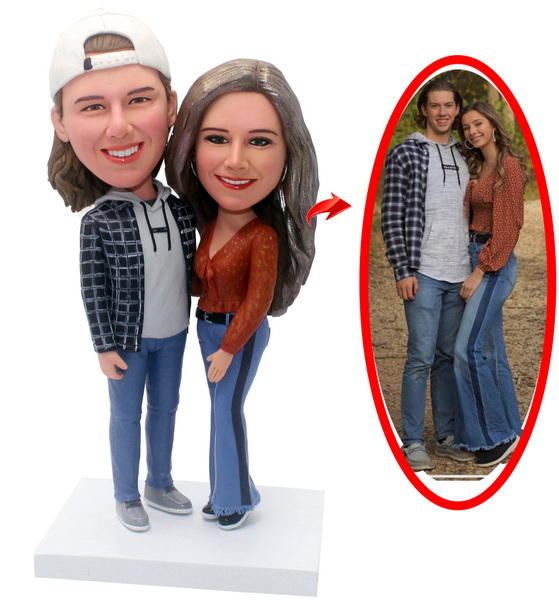
Couple Bobblehead | 5–7 inches tall (two figures) | ≈0.6–0.8 kg per pair | Two-person Bobblehead designs roughly double material usage. |
Oversized Bobblehead | 9–12 inches | Often >1 kg depending on design | Large display Bobblehead pieces use much more resin or clay. |
Giant promotional Bobblehead | Several feet tall | Hundreds to 1,500+ pounds | Massive outdoor or event Bobblehead structures for advertising. |
Standard consumer Bobblehead products for desks, cars, or gift boxes almost always fall into the “Standard Bobblehead” or “Heavy standard Bobblehead” rows in this table. Giant Bobblehead structures—such as record-breaking promotional Bobblehead installations—are special cases and are engineered more like sculptures than everyday Bobblehead collectibles.[6][1]
The main Bobblehead materials—polyresin, polymer clay, and plastic—have different densities, which change the final weight of the Bobblehead even at similar sizes. Polyresin Bobblehead figures tend to be heavier and more rigid, while plastic Bobblehead products are lighter but may feel less premium.[1]
Polymer clay Bobblehead figures are usually handmade, with weight depending on how thick the sculptor builds the Bobblehead head, body, and base. Many polymer clay Bobblehead makers still land close to the 0.3–0.4 kg range for a standard single Bobblehead, but variations are common when adding props, pets, or vehicles around the main Bobblehead figure.[5][7]
Even when two Bobblehead products share the same height, design differences can change the weight by 100 g or more. For example, a Bobblehead with a wide, solid base, thicker body, and multiple accessories will weigh noticeably more than a minimalist Bobblehead on a thin, flat base.[2]
Common weight-increasing features include:
- Large or thick Bobblehead bases with logos, text, or 3D decorations.[3]
- Couple, family, or team Bobblehead sets with multiple figures on a single base.[5]
- Bobblehead designs including cars, pets, instruments, or elaborate backgrounds around the main character.[8]
When planning a promotional Bobblehead, brands often decide how heavy the Bobblehead should feel in the hand, then coordinate with the factory to adjust base thickness, internal hollows, or fillers to meet a target Bobblehead weight range.[2]
In logistics and e-commerce, Bobblehead buyers need to distinguish between the net weight of the Bobblehead itself and the packaged weight including box and protective materials. A single Bobblehead might have a net weight of around 500 g, but the packaged Bobblehead weight can rise to about 700 g after adding inner box, foam, and outer carton.[2]
Some Bobblehead suppliers also publish typical net weights such as 350 g for a standard single Bobblehead and 700 g for a standard couple Bobblehead to help customers forecast shipping costs. If a project includes dozens or hundreds of Bobblehead units, this small difference between net Bobblehead weight and packaged Bobblehead weight has a big impact on freight pricing and warehouse storage planning.[9][2]
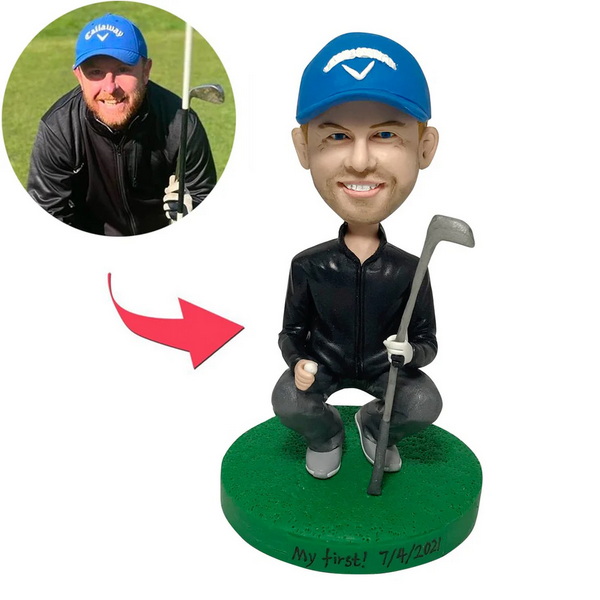
Collectors often judge Bobblehead quality partly by weight: a Bobblehead that feels solid and balanced suggests dense resin or clay and careful construction. A very light Bobblehead may be perfectly fine, but some collectors associate heavier Bobblehead designs with higher craftsmanship and better durability over time.[3][1]
At the same time, the Bobblehead must not be so heavy that the spring mechanism struggles to move the head smoothly or that the figure becomes unstable on narrow shelves. For this reason, Bobblehead designers work to keep weight concentrated in the base and lower body, allowing the oversized Bobblehead head to bobble freely while the figure stays upright.[3]
Shipping cost is strongly influenced by both the dimension and weight of each Bobblehead package, especially for international orders or bulk Bobblehead shipments. When a buyer understands that a standard packaged Bobblehead may weigh around 0.7 kg, they can more accurately estimate air or sea freight for 50, 100, or 1,000 Bobblehead units.[2]
Heavier or oversized Bobblehead designs require stronger cartons and additional cushioning materials, which again increase the packaged Bobblehead weight and overall freight bill. For B2B projects, choosing a Bobblehead design that balances visual impact with moderate weight makes it easier to control logistics costs while still delivering a premium Bobblehead gift to end users.[2]
Several custom Bobblehead brands and marketplaces provide approximate weight ranges for their typical Bobblehead products, which offer a useful reference for planning. These data points confirm that a “normal” Bobblehead tends to land around onethird to onehalf of a kilogram for standard-height figures.[1]
For example, some FAQ pages state that a single custom Bobblehead has a net weight of about 350–500 g, while couple Bobblehead designs weigh about 700–800 g on average. Other suppliers selling 7inch Bobblehead trophies or figurines list weights around 0.6–0.65 lbs, closely matching the common 0.3 kg Bobblehead standard.[1][2]
At the extreme end of the Bobblehead world are giant promotional Bobblehead figures designed for outdoor installations, sports events, and corporate branding. These enormous Bobblehead structures can reach heights of several meters and weigh hundreds or even thousands of pounds, making them closer to large sculptures than ordinary Bobblehead collectibles.[6]
One recordsetting Bobblehead installation, for instance, stands about several meters tall and weighs roughly 1,500 pounds, demonstrating how far Bobblehead engineering can go when size is the main goal. Other large Bobblehead examples include multimetertall designs built from PVC, metal, and composite materials, each weighing many hundreds of pounds.[6]
If you are planning a custom Bobblehead project, you can estimate Bobblehead weight using a few simple rules of thumb based on size and design complexity. First, decide whether your Bobblehead will be a mini, standard, larger display, or giant promotional piece, then match that category to typical weight ranges such as 0.3 kg for standard Bobblehead designs and 0.6–0.8 kg for couple Bobblehead designs.[5][1]
Next, consider whether your Bobblehead includes an extrawide base, heavy background, or large accessories; each of these elements can add 50–200 g or more to the final Bobblehead weight. Finally, ask your Bobblehead supplier or factory to confirm sample net weight and packaged weight, especially for bulk Bobblehead orders where precise numbers affect shipping contracts and customer pricing.[2]
From a user's perspective, the “right” Bobblehead weight is the one that feels comfortable to pick up, stable on a shelf, and satisfying when the head moves. A Bobblehead that is too light might tip easily when bumped, while a very heavy Bobblehead could feel awkward for children or elderly recipients to handle, especially if they frequently move the Bobblehead between locations.
Giftgivers often want a Bobblehead that surprises people with its quality when they first lift it. In many cases, this means selecting a Bobblehead weight that is slightly heavier than a typical plastic toy but still easy to handle. By staying near the 0.3–0.4 kg range for a standard Bobblehead, manufacturers can provide a solid, premium impression without sacrificing usability.[1]
The weight of a Bobblehead can also influence durability over time. A thicker, heavier Bobblehead body and base usually provide more resistance to impact or rough handling during shipping and everyday use. However, if the Bobblehead head is too heavy relative to the spring and neck area, the joint can experience extra stress, increasing the risk of damage if the Bobblehead is dropped.
Many professional Bobblehead makers therefore finetune the internal structure and the relative weight of the Bobblehead head and body. Reinforced neck areas, carefully sized springs, and welldistributed mass in the base help the Bobblehead survive transport and regular bobbling motion. This balance means that a welldesigned Bobblehead can be both pleasantly heavy and mechanically reliable for longterm display.[3]
When companies order Bobblehead products for marketing, employee recognition, or giveaways, weight becomes an important cost driver. A difference of just 50 g per Bobblehead can produce a major increase in total shipment weight when ordering several thousand Bobblehead units. This, in turn, affects freight rates, customs declarations, and even the choice of courier or transport mode.
Corporate buyers often request detailed packaging specifications that include net Bobblehead weight, packaged weight per unit, and total weight per master carton. With these details, they can calculate storage capacities, estimate lastmile delivery expenses, and adjust the number of Bobblehead units per shipment to fit budget and scheduling constraints.[2]
Ultimately, choosing an ideal Bobblehead weight is about balancing design goals and financial realities. A heavier Bobblehead with a thick base and multiple 3D elements may look more impressive and feel luxurious, but it will cost more to ship and may be less convenient for certain users. A lighter Bobblehead is cheaper to move and easier to handle, though some recipients might perceive it as less substantial.
Savvy buyers and manufacturers collaborate early in the design phase, deciding on target dimensions, materials, and desired Bobblehead weight. With a clear Bobblehead weight target, the production team can adjust internal hollows, wall thickness, and base design to meet both aesthetic and logistical requirements. In this way, Bobblehead weight becomes a controlled, strategic variable instead of an afterthought.[2]
Most standard Bobblehead figures in the 5–7 inch range weigh around 0.3 kg, or roughly 0.6–0.65 lbs, with many custom Bobblehead suppliers publishing typical net weights of 300–500 g for single designs and 700–800 g for couple designs. Actual Bobblehead weight depends on the materials, base thickness, decorative elements, and whether the design features single or multiple characters, while giant promotional Bobblehead installations can weigh hundreds or thousands of pounds.[6][1][2]
Understanding Bobblehead weight is important not only for collectors who care about feel, stability, and durability, but also for brands, exporters, and event organizers who must plan packaging, warehousing, and international freight for each Bobblehead shipment. By combining size, material, and design data from your Bobblehead supplier with common industry ranges, you can confidently estimate how much your Bobblehead will weigh and design Bobblehead projects that balance visual impact, longevity, and cost.[2]
A standard single Bobblehead in the 5–7 inch height range usually weighs about 0.3 kg, which is roughly 0.6–0.66 lbs. Some suppliers specify more exact net Bobblehead weights such as 300–350 g depending on the base and sculpting details used in the Bobblehead.[1]
Bobblehead weight varies because of material density (polyresin vs. plastic), body thickness, base size, and the number of accessories or background elements in the Bobblehead design. A Bobblehead with a large solid base, multiple figures, or heavy props requires more material and can easily weigh 100–200 g more than a minimalist Bobblehead of the same height.[1][2]
A typical couple Bobblehead, with two characters on a shared base, often weighs between about 0.6 kg and 0.8 kg, roughly double a single Bobblehead design. Larger family or team Bobblehead pieces with three or more figures can exceed 1 kg, especially if the base is thick and includes extra decorations, logos, or props around the Bobblehead group.[5][2]
The packaged weight of a Bobblehead is usually higher than the net figure weight because it includes the inner gift box, foam or molded inserts, and outer carton for protection. As a broad rule of thumb, a Bobblehead with a net weight of about 500 g may reach approximately 700 g when fully packaged for safe domestic or international shipping.[2]
Some of the largest Bobblehead installations have reached several meters in height and weigh well over 1,000 pounds. One recordholding Bobblehead structure, for example, stands several meters tall and weighs roughly 1,500 pounds, far exceeding the weight of any normal consumer Bobblehead and illustrating the engineering potential of oversized Bobblehead designs.[6]
[1](https://www.bbobbler.com/the-average-size-of-a-bobblehead-what-you-need-to-know/)
[2](https://www.laclayfigurine.com/pages/faq)
[3](https://www.bbobbler.com/how-are-bobble-heads-made/)
[4](https://www.dealsmagnet.com/deal/eitheo-bobblehead-superstar-celebrity-standing-fig-19sgsech)
[5](https://www.etsy.com/listing/1896151375/handmade-custom-king-queen-crown-bobble)
[6](https://www.my3dselfie.com/blogs/news/bobblehead-how-tall-is-the-biggest-one)
[7](https://www.bobbleheads.com/rbs1272/fully-customizable-single-bobblehead)
[8](https://www.abobblehead.com/pages/faq)
[9](https://www.bobbleheadz.ca/faq-bobbleheadz)


