
Views: 270 Author: Mia Publish Time: 2026-10-05 Origin: Site
Content Menu
● Is It Normal for a Custom Bobblehead to Look Different?
● A Custom Bobblehead Is Not a 3D Photograph
>> Why Bobblehead Proportions Change Facial Appearance
● The Seven Main Reasons Your Bobblehead Looks Different
>> 1. The Reference Photo Is Blurry, Filtered, or Incomplete
>> 2. The Photo Does Not Show the Customer's Most Important Features
>> 3. The Customer Expected Realism but Ordered a Caricature Style
>> 4. Lighting Changes the Perceived Skin Tone and Paint Color
>> 5. Small Details Were Not Included in the Order Notes
>> Identify "Likeness Anchors"
● Why a Proof Approval Process Matters
>> What to Review During the Sculpt Proof
>> What to Review During the Paint Proof
>> The Hidden Risk of Fast Production
● How to Submit Better Photos for a Custom Bobblehead
● Where Likeness Can Change During Production
>> Stage 1: Reference Interpretation
>> Stage 3: Mold or Casting Preparation
>> Stage 5: Spring Assembly and Final Inspection
● What to Do If Your Finished Bobblehead Does Not Match Expectations
>> Step 1: Gather Order Evidence
>> Step 2: Compare Against the Approved Proof
>> Step 3: Give Numbered Correction Requests
● Custom Bobblehead Quality Checklist for Wholesale Buyers
● Why Top Arts & Crafts Co., Ltd. Uses a Detail-First Process
>> 1. Why does my custom bobblehead look more cartoon-like than my photo?
>> 2. What photos produce the most accurate custom bobblehead?
>> 3. Can I request changes after I approve the proof?
>> 4. Why does the paint color look different from my phone photo?
>> 5. How can I make sure the face resembles the person?
A custom bobblehead may look different from the reference photo because it is a hand-finished, three-dimensional interpretation—not a flat photographic copy. Photo quality, camera perspective, sculpting style, facial proportions, paintwork, proof approval, and shipping conditions can all affect the final likeness.
At Top Arts & Crafts Co., Ltd., we manufacture personalized resin crafts and polymer clay gifts for global customers. From a production perspective, most "it looks different" concerns can be prevented before manufacturing begins. The key is to understand what a custom bobblehead can realistically reproduce, provide the right photo references, and review the correct details at the proof stage.
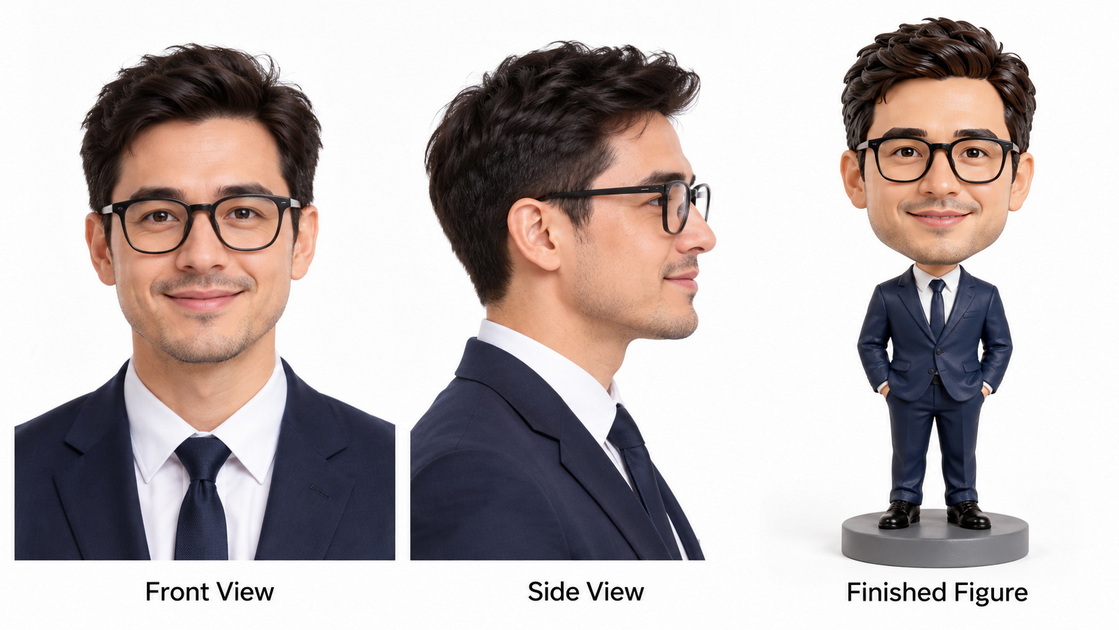
A custom bobblehead is usually designed with an oversized head, a smaller body, a flexible neck or spring mechanism, and a stylized sculpted face. That style changes the relationship between facial features. A forehead may look broader, cheeks may appear rounder, and a nose or hairstyle may be simplified so the face remains recognizable at a small scale.
However, normal artistic variation is different from a preventable production issue. A buyer should raise a concern when the delivered bobblehead differs materially from the approved design, ordered color, requested accessory, base text, or agreed facial feature.
| Normal Handmade Variation | Issue That May Require Review |
|---|---|
| Slight variation in brush-painted shading | Wrong hairstyle or hair color |
| Small difference in skin-tone warmth under different lighting | Missing glasses, beard, earrings, tattoo, or key accessory |
| Stylized face proportions | Incorrect name, date, logo, or base message |
| Minor difference between screen color and physical paint | Product does not match the approved proof |
| Slightly different visual impression from different angles | Damaged head, body, base, or spring |
| Handmade texture in clay or resin | Wrong pose, clothing, or body design |
The best comparison is not between the final bobblehead and one filtered selfie. It is between the final bobblehead, the complete reference package, and the proof or sample the customer approved.
The most important expectation to set is simple: a personalized bobblehead from photo is a small physical sculpture, usually created through hand sculpting, resin-craft production, polymer clay work, hand painting, and final assembly.
A two-dimensional photo contains limited information. It may show only the front of a person's face. It cannot fully reveal:
- The exact depth of the nose.
- The side profile of the jaw.
- The curve of the ears.
- The volume of the hairstyle.
- The back of the head.
- The true body proportions.
- The natural posture of the shoulders.
- The color changes caused by different lighting.
The artist must interpret missing visual information. That interpretation is necessary, but it also explains why the final product may not look exactly like a photograph.
A quality supplier should aim for recognizable likeness, not impossible pixel-level duplication.
Traditional bobblehead design uses a larger head and smaller body. This is intentional. It creates the playful movement and collectible appearance that customers expect.
The enlarged head can make these features look stronger:
- Forehead.
- Cheeks.
- Nose.
- Chin.
- Glasses.
- Hair volume.
- Smile lines.
- Facial hair.
A face that looks balanced in a normal portrait photograph can look very different when sculpted at a larger scale. Skilled artists must adjust proportions carefully so the finished figure remains charming instead of distorted.
A good custom bobblehead should look like the person in a stylized collectible format—not like a miniature passport photo.
Poor-quality photos are the most common cause of likeness concerns.
A supplier cannot accurately sculpt what is not visible. A heavily filtered selfie may change skin texture, eye size, nose shape, jawline, and face width. A photo taken in dim light can hide a hairline, beard shape, or eye color. A close selfie shot can also make the nose, forehead, or chin appear larger than they are.
Perspective distortion happens because the camera is placed close to the subject. Features nearest to the lens can appear disproportionately large, while features farther away can look smaller or flatter.
Avoid using only one selfie as the main reference.
For better accuracy, provide:
- One high-resolution front-facing photo.
- One left-side or right-side profile photo.
- One photo in natural daylight.
- One photo showing the normal hairstyle.
- One photo showing the preferred facial expression.
- One full-body photo if you request a fully customized body.
- Close-up photos of special details such as glasses, beard, earrings, tattoos, or uniforms.
Professional custom-bobblehead providers similarly recommend a sharp front-facing image and a profile image, particularly because profile photos help artists judge nose shape and facial depth.
Many customers send a photo that looks attractive but does not show the traits that make them recognizable.
For example:
- A photo may show a person wearing sunglasses, but the order requires normal eyeglasses.
- A wedding photo may hide the hairstyle beneath a veil.
- A group photo may make the face too small to examine.
- A sports photo may show a helmet, cap, or face paint instead of everyday features.
- A side-lit photograph may hide one cheek or eye.
- A formal headshot may not show a person's usual smile.
The artist may then need to guess. Even a small guess can create a major difference in perceived likeness.
Not all personalized bobbleheads use the same visual style.
Common styles include:
| Style | Typical Appearance | Best For |
|---|---|---|
| Traditional Bobblehead | Large head, compact body, playful expression | Corporate gifts, sports figures, team awards |
| Cartoon Style | Simplified features and expressive proportions | Couples, weddings, birthdays, novelty gifts |
| Semi-Realistic Style | Balanced facial features with handmade character | Premium personalized gifts |
| Portrait Style | More detailed facial modeling and subtle expression | Memorial gifts, executive gifts, collectible displays |
| Chibi Style | Very large head, small body, cute proportions | Youth-oriented gifts, character-inspired designs |
If a buyer expects a portrait-style figurine but approves a traditional bobblehead concept, the finished product may feel "different" even if the artist followed the intended style correctly.
Before production, confirm:
- How large the head should be compared with the body.
- Whether the result should be cartoon-like or semi-realistic.
- Whether smile lines, dimples, freckles, and facial hair should be emphasized.
- Whether a playful expression or a natural expression is preferred.
- Whether the customer wants flattering interpretation or strict realism.
Style alignment should happen before sculpting—not after painting.
A reference photo taken under warm indoor lighting can make skin appear orange or yellow. A photo taken under cool daylight may create gray or blue shadows. Smartphone cameras also automatically adjust saturation and contrast.
Painted figurines create another layer of variation. Paint reflects light differently from human skin. A matte-coated resin face can appear softer under warm light, while a glossy surface may look darker or more saturated under direct lighting.
This does not mean that color differences should be ignored. A supplier should follow approved color references, especially for:
- Brand uniforms.
- Sports jerseys.
- Wedding dresses.
- Corporate logos.
- Skin tone.
- Hair color.
- Eye color.
- Base graphics.
For branded projects, provide Pantone references, vector logos, or approved color swatches instead of relying only on a phone photo.
A bobblehead may look generally correct but still feel wrong because one important detail is missing.
A customer may notice immediately that:
- The glasses have the wrong frame color.
- The beard is too short.
- The hairline is too high.
- The hairstyle is too flat.
- The earrings are missing.
- The uniform logo is absent.
- The wedding bouquet is the wrong color.
- The base text contains one misspelled word.
- The customer's signature accessory was not included.
These details may seem minor during order placement, but they often create the strongest emotional reaction once the product arrives.
In custom figurine production, we recommend asking customers to identify three to five likeness anchors. These are the features that must be correct for the figurine to feel like the intended person.
Typical likeness anchors include:
- Thick black glasses.
- Curly shoulder-length hair.
- A distinct beard shape.
- Dimples when smiling.
- A bright red football jersey.
- A nurse uniform and stethoscope.
- A signature guitar.
- A wedding veil.
- A company logo on the shirt.
- A specific pet breed or pet color pattern.
When artists know the highest-priority features, they can allocate more attention to the details that matter most.
A proof process is the strongest protection against disappointment.
A proof may be a digital render, sculpting-stage photograph, body-layout image, hand-painted preview, or pre-production sample. The exact format depends on the supplier and product type.
The purpose is to let the buyer check major details before final assembly and shipping.
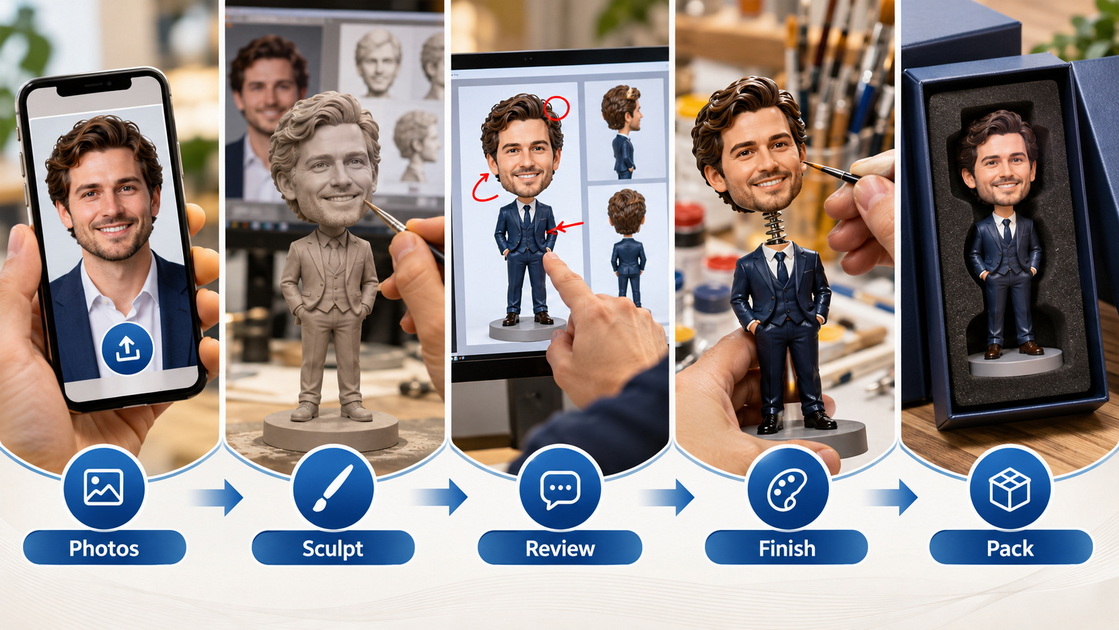
Focus on structure, not paint.
Check:
1. Face shape and head size.
2. Nose shape and profile.
3. Hairline, hairstyle, and hair volume.
4. Eye position and expression.
5. Glasses, beard, mustache, and earrings.
6. Body pose and hand position.
7. Clothing style and accessories.
8. Base shape and engraved or printed text.
Focus on color and finish.
Check:
1. Skin tone.
2. Hair color.
3. Eye color.
4. Clothing colors.
5. Brand logo placement.
6. Jewelry and accessory colors.
7. Base text spelling.
8. Surface finish, such as matte or gloss.
Many custom-bobblehead sellers use staged proofing and ask customers to approve a head proof, body proof, and finished proof before moving to the next stage.
Rush orders often reduce revision time.
Some suppliers may offer faster production with fewer proof stages or no proof stage at all. This can work for simple orders, but it increases the risk of mismatch for fully customized faces, complex poses, company mascots, or high-value gift programs.
If likeness is critical, prioritize:
- A clear photo package.
- At least one sculpt approval stage.
- Written revision rules.
- Sufficient time for feedback.
- Final confirmation before shipment.
Speed and customization accuracy are often a trade-off.
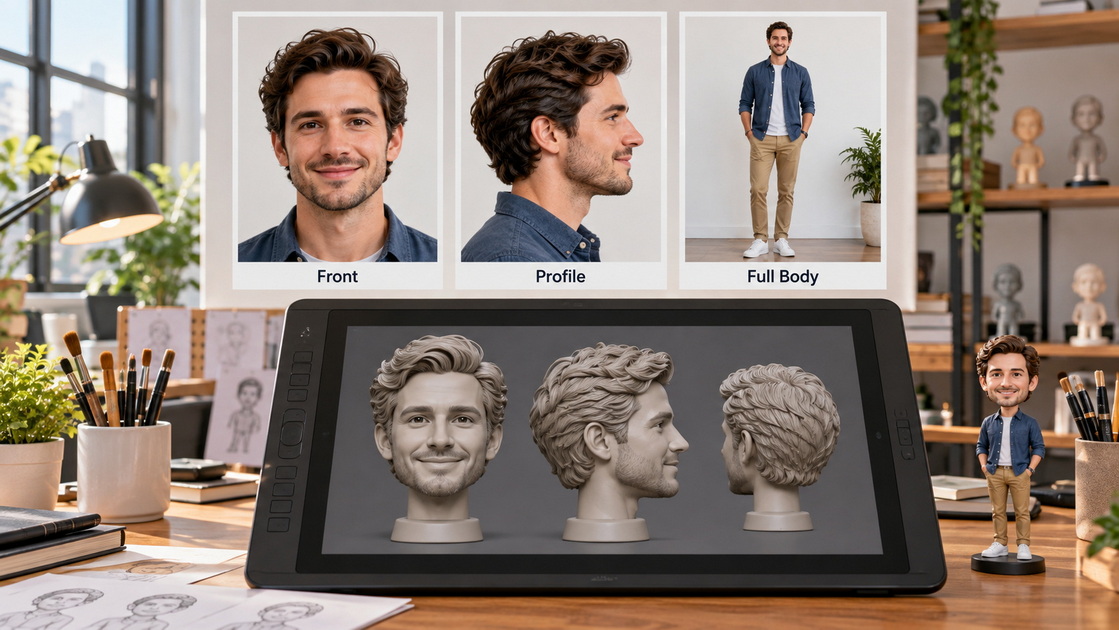
The easiest way to improve likeness is to submit better references from the beginning.
| Requirement | Recommended Standard | Why It Helps |
|---|---|---|
| Front photo | Clear, straight-on, high-resolution headshot | Shows eye spacing, face width, smile, and hairline |
| Side photo | Left or right profile | Helps define nose, jawline, ear, and hairstyle volume |
| Lighting | Bright natural light or evenly lit indoor environment | Reduces harsh shadows and misleading color shifts |
| Expression | Natural smile or intended expression | Helps artists match emotional character |
| Hair | Visible without hats, filters, or extreme wind | Supports accurate hair volume and shape |
| Accessories | Separate close-up reference photos | Prevents missing or incorrect small details |
| Body reference | Full-body photo for custom outfit or pose | Improves clothing, posture, and proportions |
| File quality | Original camera image where possible | Avoids pixelation and hidden facial information |
Avoid these reference types whenever possible:
- Low-resolution screenshots.
- Photos copied from social-media thumbnails.
- Group photos with a tiny face.
- Heavily filtered selfies.
- Photos with sunglasses.
- Photos taken in very dark rooms.
- Extreme side-angle images.
- Wide-angle close selfies.
- Photos with the face partially covered.
- Photos where hair is hidden by a hat or helmet.
A strong front-view photo and at least one profile photo are consistently recommended in custom-bobblehead workflows because they give artists more complete information for shaping the face and nose.
From a manufacturing standpoint, a personalized bobblehead passes through multiple stages. Each stage can affect the final appearance if the specification is unclear.
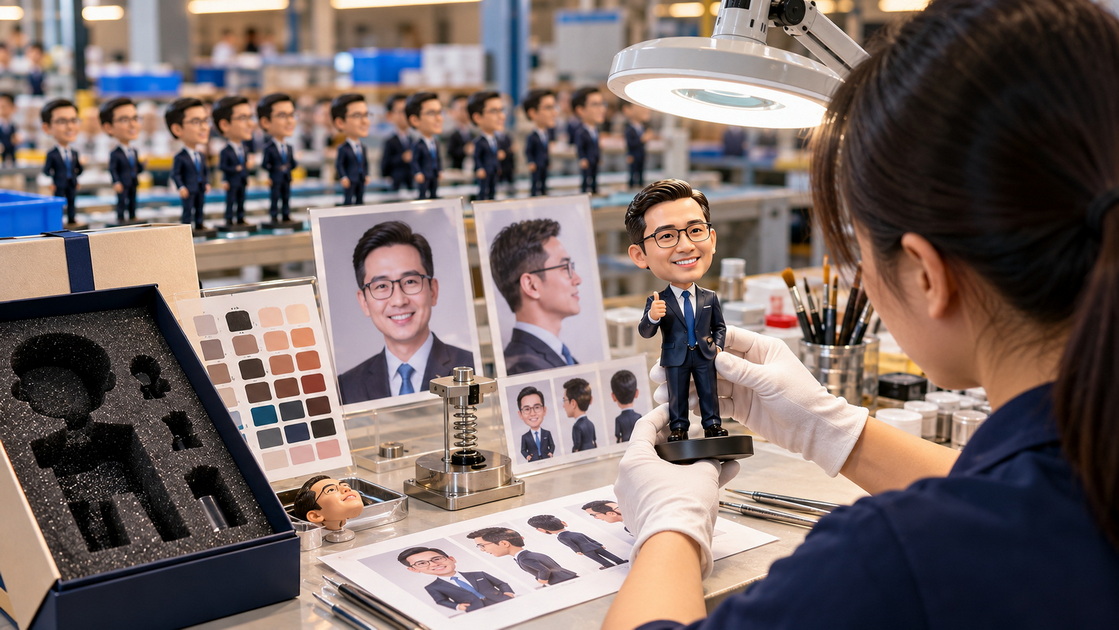
The artist studies the photos and order notes. This is where missing visual information creates the greatest risk.
Control method: Send clear photos and a written list of likeness anchors.
The sculptor creates the three-dimensional face, hair, ears, and neck connection.
Control method: Request a sculpt proof and compare it with front and side references.
For resin products, the design may be transferred into a molding and casting workflow. Small differences in surface texture, seam lines, or thickness can occur depending on the production method.
Control method: Confirm the preferred finish, acceptable seam location, and base design before production.
Painters add facial shading, eyebrows, lips, eye color, hair color, clothing details, logos, and accessories.
Control method: Provide color references and require careful spelling confirmation for names, dates, and logos.
The bobblehead head is attached to a spring or internal connector. The figure is checked for stability, movement, paint defects, missing parts, and packing protection.
Control method: Request final photos or an inspection report for important wholesale orders.
If the product has arrived and you believe it looks different from the approved reference, do not send only a general message such as "It does not look like me."
A supplier needs specific, visual, and actionable feedback.
Prepare:
- Order number.
- Original reference photos.
- Order notes.
- Requested pose and clothing.
- Approved proof or sample.
- Approval emails or messages.
- Clear front, side, and back photos of the delivered item.
- Close-up photos of the disputed feature.
- A short video if the head movement is the problem.
- Photos of damage and packaging if shipping damage occurred.
Ask these questions:
1. Was the disputed feature included in the original order notes?
2. Does the delivered item differ from the approved proof?
3. Is the difference caused by handcrafted variation, a production error, or shipping damage?
4. Is the issue visual, structural, functional, or related to incorrect text?
5. Can the issue be repaired, remade, partially refunded, or replaced?
A structured comparison file makes it easier for the supplier to assess the case. Top Arts & Crafts' published guidance similarly recommends comparing the final product with the supplied photos, approved materials, and specific order records before requesting an artistic review.
Use direct language.
For example:
- "Please compare the beard shape with Photo 2. The delivered beard is shorter and has no pointed lower edge."
- "The glasses should be matte black, not silver."
- "The base should read 'Happy Retirement, Marco' instead of 'Happy Retirment, Marco.'"
- "The hairstyle should have visible curls on both sides of the head."
- "The head spring is loose and does not hold the head upright."
Specific feedback leads to faster and fairer resolution.
For corporate gifts, ecommerce brands, distributors, and promotional-product buyers, a quality checklist should be part of every repeat order.
- Likeness matches approved proof.
- Face shape is balanced.
- Hair and facial hair match the reference.
- Accessories are present.
- Paint coverage is even.
- Logos are legible and correctly positioned.
- Text is spelled correctly.
- Colors match approved artwork.
- Head movement is smooth.
- Spring tension is stable.
- The figure stands level.
- The base is secure.
- No visible cracks, chips, or loose components.
- No sharp edges on decorative products.
- Fragile accessories are reinforced where possible.
- Individual protection prevents contact between fragile parts.
- Foam or EVA insert fits the product securely.
- Gift-box graphics are accurate.
- Outer carton supports stacking and transport.
- Carton marks are clear.
- Replacement and spare-part policy is agreed in advance.
For items intended as children's toys, additional product-safety review is required. In the United States, toys may need age labeling where choking hazards affect children under three, and toy safety requirements can include controls for small parts, sharp edges, lead, and phthalates.
Top Arts & Crafts Co., Ltd. produces personalized bobbleheads, resin crafts, and polymer clay custom gifts for global retail and wholesale buyers. We understand that buyers do not judge a customized figurine only by whether it is technically complete. They judge whether it captures the person, event, job, relationship, or brand story behind the order.
Our detail-first production approach supports:
- Clear photo and specification review before sculpting.
- Priority identification of likeness anchors, such as hair, glasses, facial hair, uniforms, and signature accessories.
- Flexible customization for faces, poses, clothing, props, bases, and printed messages.
- Resin and polymer clay options based on the desired finish and order profile.
- Proof-based communication for projects requiring closer visual control.
- Quality checks for painting, assembly, text, accessories, and packaging.
- Export-ready protective packing for global delivery.
For individual gifts, this process helps preserve emotional value. For B2B buyers, it helps reduce returns, improve repeat orders, and create a more consistent custom-gift program.
Your custom bobblehead may look different from the reference photo because photos are incomplete, cameras alter perspective, bobbleheads use stylized proportions, and handmade production involves artistic interpretation. These differences are manageable when buyers submit multiple clear photos, define their preferred style, identify key likeness features, and carefully review proofs before production.
The most reliable approach is simple: treat a personalized bobblehead as a collaborative design project, not as an automatic photo-printing service.
Share clear front and side photos, your preferred facial expression, clothing references, custom accessories, base text, desired size, and quantity with Top Arts & Crafts Co., Ltd. We can recommend a suitable resin or polymer clay production method and help you build a custom bobblehead that better reflects the person behind the photo.
Most bobbleheads use intentionally oversized heads and simplified proportions. The product may also follow a traditional, cartoon, or semi-realistic style rather than strict portrait realism. Before ordering, confirm the preferred style and ask for a sculpt proof if likeness is especially important.
Use a high-resolution front-facing photo, at least one side-profile photo, and an image taken in natural or evenly balanced lighting. Include separate close-ups for hair, glasses, facial hair, jewelry, uniforms, and other distinctive details. Avoid filters, sunglasses, dark lighting, and extreme selfie angles.
It depends on the supplier and the production stage. Changes are usually easier before sculpting is finalized or before painting begins. Once the figure is painted, assembled, or packed, major changes may require additional cost or a remake. Review every proof carefully before approving it.
Phone displays, lighting conditions, camera settings, and paint materials all affect color appearance. Provide Pantone references, brand artwork, or a physical color standard for important brand colors. For personal gifts, submit several photos under different lighting conditions if exact hair or skin tone matters.
Identify three to five likeness anchors, such as hairstyle, glasses, beard shape, face shape, smile, uniform, or signature accessory. Provide front and side images, choose a proof-based order process, and send specific written correction requests rather than general comments.
1. [Top Arts & Crafts: What Can I Do If the Finished Bobblehead Does Not Look Like I Expected?]
2. [Amazing Bobbleheads: How Custom Bobblehead Production Works]
3. [Webobble: What to Know Before Ordering a Custom Bobblehead]
4. [Bobbleheadz: Customized Bobblehead FAQ and Proofing Process]
5. [Click Love Grow: Lens Distortion and Portrait Photography]
6. [U.S. Consumer Product Safety Commission: Toy Safety Information]
7. [Landmark Global: CPSC Certification for International Toy Sellers]


