
Views: 258 Author: Mia Publish Time: 2026-10-17 Origin: Site
Content Menu
● What Counts as a Customization Mistake?
>> Objective Errors Versus Artistic Interpretation
● Who Is Responsible for the Custom Bobblehead Error?
>> When the Delivered Figure Differs From the Approved Design
>> When the Buyer Submitted or Approved Incorrect Information
>> When Instructions Were Ambiguous
● Does Proof Approval Prevent a Replacement Request?
● How to Request a Replacement for a Customization Mistake
>> 1. Inspect the Complete Order
>> 2. Preserve the Figure and Packaging
>> 3. Photograph the Specific Problem
>> 4. Gather the Order Records
>> 5. State the Remedy You Want
>> 6. Obtain Written Confirmation
● A Ready-to-Use Replacement Request
● Repair, Partial Replacement, or Full Remake?
● Who Pays for Replacement Production and Shipping?
● How Long Will a Custom Bobblehead Replacement Take?
● Wholesale Orders Need Recipient-Level Error Tracking
● How to Prevent Another Customization Mistake
● Get Your Customization Concern Reviewed
>> 1. Can I request a replacement if the bobblehead does not look like the person?
>> 2. Can I get a replacement after approving the proof?
>> 3. What if I supplied the wrong name or date?
>> 4. Must I return the incorrect bobblehead?
>> 5. Is shipping damage the same as a customization mistake?
Can I Request a Replacement for a Customization Mistake? Yes, you can request a replacement for a customization mistake on a custom bobblehead. Whether you receive a free remake, a repair, or another solution depends on what went wrong, how the delivered figure compares with your approved specifications, the seller's terms, and applicable consumer protections.
The most important distinction is responsibility: did the finished product depart from the agreed design, or are you requesting a change to something you previously approved?
At Top Arts & Crafts Co., Ltd., our business focuses on personalized bobbleheads, polyresin crafts, and polymer clay custom gifts for individual and wholesale customers worldwide. This guide explains how to document a problem and request an appropriate solution. It provides general guidance, not a promise that every order qualifies for a free replacement.

A customization mistake is a meaningful difference between the agreed order and the product received. It is not simply any difference between a handmade figure and a photograph.
Start by comparing three records:
1. Your original order instructions and reference images.
2. The latest approved proof and any accepted revisions.
3. Clear photographs of the delivered bobblehead.
Together, these records help distinguish a production error from an unclear instruction, an approved detail, or a later preference change.
Some mistakes are straightforward: the wrong name appears on the base, an agreed accessory is missing, or the figure belongs to another customer.
Facial likeness requires a more careful comparison. Bobbleheads are stylized figures, so exaggerated proportions alone do not establish a mistake. However, an omitted defining feature or a substantial departure from the approved sculpt deserves review.
| Issue | What to compare | Possible resolution |
|---|---|---|
| Incorrect engraved name | Submitted text and approved inscription | Corrected base or replacement |
| Missing glasses or accessory | Written instructions and final proof | Accessory replacement or rework |
| Wrong clothing color | Accepted specification and color reference | Repainting or remake |
| Facial likeness concern | Reference photos and approved sculpt | Review, revision, or remake assessment |
| Broken neck or damaged figure | Arrival photos and packaging condition | Damage claim and suitable remedy |
| New preference after approval | Approved design and later request | Paid modification or new order |
These are assessment examples, not guaranteed outcomes.
A replacement request is stronger when the final product clearly conflicts with accepted instructions.
For example, suppose the approved proof shows a navy suit and a base reading "Congratulations, Daniel." The delivered figure wears a red suit and reads "David." That is an identifiable discrepancy, not merely dissatisfaction with artistic style.
Point to the exact difference rather than describing the entire order as unacceptable. A focused explanation makes investigation and correction easier.
If you entered the wrong date or approved a misspelled name, a free replacement is less certain. Ask whether the affected component can be corrected at a reasonable cost.
Still, examine the complete record. If you sent corrected text and the seller accepted it before production, an older proof may not represent the final agreement.
The relevant question is not simply, "Was there an approval?" It is, "Which specifications were actually agreed for production?"
A request such as "make the jacket blue" leaves room for interpretation. A named shade, suitable reference, or agreed physical sample provides a clearer target.
Where instructions conflict or remain vague, neither party should assume the outcome. Review the correspondence and discuss a proportionate solution.
Proof approval matters because it records what the buyer accepted. It does not automatically answer every later complaint.
First, identify what the proof covered:
- A sculpting proof may show facial shape but not final paint.
- A painting proof may show colors but not the completed inscription.
- A single front view may not reveal a missing detail on the back.
- A digital mockup may not establish the exact finish of a physical product.
My recommended approach is to assess each complaint against the relevant approval stage. Approval of an unpainted head should not be treated as confirmation of a clothing color that had not yet been shown.
Likewise, approving a design does not explain away shipping damage or a final product that differs materially from that design. The significance of approval depends on the facts, contract terms, and applicable law.
A well-organized request gives customer service something specific to investigate. Follow these six steps.
Check the face, hair, clothing, accessories, base inscription, overall assembly, and visible damage.
For multiple figures, confirm that each head, body, base, and recipient label belongs together. A packaging mix-up can otherwise look like several unrelated customization errors.
Keep the outer carton, cushioning, shipping label, and detached parts until the seller provides instructions.
Avoid repainting, gluing, or disassembling the bobblehead before the claim is assessed. Alterations can make it harder to determine the original condition.
Take a full-product image and close-ups of each disputed detail. Use neutral lighting and avoid filters.
For a likeness complaint, include comparable front and side views. For a damaged neck or unstable head, a short video may help explain the issue without forcing the mechanism.
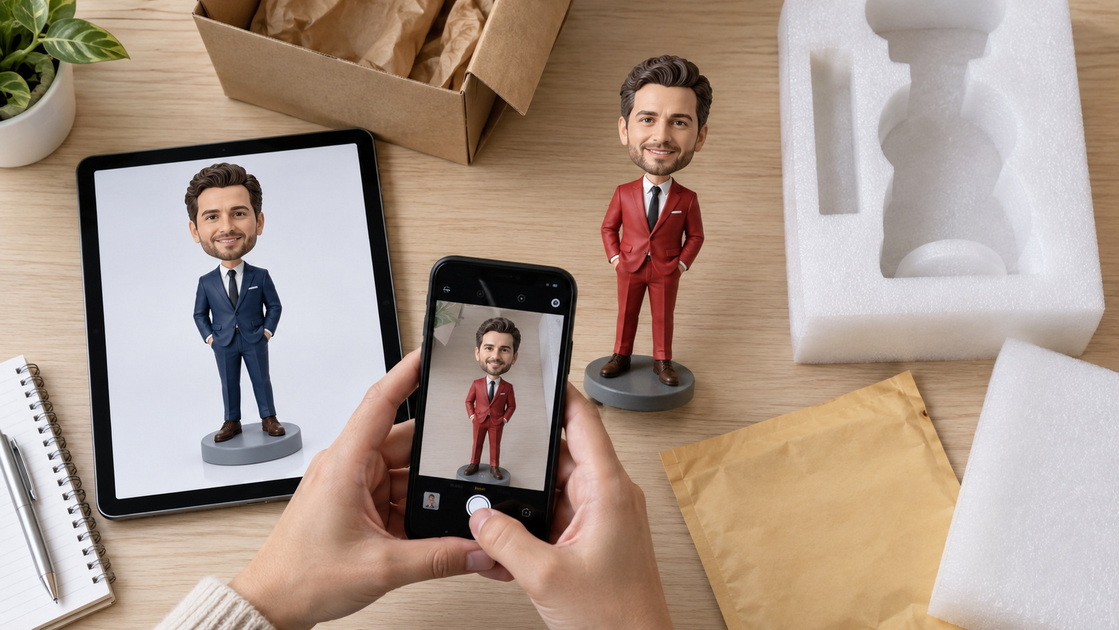
Prepare:
- Your order number and delivery date.
- Original customization instructions.
- Reference photographs.
- The latest approved proof.
- Messages confirming accepted changes.
- Photographs of the delivered item.
Keep the originals and send copies. Organizing evidence this way follows established consumer-complaint guidance.
Explain whether you prefer a corrected base, replacement accessory, repair, full remake, or another resolution.
If the gift is for an upcoming event, include the actual date. Do not assume the original delivery estimate also applies to replacement production.
Before returning anything or paying an additional charge, confirm the agreed solution, shipping arrangements, expected schedule, and whether a new proof will be provided.
Written confirmation reduces the risk of a second misunderstanding.
Subject: Customization Mistake Review — Order [Order Number]
Hello,
I received my custom bobblehead on [date] and noticed a difference from the agreed specifications.
The approved detail was: [describe the correct detail].
The delivered detail is: [describe the discrepancy].
I have attached the order instructions, relevant approval, and clear photographs. My preferred resolution is [corrected component, replacement, or other remedy].
The gift is needed by [date, if applicable]. Please confirm whether you need further evidence, whether the original item must be returned, and the proposed production and shipping arrangements.
Thank you for reviewing this issue.
This format keeps the request factual while making your preferred outcome clear.
A complete replacement is not always the most practical answer.
A wrong inscription may be resolved with a corrected base. A missing accessory may require only the accessory. A substantially incorrect sculpt may require more extensive work.
For polyresin and polymer clay gifts, repair options depend on construction, finish, component attachment, and the location of the problem. Buyers should not assume that every head, base, or accessory is removable.
A useful decision framework is:
1. Can the affected detail be corrected without damaging the figure?
2. Will the correction restore the agreed appearance and function?
3. Can the work be completed within a reasonable timeframe?
4. Does the proposed remedy comply with applicable obligations?
A partial refund can be worth discussing if you knowingly choose to keep an imperfect figure. However, it should not be presented as the only option where applicable law requires another remedy.
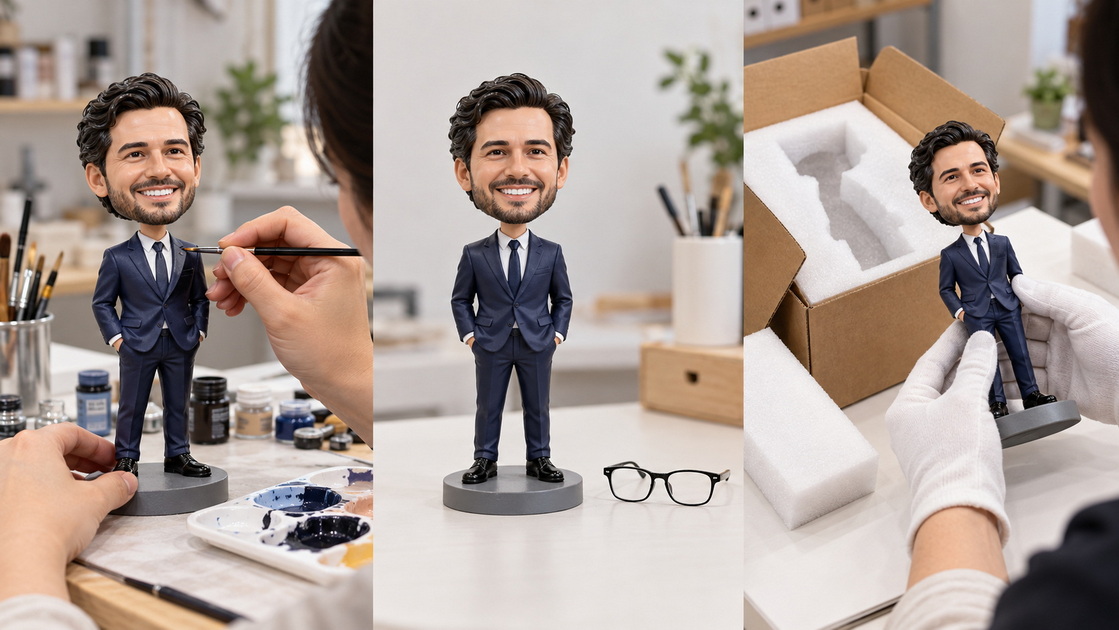
Do not assume that every replacement is free—or that every personalized item is excluded from remedies.
For a seller-caused discrepancy, request written confirmation of:
- Correction or remake charges.
- Replacement shipping.
- Any required return shipping.
- Handling of cross-border customs paperwork.
- Whether additional charges could arise at delivery.
If you are requesting a new preference after approval, ask for a separate quotation before authorizing work.
Also distinguish a change-of-mind return from a faulty-product claim. Under applicable EU consumer rules, clearly personalized goods are generally excluded from the ordinary 14-day withdrawal right. That exclusion does not itself remove protections for faulty or misdescribed goods.
Consumer protections vary by jurisdiction. International purchases and business orders require particular attention to the contract and applicable law; EU rules should not be assumed to govern every worldwide transaction.
There is no reliable universal replacement timeline.
The schedule depends on the remedy, proofing requirements, production availability, destination, and transport arrangements. Replacing an existing accessory and remaking a personalized head are different tasks.
Ask for separate estimates for:
- Claim assessment.
- Revised proof preparation, if needed.
- Correction or production.
- Dispatch and transportation.
For wedding gifts, retirements, and corporate events, distinguish the required arrival date from the dispatch date. Faster shipping cannot eliminate time needed to recreate the product.
If the original occasion cannot be met, discuss alternatives before committing to a remake.
For corporate buyers and retailers, a customization error can affect one recipient or an entire batch. The first task is to establish its scope.
Create a discrepancy register:
| Record field | Purpose |
|---|---|
| Recipient or item ID | Identifies the affected figure |
| Approved proof version | Establishes the agreed design |
| Error description | Defines the correction |
| Evidence filename | Connects the claim to photographs |
| Quantity affected | Separates isolated and repeated issues |
| Required arrival date | Supports replacement planning |
These are illustrative control fields, not customer case data.
Inspect whether the same problem appears elsewhere in the order. Repeated incorrect inscriptions may indicate an outdated production file; mismatched recipient labels may require checking packaging assignments.
Before approving replacement production, reconcile the corrected master list, proof version, quantity, and delivery addresses. Otherwise, a rushed correction can repeat the original mistake.
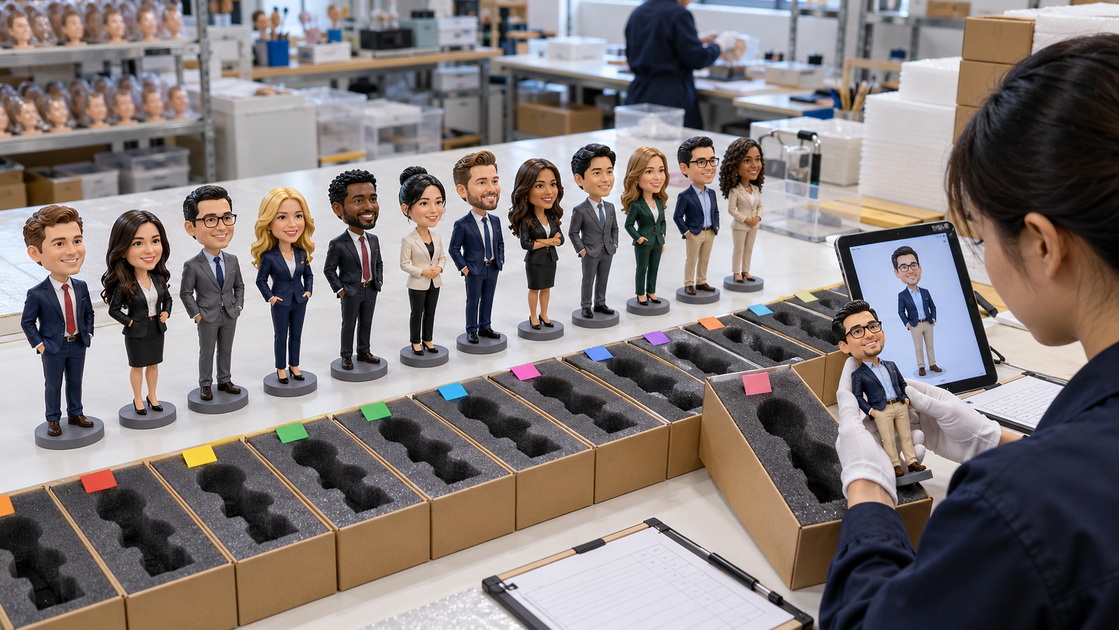
Prevention works best when requirements are specific and approvals are traceable.
Before ordering:
- Supply clear, recent photographs from useful angles.
- Identify defining features that must be preserved.
- Type names and dates rather than relying on handwritten images.
- Separate essential requirements from optional preferences.
- Confirm which details are included in the price.
During proofing, consolidate feedback into one numbered list. Replace "the face looks wrong" with an actionable observation such as "please retain the glasses shown in reference image two."
For wholesale projects, assign one final approver and label each accepted proof clearly. Ask which changes remain possible at each stage rather than assuming revisions stay available indefinitely.
A custom bobblehead replacement request should begin with evidence, not assumptions. Compare the delivered figure with the agreed specification, identify the discrepancy, and request a remedy suited to the problem.
Yes, you can request a review. Explain the specific features that differ from the agreed reference or approved sculpt. General disappointment is harder to assess than identifiable discrepancies.
Possibly. Approval is relevant, but the seller should still assess whether the delivered product matches it. Damage and details outside the proof's scope also require separate consideration.
Contact the seller immediately. A free remake is not assured, but a corrected base or paid modification may be available. Ask whether production has started before assuming changes remain possible.
That depends on the agreed remedy and applicable requirements. Obtain return authorization and shipping instructions first. Keep the figure and packaging until the seller confirms what to do.
No. Shipping damage concerns the item's condition rather than its design. Photograph the product and packaging, report the damage promptly, and follow the seller's claim instructions.
1. Federal Trade Commission. "Solving Problems With a Business: Returns, Refunds, and Other Resolutions." Supports the recommendations to collect purchase records, explain the problem, specify a requested remedy, and retain written communications. [consumer.ftc]
2. Federal Trade Commission. "Have a Problem With Something You Bought?" February 11, 2025. Supports contacting the seller first and providing documentation with a clear request for resolution. [consumer.ftc]
3. European Commission, Your Europe. "Returns and the Right of Withdrawal." Explains the personalized-goods exception to the ordinary withdrawal right and responsibility for returning defective products where the rules apply. [europa]
4. European Commission, Your Europe. "Consumer Guarantees, Warranties, Claims and Returns." Explains conformity requirements and the conditions governing repair, replacement, price reduction, and reimbursement under applicable EU consumer rules. [europa]
5. European Commission, Your Europe. "FAQs: Guarantees on Goods Bought in the EU." Clarifies seller responsibility and circumstances in which repair may be offered instead of replacement. [europa]
6. DIY Bobbleheads. "Frequently Asked Questions." Provides a commercial example of in-process preview photographs and buyer feedback. It does not establish Top Arts & Crafts Co., Ltd.'s policies. [diybobbleheads]


