
Views: 253 Author: Mia Publish Time: 2026-10-18 Origin: Site
Content Menu
● 1. Define What "Custom" Means Before Comparing Prices
● 2. Choose a Supplier Using Evidence, Not Just Ratings
>> Read Reviews as Process Evidence
● 3. Match the Artistic Style to the Recipient
>> Define the Features That Matter Most
● 4. Provide Reference Photos That Reduce Guesswork
● 5. Compare Polymer Clay and Resin Without Oversimplifying
● 6. Check Size, Proportions, and Display Fit
● 7. Evaluate the Bobble Mechanism, Not Just the Face
● 8. Separate Approval Stages to Prevent Expensive Surprises
>> Confirm Revision Terms Early
● 9. Compare the Complete Delivered Cost
● 10. Plan Backward From the Required Arrival Date
● The Right Figure Goes to the Wrong Person
● Packaging and After-Sales Terms Deserve Equal Attention
● Working With Top Arts & Crafts Co., Ltd.
>> 1. How can I judge likeness before receiving the figure?
>> 2. Is resin always better than polymer clay?
>> 3. Should I choose a fully custom body?
>> 4. Are custom bobbleheads automatically suitable for children?
>> 5. What if the finished figure differs from the approved design?
Choosing custom bobbleheads requires more than finding an attractive sample and a low price. A successful order combines a recognizable likeness, suitable materials, clear approval stages, reliable movement, and packaging that protects the finished figure.
Whether you are buying a personalized gift, wedding keepsake, corporate award, or wholesale collection, the best choice depends on what you need customized and how the supplier manages the process.
My recommendation is to prioritize clarity. Define the design, revisions, delivery expectations, and remedies before production begins. Clear specifications are more useful than broad promises such as "premium quality" or "perfect resemblance."
This guide explains how to compare custom bobblehead suppliers and prepare a practical brief for Top Arts & Crafts Co., Ltd.
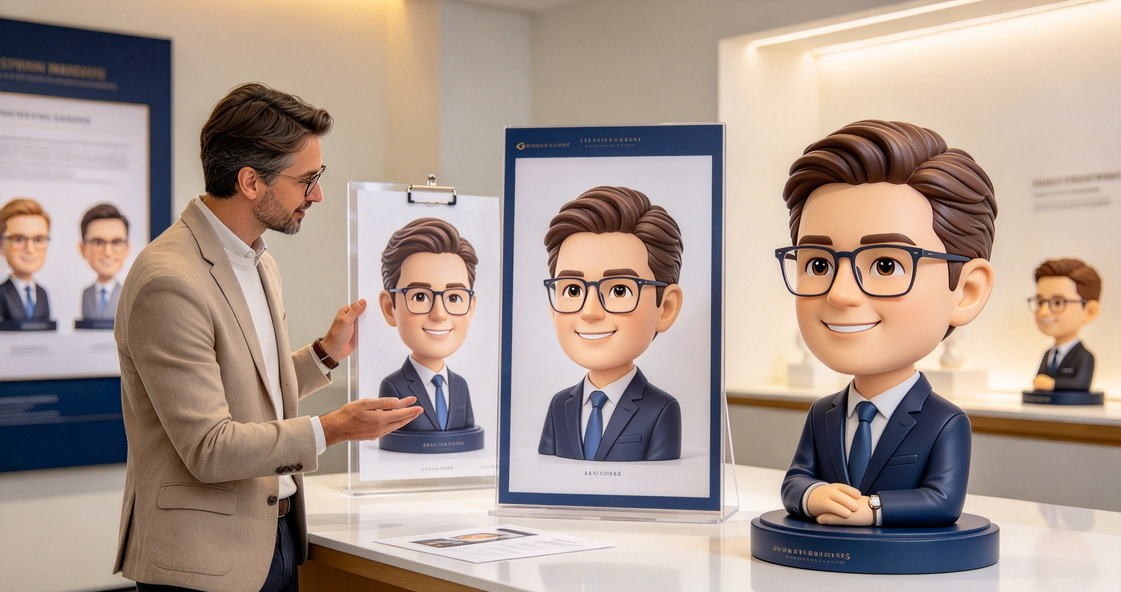
Not all personalized bobbleheads involve the same work.
Some combine a custom head with a standard body. Others include a new pose, clothing, accessories, and base. A figure with personalized wording alone is a different product again.
| Customization level | Typical scope | What to confirm |
|---|---|---|
| Personalized standard figure | Existing design with selected wording or colors | Which features remain unchanged |
| Custom head and standard body | Individual likeness on an existing body | Body dimensions and head compatibility |
| Fully custom figure | Head, body, pose, and accessories | Development stages and revision limits |
| Repeated promotional design | Multiple copies of an approved figure | Sample approval and consistency criteria |
| Individually personalized batch | Different identities across one order | Recipient tracking and separate approvals |
Ask every supplier to quote the same scope. Otherwise, apparent savings may reflect fewer customized features.
Look for examples resembling your intended project.
A supplier experienced in wedding couples may not have demonstrated the same capability with technical uniforms, detailed sports equipment, or repeated corporate orders.
Request clear photographs showing:
- Front, side, and rear views.
- Faces at a useful scale.
- Accessories and base details.
- Complete figures rather than cropped heads.
- Packaging where relevant.
A portfolio is evidence of style and presentation—not independent proof of capacity or delivery performance.
Useful reviews describe what happened: communication, proofing, revisions, delivery, packaging, or problem resolution.
Generic praise provides less purchasing information.
Check several sources, consider recency, and investigate repeated complaints. A burst of reviews may justify closer examination, but appearance alone cannot reliably establish whether a review is genuine.
Do not treat a high rating as a substitute for a written order specification.
Custom bobbleheads are stylized objects, not miniature photographs.
Some designs exaggerate the head and simplify facial features. Others aim for a more realistic expression while retaining bobblehead proportions.
Choose a supplier whose existing work matches your expectations.
Identify a short list of priorities:
- Face outline.
- Hairstyle and hairline.
- Smile or expression.
- Eyebrows.
- Facial hair.
- Glasses.
- Distinctive clothing.
This gives feedback a practical direction.
"Make it more realistic" is difficult to act on. "The jaw should be narrower and the smile less open" is more useful.
Avoid expecting added texture to correct a fundamental proportion problem.
Use a clear front-facing photograph and additional views showing the profile, hairstyle, and important details.
Avoid relying entirely on heavily filtered images, distant group photographs, or pictures obscured by sunglasses.
If your references show different ages, expressions, or hairstyles, identify the preferred version.
For clothing and accessories, provide separate references rather than expecting one portrait to communicate everything.
Before sharing images, confirm that you have appropriate permission. For corporate programs, explain how recipient photographs will be collected, transferred, retained, and deleted.
These details belong in the project brief, especially where multiple people's images are involved.
Material names alone do not establish quality.
Polymer clay can support individually sculpted designs. Molded resin can suit repeated copies of an approved master. Hybrid workflows are also possible.
However, neither material is automatically cheaper, stronger, faster, or more accurate in every project.
| Buying question | What to request |
|---|---|
| What is the figure made from? | Material and production-process description |
| How is the likeness created? | Hand sculpting, digital modeling, or another defined method |
| How are copies produced? | Individually made parts, molds, or printing |
| How is the surface finished? | Painting and coating information |
| What affects durability? | Construction details, projecting parts, and handling guidance |
| Can performance be assessed? | A representative finished sample |
Ask about the complete construction, including the base, accessories, spring attachment, and finish.
A fragile projecting accessory can be the main transport risk regardless of the body material.
"Six-inch figure" can be ambiguous.
Does the stated height include the base, hairstyle, hat, or raised accessory?
Request overall dimensions and, where relevant:
- Base footprint.
- Head dimensions.
- Maximum accessory projection.
- Packaging dimensions.
- Finished weight.
For a desk gift, confirm that the figure fits the intended location. For retail, consider shelf clearance and packaging presentation.
A larger figure is not automatically a better purchase. More size may add cost and shipping exposure without improving the likeness.
A custom bobblehead should function as agreed.
Ask whether the head moves, how the supplier checks the mechanism, and whether a physical sample or short video is available.
Review:
- Resting head position.
- Clearance above the shoulders.
- Contact with hair, hats, or accessories.
- Security of the connection.
- Stability on a level surface.
Do not specify a universal amount of movement without discussing the design. Head shape, weight distribution, and assembly influence the result.
For repeated orders, agree on a practical functional acceptance method rather than a vague requirement that every piece "bobble perfectly."
One approval should not silently authorize every remaining decision.
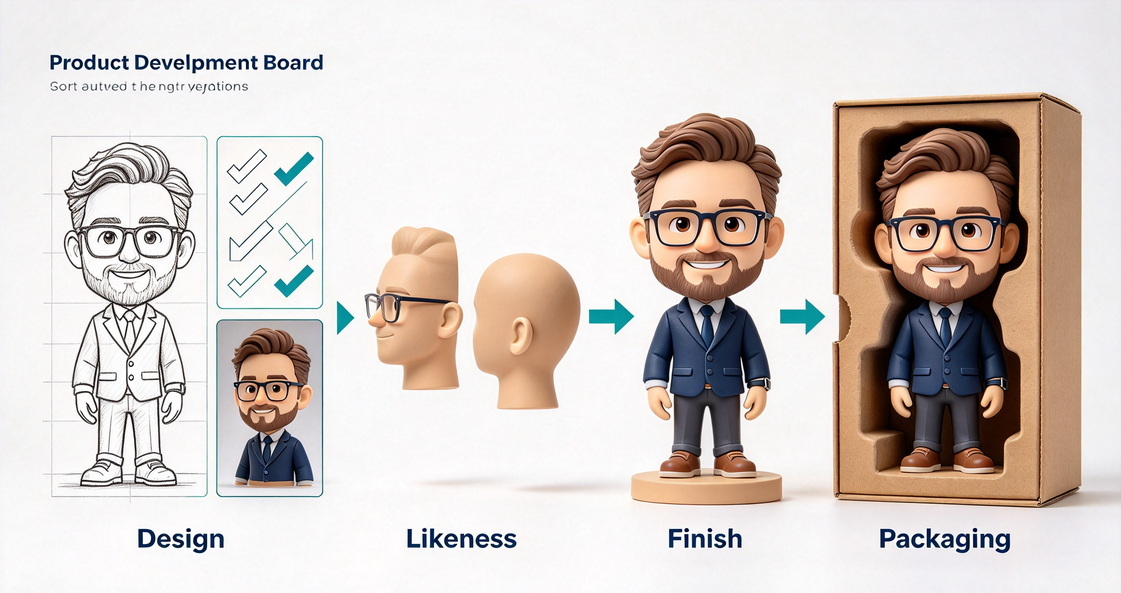
A useful process distinguishes:
1. Design concept.
2. Head likeness.
3. Body, pose, and accessories.
4. Color and wording.
5. Finished assembly.
6. Packaging.
Ask:
- Which stages include revisions?
- How many rounds are included?
- What counts as a new design request?
- What happens after approval?
- Are additional charges possible?
- How do revisions affect the schedule?
A digital image can confirm appearance, but it cannot prove physical movement, stability, or packaging protection.
For important bulk programs, a representative physical sample can address questions that photographs cannot.
The lowest advertised price may exclude meaningful project elements.
Request an itemized quotation covering:
- Design or development.
- Custom head and body work.
- Accessories.
- Base text and branding.
- Proofing and revisions.
- Molds, where applicable.
- Individual packaging.
- Freight.
- Applicable import-related charges.
Compare the same quantity and customization level.
Also clarify whether replacement shipping is included if an agreed defect or transit-damage claim is accepted.
For wholesale projects, distinguish one design repeated many times from many individually personalized figures. Those orders require different development and coordination work.
A production estimate is not an arrival guarantee.
Separate the schedule into reference review, proof preparation, buyer feedback, revisions, manufacturing, packing, transit, and possible customs processing.
Identify when the clock starts. It may depend on payment, complete photographs, or final approval.
For weddings, awards ceremonies, or product launches, agree on an internal target earlier than the event date.
Ask the supplier to explain what happens if approval is delayed or a correction becomes necessary. Rush production cannot remove every other scheduling risk.
A well-made figure can still become a failed gift if its name, photograph, or shipping label is mismatched.
For individually personalized orders, use one controlled record per recipient.
Include:
| Control field | Purpose |
|---|---|
| Unique order identifier | Links the figure to its records |
| Approved reference set | Prevents outdated images being used |
| Name and wording | Controls spelling and punctuation |
| Body and accessory choices | Prevents configuration mix-ups |
| Approval status | Separates pending and released work |
| Packaging identifier | Supports final matching |
| Destination | Controls distribution |
Avoid managing changes only through scattered messages.
Assign one person to consolidate revisions and confirm the final release list.
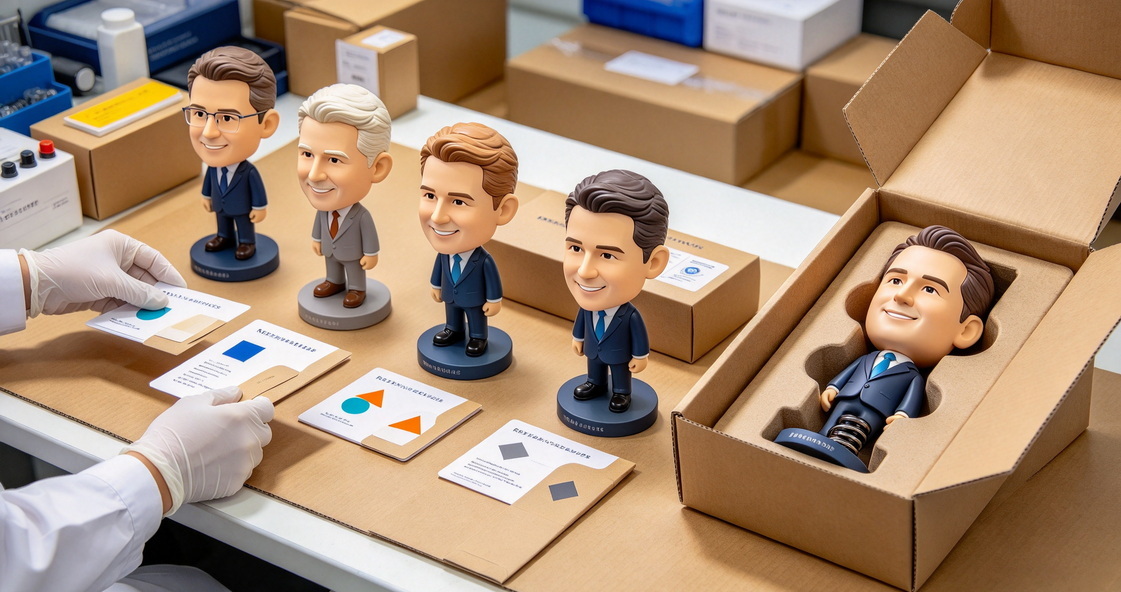
Request packaging that protects the base, body, head, and projecting accessories without unnecessarily stressing the spring connection.
For larger orders, assess a representative packed sample and the intended shipping method.
Agree on the evidence needed for a claim, such as photographs of the packaging and damage. Keep that process proportionate and clearly documented.
Distinguish a change-of-mind request from damage, incorrect personalization, or failure to match the agreed specification.
In applicable EU consumer transactions, clearly personalized goods can be excluded from ordinary withdrawal rights. That does not eliminate rights concerning faulty or nonconforming goods. Wholesale and cross-border arrangements require their own contractual assessment.
Top Arts & Crafts Co., Ltd. is a China-based manufacturer and retailer specializing in resin crafts, polymer-clay custom gifts, and personalized bobbleheads.
According to the supplied company brief, it supports wholesale, customization, and export for international customers.
For a useful quotation, provide the references, customization level, quantity, dimensions, packaging expectations, destination, and required arrival date.
Ask the company to confirm its material proposal, approval stages, revision policy, production schedule, and remedies in writing.
These project-specific commitments matter more than an unsupported claim of universal quality.
The right custom bobblehead combines a suitable artistic style with clear specifications, functional assembly, careful approvals, and reliable order management.
Compare suppliers using equivalent requirements. Review the complete figure, not only the face, and treat packaging and after-sales responsibility as part of the product.
Request consistent front and profile views and compare agreed features. Give specific feedback about proportions and expression. For larger projects, consider a physical sample before releasing the full order.
No. Evaluate the actual formulation, construction, finish, customization method, and intended use. Material labels alone do not establish comparative durability or quality.
Choose it when pose, clothing, or accessories are central to the gift. An existing body may suit projects where facial likeness matters most. Confirm the differences in price and development work.
No. Intended age, design, marketing, small parts, and applicable safety requirements must be assessed. An adult-collectible label alone does not determine the classification.
Document the difference and compare it with the agreed specification and approval record. Follow the supplier's claim process and applicable legal rights. Establish correction, replacement, and refund terms before ordering.
1. Bobblegifts. "Tips For Choosing The Right Custom Bobbleheads." Original article reviewed for supplier selection, customization, materials, likeness, size, and price-comparison themes. Its universal material rankings, popularity claims, and gift-lifetime language were not adopted. [bobblegifts]
2. Federal Trade Commission. "How To Evaluate Online Reviews." Consumer guidance supporting the recommendation to compare sources, examine review context and recency, and avoid assuming authenticity can be determined from appearance alone. [consumer.ftc]
3. Federal Trade Commission. "FTC Warns Businesses About Fake Reviews." December 3, 2025. Supporting guidance on independent sources, recent reviews, and unusual review bursts. No specific supplier's reviews were classified as genuine or false in this article. [consumer.ftc]
4. European Union, Your Europe. "Returns and the Right of Withdrawal." Official explanation of withdrawal rules and exceptions for made-to-order or clearly personalized goods. Applicable consumer rights depend on the transaction and jurisdiction. [europa]
5. European Union, Your Europe. "Guarantees on Goods Bought in the EU." Official explanation of remedies for faulty or nonconforming goods. These consumer protections were not presented as universal wholesale contract terms. [europa]
6. U.S. Consumer Product Safety Commission. "Children's Products." Official guidance on classification based on intended use, presentation, and other factors rather than a label alone. [cpsc]
7. U.S. Consumer Product Safety Commission. "Small Parts Ban and Choking Hazard Labeling." Official guidance relevant to small components in applicable toys and children's products. [cpsc]


