
Views: 246 Author: Mia Publish Time: 2026-10-19 Origin: Site
Content Menu
● Handmade Custom Bobbleheads vs AI-Generated Models: What Are You Comparing?
● Why Recognizable Faces Need More Than Photographic Detail
>> Distinctive Features Matter More Than Generic Perfection
>> Controlled Exaggeration Suits the Bobblehead Format
● Where AI-Generated Bobblehead Models Can Lose Likeness
>> One Photograph Cannot Reveal the Whole Head
>> A Polished Preview Can Conceal Structural Problems
● How Handmade Custom Bobbleheads Capture Expression
>> Small Corrections Can Change the Whole Face
>> Personal Details Support Recognition Without Replacing It
● A Practical Likeness Audit Before You Approve Production
>> Step 1: Check the Overall Silhouette
>> Step 2: Compare Feature Relationships
>> Step 3: Review Expression and Defining Traits
>> Step 4: Review the Finished Physical Object
● Polyresin vs Polymer Clay: Does Material Determine Resemblance?
>> Polymer Clay Custom Bobbleheads
>> Polyresin Custom Bobbleheads
● From Digital Model to Finished Bobblehead: The Manufacturing Gap
● When AI-Assisted Custom Bobbleheads Make Sense
● What Wholesale Buyers Should Specify Before Ordering
● Turn Your Photos Into a More Personal Gift
>> 1. Do Handmade Custom Bobbleheads Always Look More Accurate?
>> 2. Can One Photo Produce a Good Personalized Bobblehead?
>> 3. Is an AI Bobblehead Image Ready for Manufacturing?
>> 4. Which Is Better for Likeness: Polyresin or Polymer Clay?
>> 5. What Should I Check Before Approving a Bobblehead Proof?
Handmade custom bobbleheads can look more like you than AI-generated models because a skilled sculptor can interpret the features that make your face recognizable, then refine them through specific feedback. A slightly uneven smile, a distinctive chin, or the way your eyebrows frame your eyes may matter more than perfectly smooth skin.
That does not mean handmade always wins. An experienced digital artist can create an excellent likeness, while a poorly executed handmade figure can miss it completely. The meaningful comparison is between an artist-led, reviewed process and an automated result accepted without careful correction.
At Top Arts & Crafts Co., Ltd., a Chinese manufacturer and retailer of personalized polyresin and polymer clay gifts, we believe buyers should evaluate likeness through the finished figure—not the appeal of a promotional rendering.
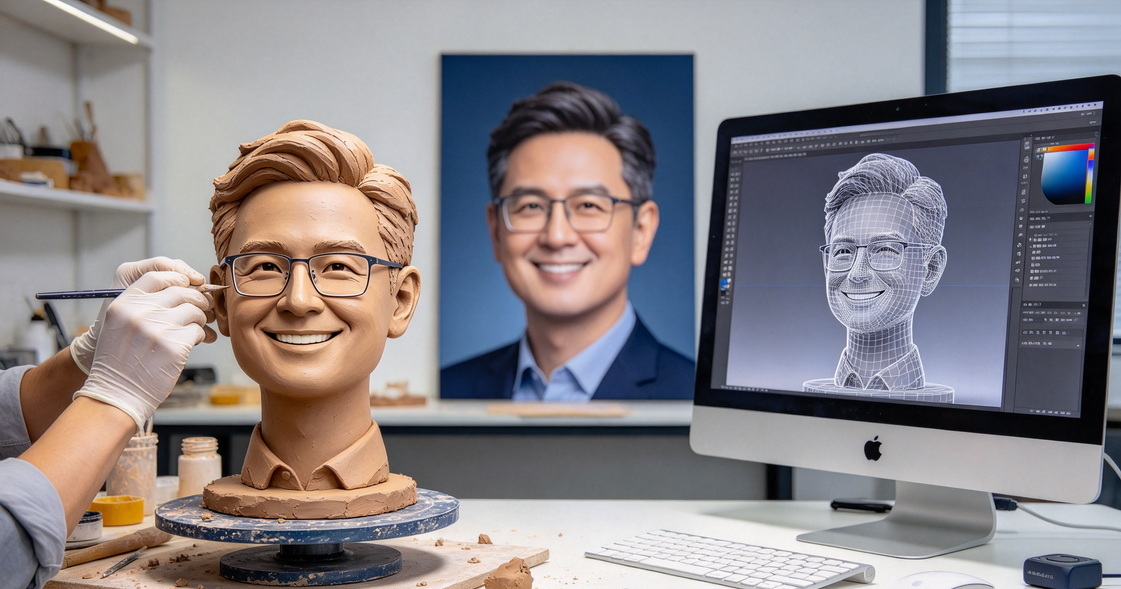
A handmade custom bobblehead usually begins with photographs interpreted by a sculptor. Depending on the production method, the artist may create a polymer clay figure or develop a master for subsequent molding and casting.
"AI-generated model" can describe two very different deliverables:
- A two-dimensional image showing what a bobblehead might look like.
- A three-dimensional model intended for editing, printing, or manufacturing.
A convincing image is not necessarily a complete, production-ready sculpture. Likewise, a printable file is not automatically an accurate portrait.
Many suppliers use hybrid workflows. They may combine automated modeling, manual digital sculpting, printed masters, casting, and hand painting. Buyers should therefore ask who controls facial interpretation and revisions rather than relying on the labels "handmade" or "AI."
| Comparison point | Artist-led handmade workflow | AI-generated workflow without substantial manual refinement |
|---|---|---|
| Facial interpretation | Artist selects and adjusts defining features | System infers features from supplied inputs |
| Unseen facial areas | Artist requests references or makes informed judgments | System must infer missing geometry |
| Expression | Can be adjusted through detailed instructions | May require regeneration or manual editing |
| Revisions | Targeted physical or sculptural adjustments | Depends on editing controls and operator skill |
| Preview | Can show the actual sculpture | May show only a rendering |
| Repeat production | Can use an approved master | Can reuse an approved digital file |
Neither column guarantees quality. Reference photographs, operator skill, and approval procedures influence both.
A recognizable portrait does not simply contain eyes, a nose, and a mouth. It preserves the relationships that distinguish one person from another.
Consider two figures with the same hairstyle and eye color. One may still look noticeably more accurate because its cheek width, eyebrow angle, and mouth position work together correctly.
Research on caricature and face recognition helps explain this. Carefully exaggerating distinctive features can sometimes improve recognition compared with an undistorted representation.
However, those findings do not prove that handmade bobbleheads outperform every automated model. They support a narrower principle: preserving identity can matter more than reproducing every visible detail.
A bobblehead deliberately changes human proportions. The enlarged head and smaller body already move the design away from literal realism.
The sculptor's challenge is deciding what to exaggerate and what to preserve.
A useful design brief might request:
- A slightly wider smile without changing its asymmetry.
- More prominent eyebrows without altering their angle.
- A larger head while retaining the original jaw shape.
- Simplified hair strands while preserving the hairline.
Too much exaggeration can weaken resemblance. The goal is a recognizable interpretation, not distortion for its own sake.
A front-facing photograph does not show the complete shape of the nose, ears, skull, or jaw.
Research on single-image three-dimensional reconstruction identifies this as an inherently ambiguous problem. Different three-dimensional shapes can produce similar two-dimensional images.
An automated model must therefore infer hidden surfaces. The result may appear convincing from the front but less accurate from the side.
Human sculptors face the same information gap. Their advantage is not magical access to missing information. It is the ability to recognize uncertainty, request another photograph, and discuss which interpretation matches the person.
Lighting, camera angle, and surface texture can make a rendering look persuasive. Yet those presentation choices may hide an overly narrow jaw or an inaccurate nose profile.
This risk is not exclusive to AI. Any supplier can photograph a figure from its most flattering angle.
For personalized bobbleheads from photos, request consistent front, three-quarter, and side views. Compare facial structure before judging presentation quality.
An attractive preview answers, "Does this look appealing?" A useful approval process also answers, "Does this look like the intended person?"
A smile involves more than the shape of the lips. Cheek volume, eyelid position, and the corners of the mouth contribute to the expression.
My advice to buyers is to replace broad instructions with observable details.
Instead of:
"Make it look happier."
Try:
"Keep the mouth closed, lift the corners slightly, and preserve the fuller cheeks shown in the reference."
Instead of:
"The face looks wrong."
Try:
"The lower face appears too narrow. Please compare the jaw width with the front-facing photograph."
These instructions help both physical sculptors and digital artists. The handmade advantage becomes strongest when the supplier provides direct, meaningful revision opportunities.
Glasses, hairstyles, uniforms, and signature accessories can make a personalized gift feel immediately familiar.
However, they should reinforce facial resemblance rather than disguise its absence.
For example, a retirement bobblehead with the correct work jacket may communicate the recipient's profession. It still needs an appropriate face shape and expression to feel genuinely personal.
A strong custom design combines identity, context, and craftsmanship.
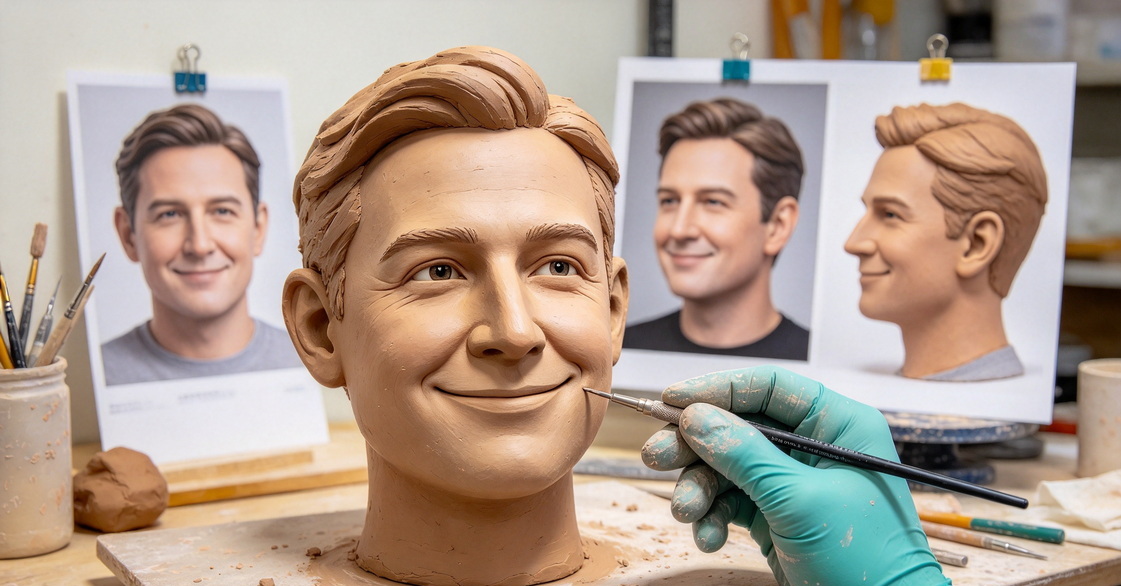
The following checklist is an editorial buying tool, not a scientifically validated scoring system. It gives customers a repeatable way to assess proofs.
Compare the head shape, forehead height, cheek width, chin, and hair outline.
Temporarily ignore paint details. If the underlying shape feels wrong, added eyelashes or skin shading will not resolve it.
Look at:
- Eye spacing relative to face width.
- Nose length relative to the lower face.
- Mouth width relative to the cheeks.
- Eyebrow height and angle.
- Chin projection in profile.
Avoid judging each feature in isolation. A reasonable-looking nose can still feel incorrect when positioned on the wrong facial proportions.
Identify three characteristics that friends or relatives would recognize.
These might include a crooked smile, pronounced dimples, or a distinctive beard outline. Confirm that the approved design preserves them.
Where available, request photographs of the actual sculpture or sample, not only a computer visualization.
Check whether paint, assembly, and final proportions still match the approved likeness. Keep revision requests together in one numbered message to reduce conflicting instructions.
Material influences the production route, but it does not independently determine portrait accuracy.
Polymer clay can support direct hand shaping and individual customization. Depending on the technique, color may be incorporated into the material, added through surface finishing, or combined.
For one-off personalized gifts, buyers should ask when shape and color changes remain possible. Do not assume unlimited revisions after curing or final assembly.
A polyresin production route can reproduce an approved master through molding and casting. This can suit projects requiring multiple copies of the same design.
However, reproducing a master consistently also reproduces its mistakes. Approving the original likeness is therefore especially important before batch production.
For either material, ask to see comparable finished work. Material names alone do not demonstrate sculpting skill, paint quality, or reliable quality control.
An AI-generated portrait model may contain details that look convincing on screen but need modification for physical production.
Three-dimensional printing guidelines show that minimum wall thickness, supported features, and small surface details depend on the printing process and material.
For a bobblehead, the production review should also consider:
- Whether glasses and accessories are sufficiently robust.
- Whether hair details remain visible at the intended size.
- Whether finishing changes fine facial features.
- Whether the head has suitable clearance for movement.
- Whether the assembled figure stands securely.
Handmade production has constraints too. Delicate features can still be vulnerable, and an attractive sculpture still requires appropriate assembly.
The practical advantage belongs to a workflow that checks both resemblance and manufacturability before delivery.
AI can be useful for exploring outfits, poses, gift themes, and preliminary visual directions.
An AI-assisted workflow may be appropriate when:
- You need several concept options before selecting a design.
- A skilled artist will refine the generated model.
- The supplier provides multi-angle physical proofs.
- You value repeatable digital assets for future orders.
A hybrid process can combine speed with artistic control. Automated tools may establish an initial form, while a sculptor corrects identity-bearing features and prepares the design for manufacture.
The important question is not, "Was AI involved?" It is, "Who takes responsibility for the final resemblance?"
Without an independent, controlled comparison, claims that handmade figures achieve a particular percentage improvement should be treated cautiously.
Corporate gifts and retail programs require more than one attractive sample.
First, distinguish between two order types:
1. Multiple copies of one person or character.
2. Multiple individually personalized recipients.
The first requires consistency against an approved master. The second also requires accurate matching of photographs, names, designs, and approvals.
Before placing a wholesale custom bobblehead order, confirm:
- Which components are individually customized.
- Whether the quotation includes proofing and revisions.
- When additional revision charges apply.
- Whether approval covers sculpture, color, or both.
- How recipient information is matched to each figure.
- Whether a physical preproduction sample is available.
- How packaging and delivery requirements affect scheduling.
Keep written approval records. Do not assume another supplier's published revision policy applies to your order.
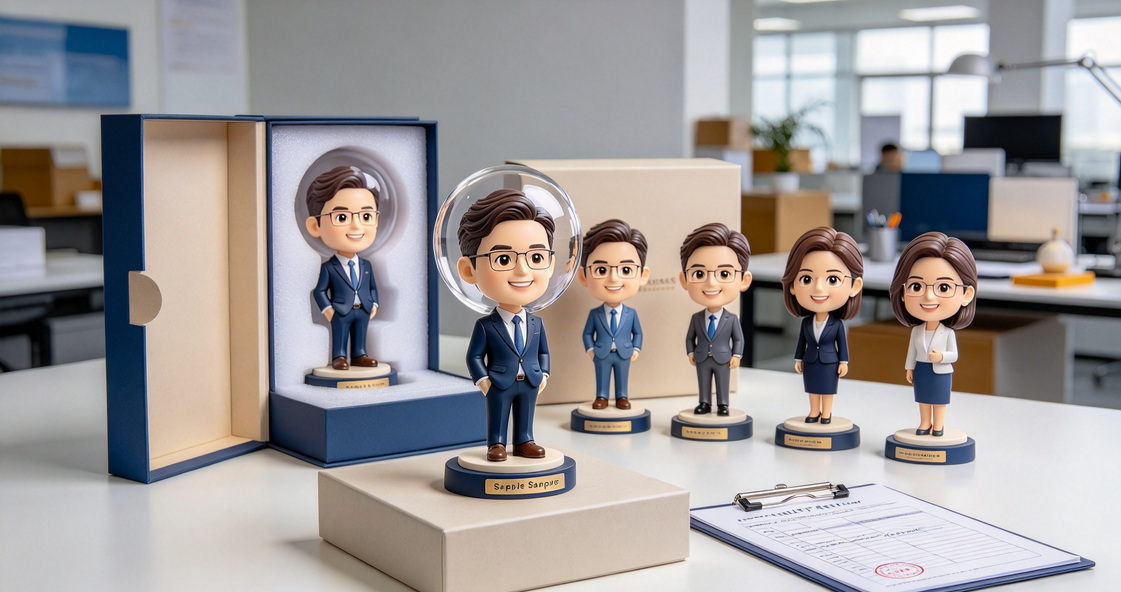
Handmade custom bobbleheads are most compelling when artistic interpretation is supported by clear references, targeted revisions, and inspection of the finished piece.
Top Arts & Crafts Co., Ltd. supplies personalized bobbleheads and custom gifts to customers worldwide, including wholesale buyers. To discuss a project, send your reference photographs, preferred style, quantity, accessories, and required delivery date.
No. Accuracy depends on the sculptor's skill, reference quality, and revision process. A carefully refined digital model can outperform a weak handmade sculpture. Compare actual finished examples rather than choosing solely by production label.
It can provide a starting point, but additional views reduce uncertainty. Submit a clear front view, a three-quarter view, and a profile when possible. Identify the primary reference if photographs show different ages, hairstyles, or expressions.
Not necessarily. A generated image may be only a visual concept. Manufacturing requires suitable three-dimensional geometry and a production review. Ask whether the quotation includes modeling, manual refinement, physical production, finishing, and assembly.
Neither material automatically produces a better resemblance. Polymer clay can support direct individual sculpting, while polyresin can reproduce an approved master. Evaluate the artist's work, proofing arrangements, and finished sample.
Review head shape, facial proportions, expression, hairstyle, and distinguishing features. Check multiple angles and confirm whether you are approving a rendering, an unfinished sculpture, or the completed figure.
1. ["Caricature and Face Recognition." PubMed record.] Research on distinctive-feature exaggeration and recognition; relevant to the discussion of controlled caricature. [pubmed.ncbi.nlm.nih]
2. ["The Reverse-Caricature Effect Revisited: Familiarization With Frontal Caricatures Improves Veridical Face Recognition." PubMed Central.] Research examining how caricature familiarization can influence subsequent face recognition. [pmc.ncbi.nlm.nih]
3. ["Shape-Pose Ambiguity in Learning 3D Reconstruction from Images." Proceedings of the AAAI Conference on Artificial Intelligence.] Technical explanation of shape-pose ambiguity in image-supervised reconstruction. [ojs.aaai]
4. ["Three-Dimensional Reconstruction from a Single RGB Image Using Deep Learning: A Review." Journal of Imaging, 2022; hosted by DFKI.] Review discussing single-view reconstruction and the difficulty of inferring invisible surfaces. [dfki]
5. ["Minimum Wall Thickness for 3D Printing." Formlabs.] Manufacturing guidance showing how feature requirements vary across printing processes. [formlabs]
6. ["Understanding Proofs and the Production Process." Webobble.] A supplier-specific example of head, body, and completed proofs, written approvals, and revision limitations—not a statement of Top Arts & Crafts Co., Ltd.'s policies. [webobble]


