
Views: 237 Author: Mia Publish Time: 2026-10-21 Origin: Site
Content Menu
● What Makes a Painting or Facial Detail a Defect?
>> A Departure From the Agreed Product
● Small Painting Differences: Acceptable Variation or Quality Problem?
>> Cosmetic Appearance and Coating Durability Are Separate Issues
● When Small Facial Differences Affect Custom Bobblehead Likeness
>> Identity-Bearing Details Deserve Special Attention
>> Sculpting Errors Cannot Always Be Fixed With Paint
● How Approved Proofs Should Be Used in a Quality Dispute
>> Match the Complaint to the Approval Stage
>> Approval Does Not Automatically Resolve Every Later Issue
● A Fair Inspection Method for Painting and Facial Details
>> Step 1: Establish the Correct Reference
>> Step 2: Compare Under Similar Lighting
>> Step 3: Review Normal Viewing and Close-Up Detail
>> Step 4: Document Each Issue Separately
>> Step 5: Avoid Altering the Figure Before Review
● An Overlooked Issue: "Minor" Does Not Always Mean Unimportant
● Define Variation Before Production
>> Create a Visual Acceptance Sheet
>> Separate Per-Item Standards From Batch Sampling
● What Remedy Is Reasonable for a Custom Bobblehead Defect?
● A Clearer Way to Resolve Your Concern
>> 1. Can a Slightly Different Skin Tone Be Considered a Defect?
>> 2. Does "Handmade" Mean I Must Accept Uneven Eyes?
>> 3. What If I Approved the Proof but Notice a Problem Later?
>> 4. Can a Personalized Item Be Returned If It Is Faulty?
>> 5. Is a Small Paint Chip Cosmetic or Structural?
Can Small Differences in Painting or Facial Details Be Considered a Defect? Yes—small differences in painting or facial details can be considered a defect when they meaningfully depart from the agreed design, approved sample, product description, or expected function. However, not every visible difference in a handmade custom bobblehead indicates poor workmanship.
A slightly different brushstroke may be acceptable. The wrong eye color, a missing signature mole, or paint covering part of an eye may require correction. The distinction depends on conformity: whether the delivered figure meets the requirements agreed for that order.
For buyers of personalized bobbleheads, this question is especially important because facial details carry emotional value. For wholesale customers, small inconsistencies can also become a repeated production problem.
At Top Arts & Crafts Co., Ltd., a Chinese manufacturer and retailer of personalized polyresin and polymer clay gifts, our recommendation is to evaluate differences against clear references rather than relying on either "handmade variation" or "it looks different" as the complete explanation.

A defect is not determined by size alone. A tiny error can be important if it affects identity, an agreed customization, durability, or function.
Consider three questions:
1. What was promised?
2. What was approved?
3. What changed in the delivered product?
A slightly uneven paint edge beneath a shoe is different from a misplaced pupil that changes the expression. Both are small, but their consequences differ.
The applicable purchase terms and local law also matter. An individual consumer purchase and an international wholesale contract may have different remedies and procedures.
Hand-shaped and hand-painted figures may show slight differences in shading, surface texture, or brushwork.
Such differences may be acceptable when they remain within an agreed appearance standard and do not undermine the design.
However, "handmade" should describe the production method—not excuse every inconsistency.
A difference becomes more concerning when it contradicts an explicit requirement.
Examples include brown eyes instead of blue, an omitted beard, the wrong jersey number, or an open-mouth smile where the approved design clearly showed closed lips.
These are not simply matters of personal taste when the requested details are documented.
The following examples provide a purchasing framework, not universal inspection tolerances.
| Observed difference | Potentially acceptable variation | Reason to request investigation |
|---|---|---|
| Hair shading | Slight tonal variation within the approved color | Clearly different hair color |
| Clothing paint | Minor brush texture visible only close up | Missing color section or incorrect design |
| Eyebrows | Small brushstroke variation preserving expression | Unequal placement that changes expression |
| Skin tone | Apparent difference caused by lighting | Persistent mismatch under comparable conditions |
| Surface finish | Subtle handmade texture consistent with the sample | Peeling, flaking, or exposed unintended areas |
| Personal markings | Slight variation within an agreed interpretation | Missing or misplaced requested identifying feature |
The most useful question is not, "Can I find any difference?" It is, "Does this difference prevent the figure from matching what we agreed?"
A color mismatch is an appearance concern. Paint that flakes during ordinary handling raises a different question about coating performance.
Do not combine the two into one vague complaint.
Describe whether the problem concerns color, coverage, adhesion, scratches, or surface contamination. Each may require a different investigation and remedy.
Facial likeness is not just a collection of individual features. Their positioning and relationships matter.
A figure can have the correct hairstyle, eye color, and glasses yet still feel inaccurate because the jaw is too narrow or the mouth is positioned too low.
Some details contribute more strongly to recognition than others.
For a particular person, these may include:
- A distinctive hairline.
- An asymmetrical smile.
- Heavy or sharply angled eyebrows.
- A beard outline.
- A prominent chin.
- A requested mole or scar.
Buyers should identify these priorities before sculpting begins.
My practical recommendation is to list three "must-preserve" characteristics in the design brief. This gives the artist a clearer target than "make it realistic."
Paint can define eyebrows, suggest hair depth, and refine an expression. It cannot reliably compensate for every structural problem.
If the cheeks are too narrow or the chin projects too far, additional shading may disguise the issue from one angle without correcting the sculpture.
Check facial proportions at the sculpting stage whenever the agreed process allows it. Reserve painted-proof review for color, surface detail, and the combined final impression.
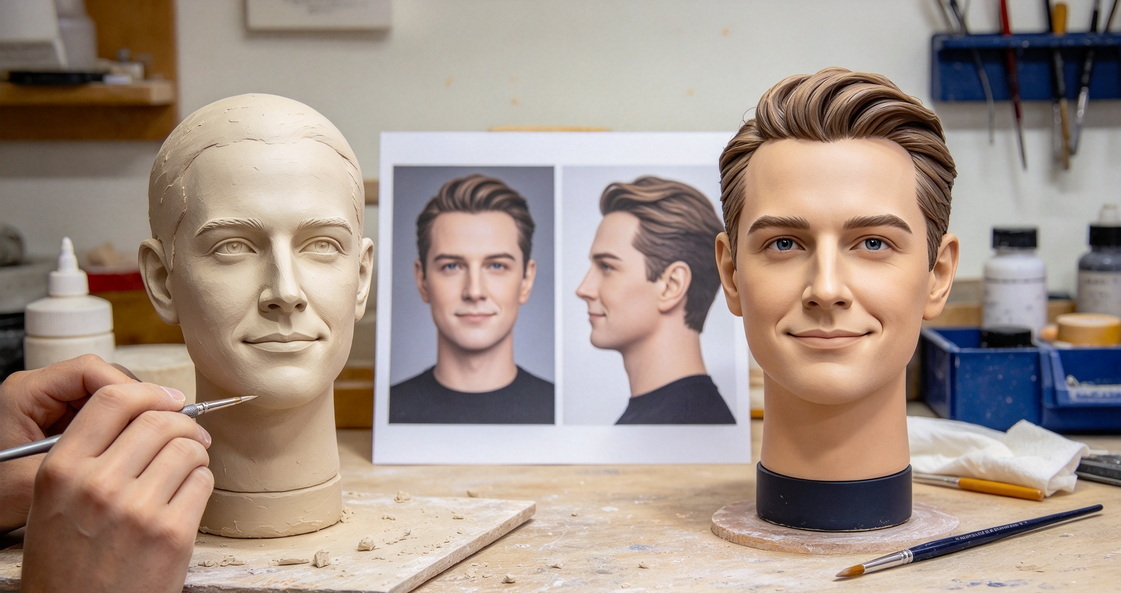
An approved proof provides important evidence, but its scope must be understood.
A customer may approve an unfinished head, a painted figure, a digital rendering, or a photograph of a physical sample. These are different approval stages.
A clay proof can show facial shape but not final skin tone.
A front-view photograph can show expression but may not reveal the nose profile.
A digital rendering can establish design direction without demonstrating the actual surface finish of the manufactured object.
Before approval, ask what remains adjustable and what that approval authorizes.
If the delivered figure differs from the approved painted sample, the approval record helps demonstrate the discrepancy.
Equally, approving a feature clearly visible in the proof can complicate a later request to change that same feature.
Neither situation should be reduced to an automatic rule. Applicable law, the agreement, what was visible, and subsequent production changes all matter.
A proof approval does not automatically waive mandatory rights relating to faults or nonconformity.
A repeatable inspection method reduces disagreements caused by inconsistent photographs or viewing conditions.
Collect the order specification, primary reference photograph, approved proofs, and written change requests.
Identify the latest agreed version. Comparing the finished figure with an earlier rejected draft can create confusion.
View the figure and reference under consistent, neutral lighting where possible.
Color specialists explain that lighting can significantly change appearance. Two physical samples may match under one light source but differ under another—a phenomenon called metamerism.
A camera or screen can introduce additional differences. Therefore, a photograph alone may not establish the exact physical color.
For color-critical wholesale orders, agree on a physical color reference and viewing conditions before production.
Start with the complete figure at the intended display distance. Then inspect important details closely.
This does not mean close-up defects should be ignored. It separates issues that affect the overall presentation from details visible only under magnification.
Agree on inspection conditions rather than inventing a viewing distance after a complaint.
Use one numbered item per concern:
"The approved proof shows dark brown eyebrows. The delivered eyebrows appear black under neutral lighting. Please review the attached comparison."
This is more actionable than "the painting is bad."
Do not repaint, sand, or apply solvents before contacting the seller. Alteration can complicate assessment and may affect the finish.
Keep packaging if transport damage may be involved.
In production inspection, "minor" can be a technical classification. In everyday conversation, it often means physically small.
Those meanings are not interchangeable.
A tiny misspelling on a retirement gift may undermine its purpose. A small paint mark under the base may have little effect on presentation.
The useful assessment combines:
- Visibility.
- Location.
- Effect on identity or meaning.
- Departure from the specification.
- Effect on durability or function.
This is why no responsible supplier should apply one blanket rule to every small difference.
For personalized products, the significance of a detail can exceed its physical dimensions.
Wholesale buyers need an agreed acceptance standard, not only an attractive sample.
Specify which characteristics are critical to the project and which allow reasonable variation.
A practical sheet can include:
- Approved front, side, and three-quarter views.
- Required eye, hair, clothing, and base colors.
- Names, numbers, and personalized markings.
- Examples of acceptable brush texture.
- Examples of unacceptable paint overflow.
- Requirements for spring movement and stability.
- Packaging and recipient-identification rules.
For repeated copies, retain a production-representative reference sample.
For individually personalized orders, check recipient-to-photo mapping separately. A well-made figure assigned to the wrong person is still an order problem.
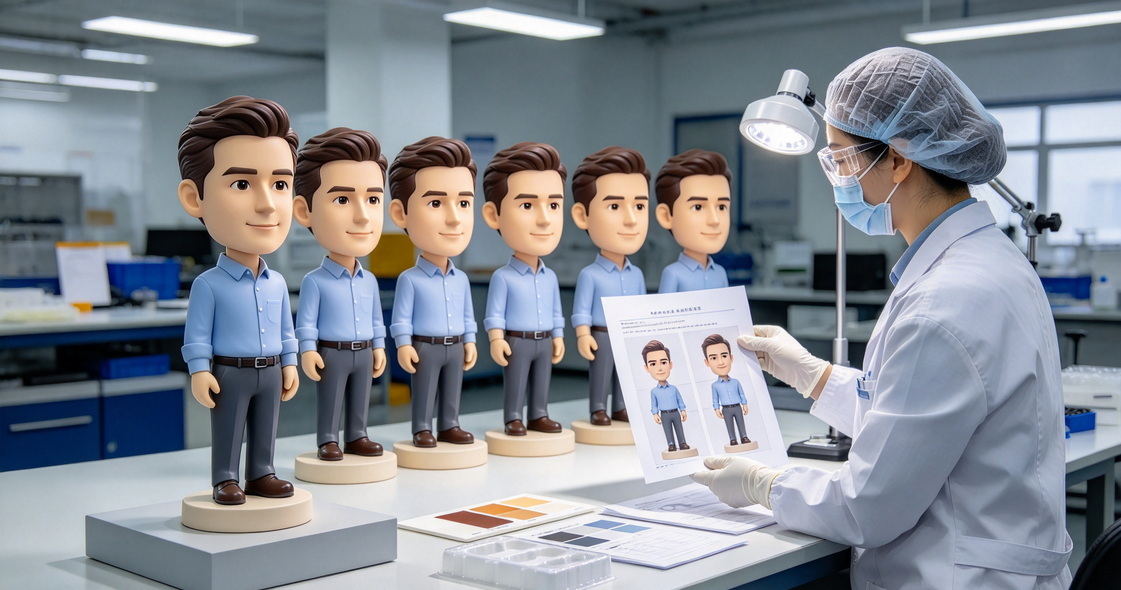
If a sampling plan is used, define its scope and acceptance rules in the contract.
A batch sampling arrangement is not the same as permission to knowingly ship incorrect personalized details. Names, recipient identity, and other designated requirements may need separate checking.
Also consider cumulative inconsistency. Several slight variations across brows, eyes, and mouth can create a noticeable change in expression even when each seems small in isolation.
Possible responses include clarification, repair, repainting, replacement, a price adjustment, or a refund where applicable.
The appropriate outcome depends on the issue and governing terms.
A localized paint problem may be repairable. A materially incorrect face may require a new head. The wrong recipient or an incorrect personalized inscription may require replacement of the affected component or figure.
For EU consumer purchases, official guidance distinguishes faulty goods from change-of-mind returns. Clearly personalized goods may be excluded from the usual withdrawal right, but that does not eliminate protection for faulty or nonconforming goods.
Repair or replacement generally comes before a price reduction or refund under the applicable framework, subject to the circumstances.
These consumer rules should not be assumed to govern every international business-to-business order.
Small differences in painting or facial details should be assessed fairly—not automatically dismissed and not automatically treated as grounds for a full remake.
For a Top Arts & Crafts Co., Ltd. order, send your order number, approved proof, and clear front, side, and close-up photographs. Identify each difference and explain which agreed requirement it affects.
Potentially. First compare under similar lighting and account for camera and screen differences. A persistent departure from an agreed physical reference is more meaningful than a mismatch between unrelated photographs.
No. Handmade production may allow reasonable variation, but it does not automatically excuse misplaced features. Assess whether the difference changes the expression or departs from the approved design.
Explain whether the issue was visible in the approved proof or appeared afterward. Provide the approval record and delivery photographs. Approval is relevant evidence, but its effect depends on the issue, agreement, and applicable law.
Possibly, depending on applicable law and circumstances. A restriction on change-of-mind returns is not the same as a restriction on remedies for faulty goods. Contact the seller and describe the nonconformity.
It may be cosmetic, but its cause matters. Determine whether it resulted from transport impact, handling, or poor coating adhesion. Photograph the chip, surrounding surface, and packaging before attempting repairs.
1. [European Union, Your Europe — Consumer Guarantees, Warranties, Claims and Returns]. Official guidance on conformity with descriptions and models, fitness for purpose, and remedies for consumer goods. [europa]
2. [European Union, Your Europe — Guarantees on Goods Bought in the EU]. Official consumer guidance on faulty goods, repair, replacement, and circumstances supporting price reductions or refunds. [europa]
3. [European Union, Your Europe — Returns and the Right of Withdrawal]. Explanation of withdrawal rights and exceptions for made-to-order or clearly personalized goods. [europa]
4. [European Consumer Centre France — Right of Withdrawal]. Explains the distinction between withdrawing from a purchase and invoking the legal guarantee for faulty goods. [europe-consommateurs]
5. [X-Rite — Lighting and Visual Evaluation]. Technical explanation of lighting's influence on visual color assessment. [xrite]
6. [X-Rite — What Is Metamerism?]. Explains why two physical colors may match under one illuminant and differ under another. [xrite]


