
Views: 214 Author: Mia Publish Time: 2026-10-23 Origin: Site
Content Menu
● Custom Bobblehead Doll vs Factory Molded Figurines at a Glance
● What Is a Custom Bobblehead Doll?
>> Full Customization vs a Personalized Head
● What Are Factory Molded Figurines?
>> Resin Casting in Flexible Molds
>> Injection Molded Plastic Figurines
● Personal Likeness and Design Freedom
>> Where Factory Molded Figurines Perform Better
● Materials, Finish, and Durability
>> Polyresin and Cast Resin Figurines
● Price Comparison: Look Beyond the Unit Quote
>> A Useful Break-Even Calculation
● Production Time, Revisions, and Repeat Orders
>> Custom Bobblehead Approval Risks
>> Molded Figurine Approval Risks
● Quality Control Needs Two Different Checklists
>> Custom Bobblehead Doll Checklist
>> Factory Molded Figurine Checklist
● A Hybrid Approach Can Offer Better Value
>> Check That the Savings Are Real
● Three Illustrative Buying Scenarios
>> A One-Person Retirement Gift
>> A Multi-Recipient Corporate Program
● How to Request a Comparable Wholesale Quotation
>> 1. Can a custom bobblehead also be factory molded?
>> 2. Are factory molded figurines always cheaper?
>> 3. Which option produces a better likeness?
>> 4. Is polymer clay better than resin?
>> 5. Can I change the design after approving it?
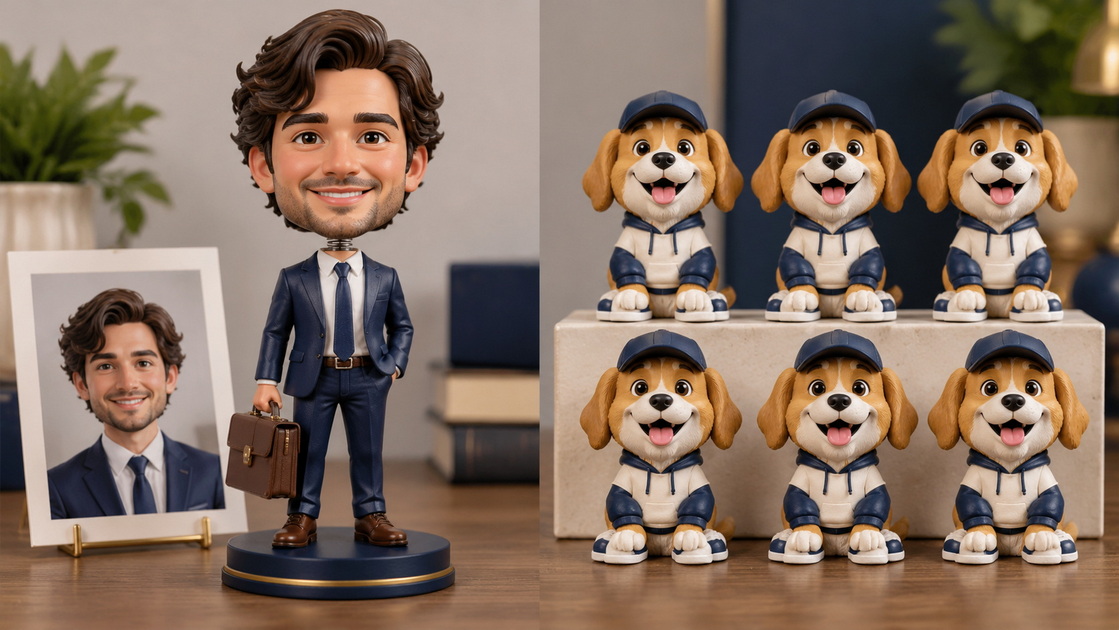
A custom bobblehead doll is usually the better choice when individual likeness and personal meaning drive the purchase. Factory molded figurines often make more sense when buyers need a repeatable design across a production run. However, these categories overlap: a custom bobblehead can also use molded components.
The useful comparison is therefore not "handmade versus factory made." It is personalization versus repeatability—and how much of each your project needs.
At Top Arts & Crafts Co., Ltd., we manufacture and export personalized bobbleheads, polyresin crafts, and polymer clay gifts for individual and wholesale customers. Our perspective is straightforward: choose the production approach around the recipient, design, quantity, and delivery requirements—not around a label that sounds more premium.
| Buying consideration | Custom bobblehead doll | Factory molded figurines |
|---|---|---|
| Primary purpose | Represent a person or personalized character | Reproduce an approved design consistently |
| Facial customization | Can be developed from individual references | Usually follows the shared master sculpt |
| Movement | Includes a bobbling head mechanism | May be static or incorporate moving components |
| Production method | May combine sculpting, casting, and assembly | Uses molds; casting and injection molding differ |
| Upfront development | Depends on customization and tooling needs | Depends heavily on the chosen molding process |
| Repeat orders | Requires retained design and recipient records | Benefits from retained masters, molds, and specifications |
| Typical applications | Retirement gifts, weddings, recognition | Mascot merchandise, souvenirs, promotional collections |
| Main approval priority | Likeness and recipient-specific details | Master design and production consistency |
Neither option automatically delivers better quality. Design execution, materials, finishing, assembly, and packaging all affect the result.
A custom bobblehead doll is a personalized figurine with a head mounted to allow movement, commonly through a spring connection. The design may represent an individual, couple, employee, athlete, or original mascot.
Customization can include:
- Facial features and hairstyle.
- Clothing and footwear.
- Pose and hand position.
- Tools, instruments, or sports accessories.
- Base lettering.
- Packaging presentation.
However, "custom" does not always mean every component is individually sculpted. Some products combine a personalized head with a standard body. Others require an entirely original figure.
For a retirement gift featuring a distinctive uniform and workplace equipment, a fully customized design may be appropriate.
For a large employee recognition program, a shared body with individually personalized heads may offer a practical compromise.
Ask the manufacturer which elements are unique, which are standardized, and which changes affect pricing. This distinction matters more than whether the product description simply says "handmade."
Factory molded figurines reproduce a design using a mold. However, the term covers different production systems.
A sculpted or digitally produced master can be used to create a flexible mold. Suitable liquid casting resin is introduced into that mold and allowed to cure.
After demolding, parts may require trimming, surface preparation, painting, and assembly.
This process can reproduce a custom design. It should not be confused with selling an existing stock figurine.
Injection molding forms parts by injecting material into tooling. Tool design, part geometry, material selection, and production quantity influence its economics.
The upfront tooling investment is distributed across the number of parts produced. Increasing quantity can reduce the tooling cost allocated to each unit, although painting, assembly, and packaging costs remain.
Consequently, factory molded figurines are not necessarily fully automated or free of hand finishing.
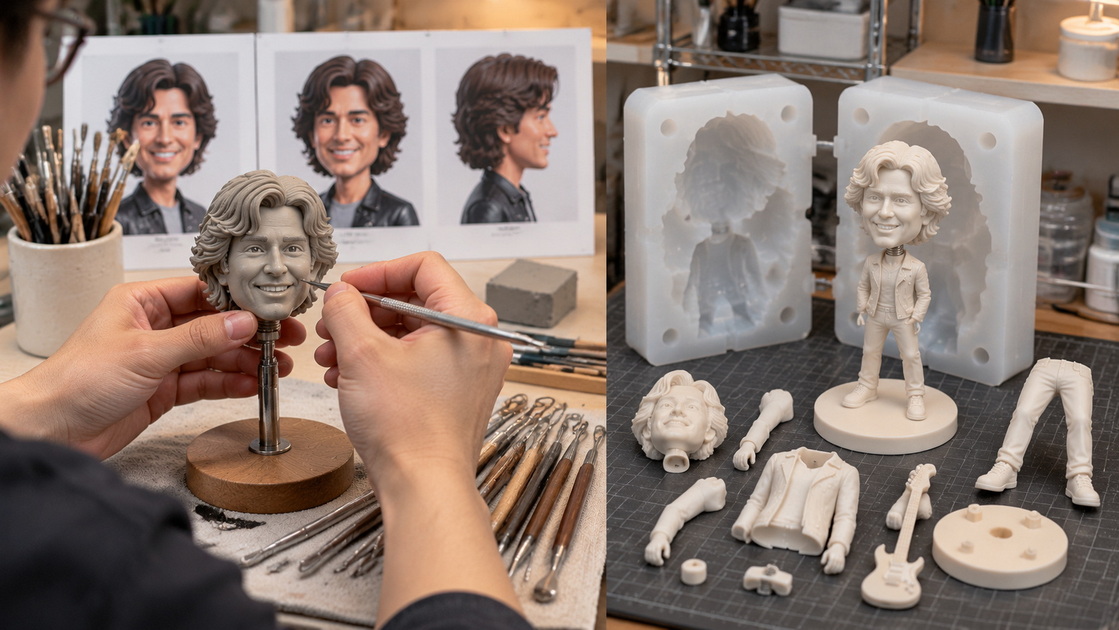
A personalized bobblehead from photos is designed around a specific person. Its success depends on whether the recipient recognizes the intended likeness—not merely whether the figure looks attractive.
Useful reference images should show:
1. A clear front-facing view.
2. A three-quarter angle.
3. The hairstyle and hairline.
4. The intended expression.
5. Important clothing or accessories.
Conflicting photographs create avoidable uncertainty. If one image shows glasses and another does not, specify the preferred appearance.
Molded production is useful when the approved character should remain consistent across an order.
Examples include a company mascot, museum souvenir, or original collectible series. Here, variation between figures may be undesirable rather than charming.
The distinction is simple: personalized projects prioritize an individual identity; repeat-design projects prioritize fidelity to a shared master.
Material names alone do not determine whether a figure will survive everyday handling.
Thin ankles, extended fingers, narrow accessories, weak connections, and unsupported projections can become vulnerable points regardless of the headline material.
Polymer clay allows a maker to shape individual features before curing. Correct preparation and curing matter, and instructions vary by product and thickness.
For buyers, the practical questions concern the finished construction: how delicate components are supported, how the head is attached, and how the item will be packaged.
"Resin" is a broad description, not a complete specification. Casting systems can use different chemistries and formulations.
Request the proposed material, finished weight, surface treatment, and handling guidance. Do not assume every resin figure has identical impact resistance.
Injection molding offers a range of material choices, but performance still depends on the selected material and geometry.
A flexible accessory and a rigid display base may require different design decisions. Ask for a sample rather than accepting "plastic is stronger" as a universal rule.
A custom bobblehead doll and a factory molded figurine can have very different cost structures.
For an individually personalized item, recurring sculpting and approval work may be significant. For a repeated molded design, upfront development and tooling may represent a larger share of the initial order.
Compare these items separately:
- Design and sculpting.
- Master preparation and tooling.
- Per-unit production.
- Painting and assembly.
- Personalization.
- Protective packaging.
- Inspection.
- Freight and applicable import charges.
Suppose two manufacturing routes can deliver an acceptable version of the same product.
The approximate break-even quantity is:
Here, \(F\) represents fixed development costs and \(V\) represents variable cost per unit. The calculation applies when route two has higher fixed costs but lower variable costs.
This is a planning model, not a quotation. It only helps when specifications are comparable and the variable costs remain reasonably stable.
Do not compare a basic unpainted figure with a fully personalized, individually boxed bobblehead and treat the price difference as manufacturing inefficiency.
Lead time includes more than fabrication.
A realistic schedule covers reference collection, design review, revisions, material preparation, production, finishing, inspection, packing, and transport.
Recipient-specific projects can slow down when photographs arrive late or several stakeholders give conflicting instructions.
Assign one decision-maker and submit consolidated feedback. Identify changes precisely: "reduce the smile width" is more actionable than "make it look better."
For repeat-design production, approve the master before committing to tooling or a wider run.
Changes to geometry after tooling may require modification or replacement, depending on the process. Color changes may be less disruptive, but should still be confirmed with the manufacturer.
For reorders, clarify mold storage, maintenance, replacement responsibility, and whether the same material and finishing specification will remain available.
A well-painted figure can still be wrong for its recipient. A recognizable likeness can still have a poorly assembled bobble mechanism.
Treat appearance and construction as separate approval areas.
- Does the face match the approved interpretation?
- Are hairstyle, clothing, and accessories correct?
- Is the base wording accurate?
- Does the head move without striking surrounding parts?
- Does the figure stand securely?
- Does the packaging protect vulnerable features?
- Does the figure match the approved master?
- Are seams, flash, voids, and surface defects acceptable?
- Are colors and decoration aligned?
- Are attached parts secure?
- Is the base stable?
- Does the packaging match the approved configuration?
Document acceptance criteria with photographs and written descriptions. For wholesale orders, agree on the inspection approach and defect remedies before production.
The choice is not always fully individual sculpting or one identical molded figure.
A hybrid project can use a shared body, base, or accessory set while personalizing selected elements.
For example, an employee recognition program might use a common uniform and pose with different heads and names. An original mascot collection might retain one body while changing an approved accessory.
A hybrid design can reduce duplicated development work, but it introduces coordination requirements.
The supplier must match the correct head, body, wording, and packaging to each recipient. An order spreadsheet should therefore use unique identifiers rather than relying only on names.
This approach is valuable when modular design genuinely supports the brief—not when it compromises the feature recipients care about most.
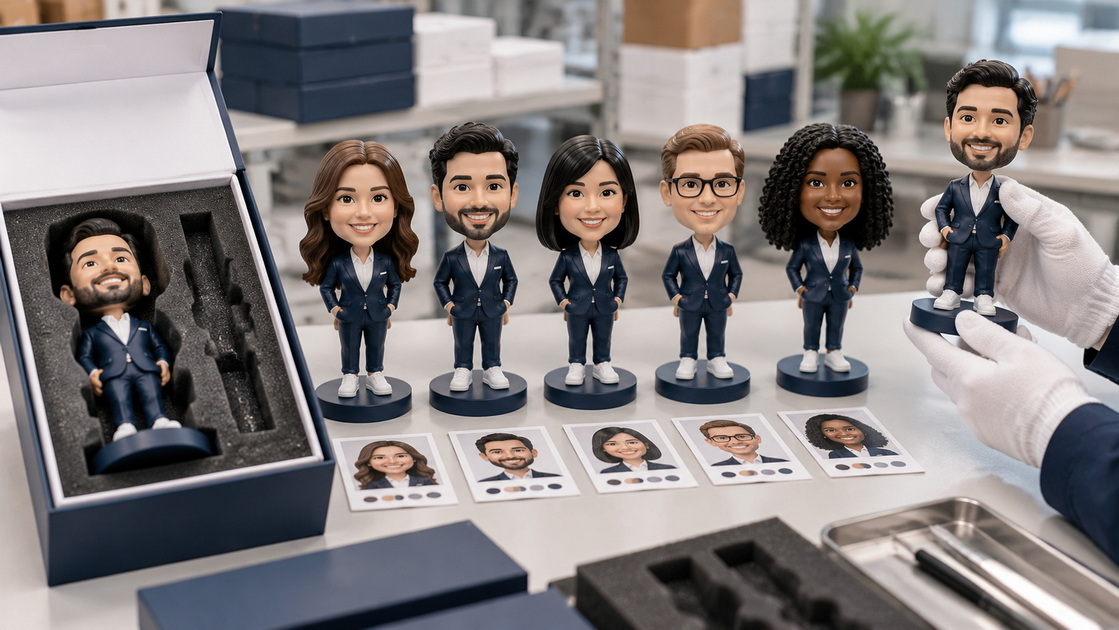
These examples explain selection logic; they are not reported customer case studies.
Choose a custom bobblehead when likeness, occupation, and personal accessories carry the message.
Spend approval time on the face and meaningful details rather than adding unnecessary decorative complexity.
Consider molded production when many buyers will receive the same approved character.
Prioritize a strong master, repeatable finishing, packaging efficiency, and a clear reorder arrangement.
Evaluate a hybrid route when recipients share a uniform or event theme but need individual identities.
Plan recipient tracking, consolidated approvals, and final matching checks as carefully as the physical production.
Send the same specification to each shortlisted supplier.
Include:
1. Intended use and destination market.
2. Quantity and number of unique designs.
3. Approximate dimensions.
4. Reference artwork or photographs.
5. Required personalization.
6. Proposed materials, if known.
7. Packaging expectations.
8. Delivery deadline.
9. Sample and revision requirements.
Also clarify permission to use photographs, likenesses, logos, and character artwork. Manufacturing capability does not establish permission to reproduce protected material.
Avoid broad environmental claims without supporting evidence. A fair comparison should consider material, product weight, packaging, rejected units, transport, and expected use—not simply "handmade" versus "factory made."
A custom bobblehead doll is a strong fit when the gift must represent a particular person. Factory molded figurines are often appropriate when a shared design must be reproduced consistently.
Neither route eliminates the need for clear specifications, meaningful approvals, and protective packaging.
Yes. Personalized products can include molded bodies, bases, or accessories. Customization describes the design requirements, not one exclusive manufacturing process.
No. Tooling, quantity, geometry, finishing, and packaging affect cost. Compare complete quotations for equivalent specifications.
An individually developed head offers more opportunity to interpret a specific person. Results still depend on references, sculpting decisions, and approval quality.
Neither is universally better. Select the material around customization, geometry, quantity, finish, and handling requirements.
Possibly, but timing matters. Changes after curing, tooling, painting, or assembly may require additional work or a remake. Confirm revision terms beforehand.
1. Protolabs. [Understanding Injection Mold Cost for Parts and Tooling]. Supports the discussion of tooling investment, geometry, production quantity, and amortized cost per part. Its company-specific figures are not presented as bobblehead industry averages. [protolabs]
2. Protolabs. [Injection Molding Services for Custom Parts]. Background on injection molding, tooling, material selection, and the relationship between production volume and economics. [protolabs]
3. Smooth-On. [Mold Making and Casting Products by Category]. Supports the distinction between flexible mold materials and casting resins, including urethane, epoxy, and polyester systems. These systems are not treated as chemically interchangeable. [smooth-on]
4. Smooth-On. [Moldmaking and Casting for a Woodgrain Finish]. Demonstrates reproducing a master's surface details using a silicone mold and cast resin. Used as process background, not a figurine performance benchmark. [smooth-on]
5. Sculpey. [How to Bake Polymer Clay]. Supports following product-specific curing instructions and accounting for thickness and temperature. [sculpey]
6. Sculpey. [How to Get Started With Polymer Clay]. Background on conditioning, shaping, and curing polymer clay. [sculpey]


