
Views: 277 Author: Mia Publish Time: 2026-10-03 Origin: Site
Content Menu
● Personalized Figurine from Photo vs 3D Printed Figurine
● What Is a Personalized Figurine from Photo?
>> Why Handmade Interpretation Matters
● What Is a 3D Printed Figurine?
>> The Strength of Digital Repeatability
● Artistic Likeness vs Digital Geometry
>> Personalized Figurine from Photo Is Better When:
>> 3D Printed Figurine Is Better When:
● Why the Surface Changes Buyer Perception
>> Resin and Polyresin Figurines
● Production Workflow Comparison
>> Personalized Figurine from Photo Workflow
>> 3D Printed Figurine Workflow
● Cost, Quantity, and Lead-Time Considerations
● Expert Buying Checklist for Custom Figurines
>> 1. What Style Will You Receive?
>> 2. What Photos Are Required?
>> 4. How Will the Figurine Be Protected?
>> 5. Is It a Decorative Gift or a Children's Toy?
● Why Work With Top Arts & Crafts Co., Ltd.
>> 1. Is a personalized figurine from photo the same as a 3D printed figurine?
>> 2. Which option creates a better face likeness?
>> 3. Are 3D printed figurines always cheaper?
>> 4. What photos should customers submit for a custom bobblehead?
>> 5. Are polymer clay and resin figurines durable?
A personalized figurine from photo and a 3D printed figurine can both turn a meaningful image into a memorable keepsake. However, they are not the same type of product. The biggest difference is not simply the material—it is the balance between handmade character, facial interpretation, surface finish, production scalability, and customer expectations.
For retailers, gift brands, corporate buyers, wedding planners, and wholesale distributors, choosing the right option affects product positioning, price, production workflow, and customer satisfaction. At Top Arts & Crafts Co., Ltd., we manufacture customized resin crafts and polymer clay bobblehead gifts for global wholesale and private-label customers. From production experience, the best choice depends on whether the buyer values artistic warmth and emotional likeness or digital precision and repeatable geometry.
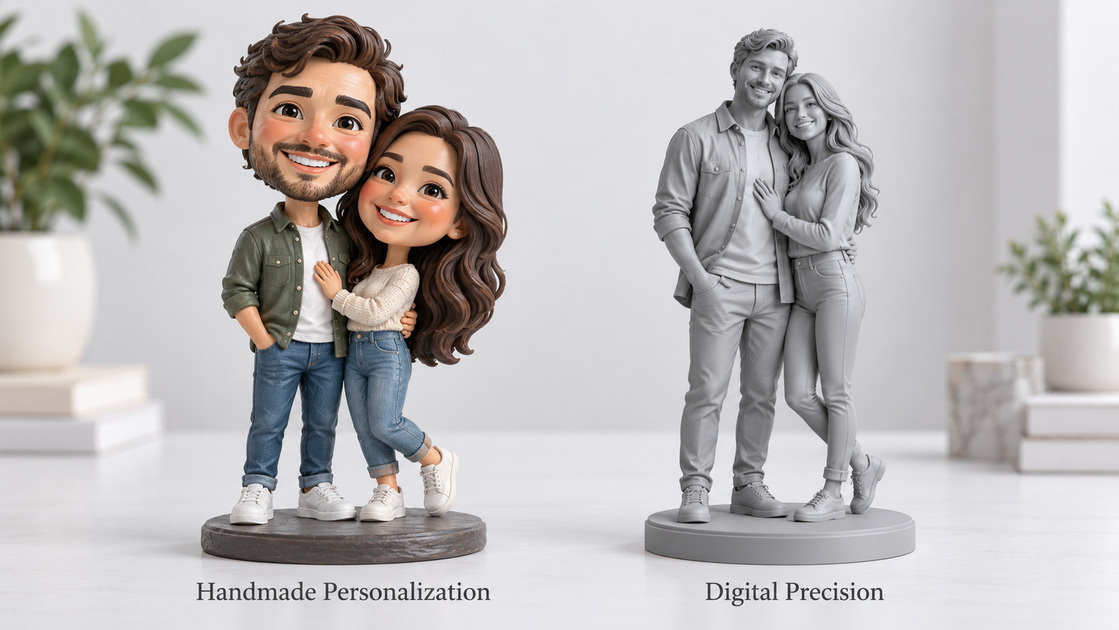
| Comparison Factor | Personalized Figurine from Photo | 3D Printed Figurine |
|---|---|---|
| Main production method | Hand sculpting, molding, casting, hand painting, or polymer clay craftsmanship | Digital 3D modeling, slicing, printing, cleaning, curing, sanding, and finishing |
| Best for | Bobbleheads, anniversary gifts, wedding cake toppers, corporate gifts, family keepsakes | Miniatures, game characters, technical prototypes, repeatable collectible models |
| Facial expression | Highly adaptable and artistically interpreted | Can be accurate but depends heavily on digital modeling and source files |
| Handmade feeling | Strong | Usually lower unless hand-painted or hand-finished |
| Surface texture | Smooth, painted, sculptural, and expressive | May show layer lines or require sanding and coating |
| Small-batch flexibility | Excellent for custom photo gifts | Excellent for one-off prototypes and digital revisions |
| Mass production suitability | Good when molds and established designs are used | Good for limited runs; cost can rise for large volumes |
| Custom pose options | Flexible but labor-intensive | Flexible after digital model creation |
| Color finish | Usually hand-painted and visually rich | Often requires painting, full-color printing, or post-processing |
| Durability | Depends on resin, polymer clay, internal structure, packaging, and intended use | Depends on print technology and material, such as PLA, PETG, or photopolymer resin |
| Emotional gift appeal | Very high | High when realism and technical detail are the priority |
The simple answer: choose a handmade personalized figurine from photo when your customers want warmth, charm, and a gift that feels personally made. Choose a 3D printed figurine when they need complex geometry, repeatable digital files, or a technical miniature-style result.
A personalized figurine from photo is a custom three-dimensional gift made by using one or more customer photos as the visual reference. Depending on the supplier and product category, the figurine may be created from polymer clay, resin, polyresin, or a hybrid process that combines manual sculpting with mold production and hand painting.
For a custom bobblehead manufacturer, photo-based personalization usually focuses on the traits customers care about most:
- Face shape
- Hairstyle
- Skin tone
- Smile and expression
- Glasses, beard, makeup, or accessories
- Clothing style
- Body pose
- Occupation-themed elements
- Pets, sports equipment, instruments, or vehicles
- Custom nameplates and packaging
The objective is not always hyper-realistic portrait sculpture. In many successful gift categories, the desired result is a recognizable and flattering caricature-style likeness. The face should look like the recipient while still feeling cheerful, polished, and giftable.
For example, a bride-and-groom bobblehead may use a larger head, smaller body, formal wedding clothing, and a playful pose. The customer is often buying the emotional story of the couple, not a museum-grade scan of every facial contour.
A photo does not automatically provide a complete 360-degree model. It may hide the ears, back of the head, side profile, hairstyle volume, hand position, or clothing details. A skilled artist fills those missing areas through informed interpretation.
This is where handmade customization has a major advantage.
A professional sculptor or product artist can:
- Improve a low-quality reference photo without changing the person's identity.
- Balance facial proportions for a more attractive figurine.
- Create a natural hairstyle from limited images.
- Match a brand mascot or uniform even if the photo is incomplete.
- Adjust the head-to-body ratio for a traditional bobblehead look.
- Add emotional storytelling through posture, props, and base design.
A personalized figurine is often judged by recognition and feeling, not by digital measurement alone.
A 3D printed figurine is made from a digital 3D model. The model may be created by a professional 3D artist, generated from scans, built from photographs with specialized software, or designed from scratch in a digital sculpting program.
The finished file is sliced into extremely thin layers. A 3D printer then builds the object layer by layer. Common processes for figurines include:
- FDM printing, which typically uses filament materials such as PLA or PETG.
- SLA or MSLA resin printing, which uses liquid photopolymer resin cured by light.
- Industrial resin or powder-based printing, used in some professional production environments.
- Full-color 3D printing, which can apply color directly during production in selected systems.
For display-quality figurines, resin-based printing is often preferred over entry-level filament printing because it can produce finer surface detail. However, printing is only one part of the process. A high-quality 3D printed figurine may still need washing, curing, support removal, sanding, priming, painting, and clear coating.
The biggest benefit of a 3D printed figurine is digital repeatability. Once the model is approved, it can be produced again without rebuilding the design from the beginning.
That makes it useful for:
- Character merchandise.
- Gaming miniatures.
- Detailed mascot figurines.
- Architecture or product prototypes.
- Limited-edition collectibles.
- Complex mechanical or geometric designs.
- Buyers who may need the same model in several sizes.
A digital file can also be adjusted before production. A customer may request a larger base, a modified pose, a different hand gesture, or a logo update. These revisions may be faster than rebuilding a physical sculpture, especially when the design is highly technical.
The most important decision is whether your project needs artist-led personalization or geometry-led reproduction.
A photo-based handmade figurine works especially well when the subject is a real person. It allows artists to prioritize recognizable features, charming proportions, and emotional expression.
A 3D printed figurine works especially well when the subject is a digital character, an existing CAD design, a collectible miniature, or a product requiring repeated dimensional consistency.
- You want a custom bobblehead gift.
- The customer provides ordinary smartphone photos.
- The order needs an expressive cartoon or semi-realistic style.
- A handcrafted appearance adds perceived value.
- The item is for a wedding, retirement, birthday, graduation, or employee recognition program.
- You need custom clothing, text, props, and storytelling.
- The product will be sold as a premium personalized gift.
- You already have a usable 3D file.
- The product contains fine mechanical structures or complex geometry.
- You need design revisions in a digital workflow.
- You need multiple identical models.
- Your product is a miniature, prototype, game figure, or collectible character.
- You need to test proportions before mold investment.
- You want a rapid prototype before moving to resin casting or large-scale production.
Customers often compare materials only by strength. In gift products, that is incomplete. The surface finish strongly influences whether the figurine feels inexpensive, premium, handmade, playful, realistic, or collectible.
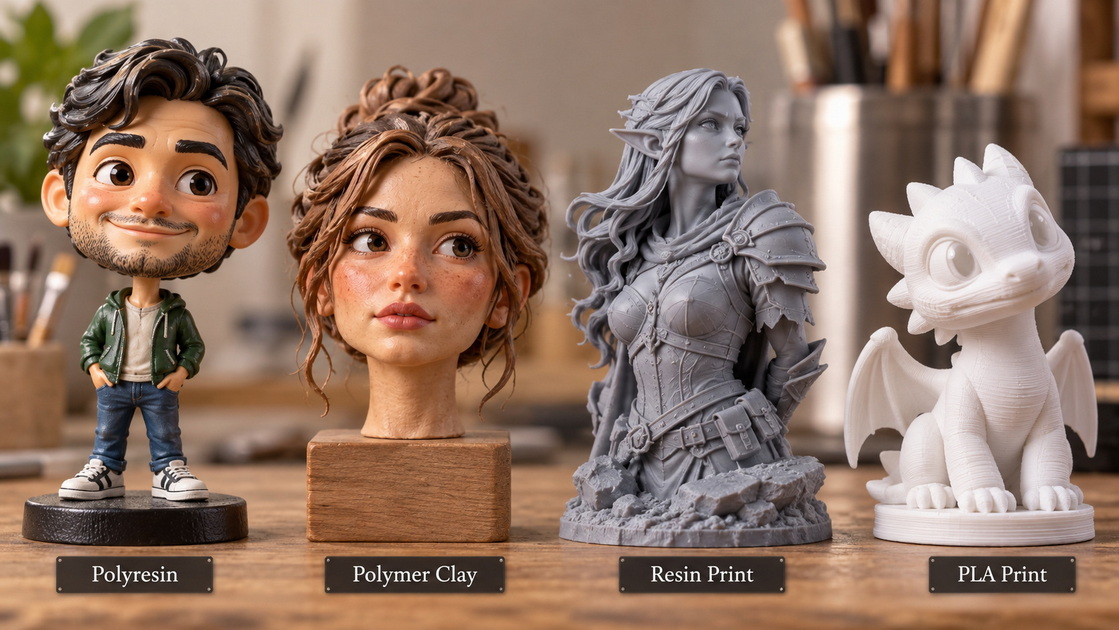
Resin and polyresin are popular for personalized bobbleheads and decorative gifts because they can create a solid, smooth, detailed surface. They are well suited to painted finishes and can reproduce a wide range of clothing folds, facial features, accessories, and custom bases.
For a finished resin figurine, buyers often appreciate:
- A polished, substantial feel
- Smooth painted surfaces
- Good detail reproduction
- Strong visual color coverage
- Flexible design styling
- Suitability for gift boxes and retail displays
However, resin crafts should still be treated as decorative items unless the product has been specifically designed, tested, and marketed for children.
Polymer clay is especially valued for its handcrafted appearance. It can create soft facial contours, expressive hair texture, clothing details, and a visible artisan touch.
Its advantages include:
- A distinctive handmade look.
- Strong appeal for sentimental one-off gifts.
- Flexible artistic styling.
- Easy integration of small custom accessories.
- A warm visual identity for wedding, couple, and family designs.
Polymer clay figurines are generally best positioned as display gifts, not rough-play items. Proper baking, structural support, sealing, and protective packaging are important to help preserve the finished piece during shipping and daily display.
The material used in 3D printing matters greatly.
| 3D Printing Material | Typical Strengths | Common Limitations |
|---|---|---|
| PLA filament | Easy printing, accessible cost, good for prototypes | Layer lines can be visible; heat resistance is limited |
| PETG filament | Better impact resistance and toughness than PLA | Fine figurine detail may be less crisp than resin printing |
| Standard photopolymer resin | Sharp details and smooth results after finishing | Can be brittle if dropped; requires careful post-curing |
| Tough or ABS-like resin | Better resistance than standard resin | Higher material cost and controlled processing needs |
| Full-color sandstone or composite materials | Direct color possibilities for display models | Surface can be more fragile or porous depending on process |
The material alone does not define quality. Model design, wall thickness, curing, paint, sealing, packaging, and intended use are equally important.
Understanding the workflow helps buyers set realistic expectations for cost, lead time, revision limits, and order quantities.
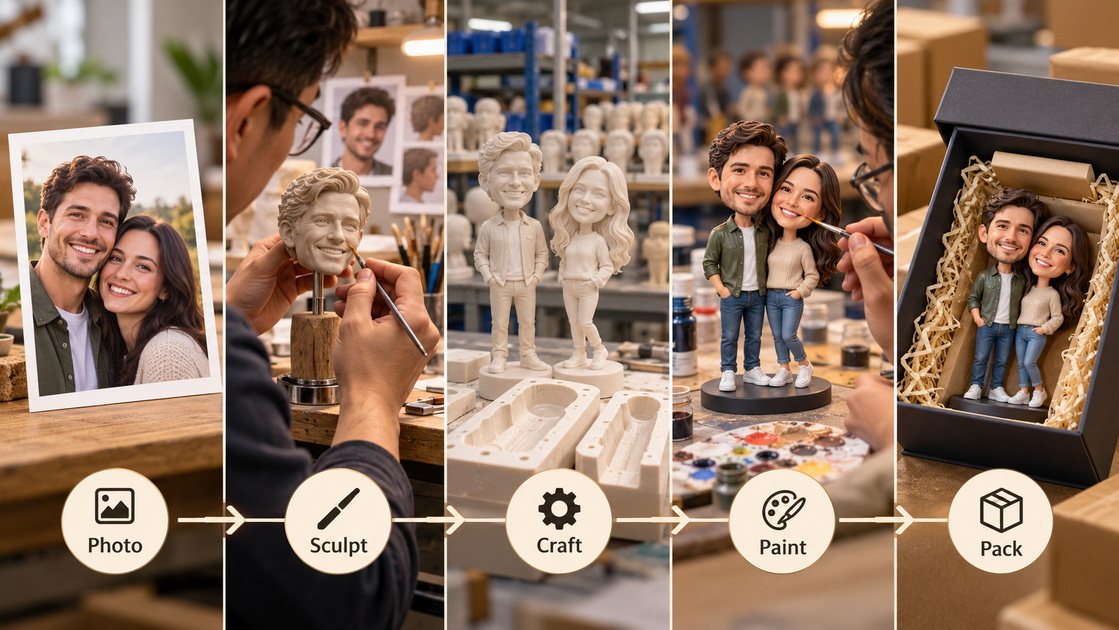
1. The customer submits clear front, side, and full-body photos.
2. The design team confirms style, size, pose, clothing, accessories, and base text.
3. Artists create the head and body design through sculpting or an established production process.
4. The customer receives a proof or progress image when the supplier offers approval service.
5. The figurine is painted, assembled, quality checked, and packed.
6. The order is shipped with protective internal packaging.
This process is ideal for emotional gifting because there is room for artistic adjustments. It also requires clear communication. A front-facing photo alone may not accurately show hairstyle depth, body proportions, or side-view features.
1. The customer provides a scan, existing model, reference images, or concept brief.
2. A 3D artist creates or edits the digital model.
3. The customer approves a digital render.
4. The model is prepared for printing, including supports and wall-thickness checks.
5. The figurine is printed, cleaned, cured, and support structures are removed.
6. The product is sanded, painted, assembled, and packaged if required.
The digital workflow is powerful, but it is not completely automatic. If the source image is unclear, the artist still makes choices about hidden facial areas, body posture, garment shape, and proportions.
The best production route depends on the commercial objective.
| Business Requirement | Better Option | Why |
|---|---|---|
| One personalized retirement gift | Personalized figurine from photo | Emotional likeness and custom storytelling matter most |
| Custom couple bobbleheads for an online gift store | Personalized figurine from photo | Supports varied faces, outfits, names, and poses |
| Detailed prototype before mold production | 3D printed figurine | Digital changes are easier before tooling investment |
| Small run of fantasy character miniatures | 3D printed figurine | Repeatable model and intricate geometry are valuable |
| Corporate employee recognition gifts | Personalized figurine from photo | Personalized uniforms, job props, and nameplates improve engagement |
| Branded mascot figurine in multiple sizes | Hybrid approach | Build a digital master, then use resin casting for scalable production |
| Wholesale promotional bobbleheads | Resin casting with custom head design | Better economics for larger repeat orders after design approval |
For B2B buyers, a hybrid strategy is often the most practical solution. A supplier can create a master design digitally, develop a prototype, refine the details, and then move into resin casting or hand-finished production for stronger unit economics at higher quantities.
Before placing an order, ask the manufacturer the following questions.
Clarify whether the product will be:
- Cartoon style.
- Semi-realistic style.
- Realistic portrait style.
- Traditional bobblehead style.
- Full-body figurine.
- Half-body desk figurine.
- 3D printed collectible miniature.
Style approval prevents disappointment. A customer expecting a realistic portrait may not be satisfied with a highly exaggerated caricature, even if the craftsmanship is excellent.
For the best result, provide:
- One clear front-facing photo.
- One left or right side-profile photo.
- A full-body photo if the body should match the person.
- Close-up images of glasses, hairstyle, uniform, jewelry, or tattoos.
- Reference images for props and accessories.
- The exact text for the base or plaque.
Avoid heavily filtered images, dark photos, group photos with cropped faces, and pictures where sunglasses hide key facial features.
A preview stage is important for personalized orders. Confirm:
- Whether the supplier provides a digital render, sculpture preview, or production photo.
- How many revision rounds are included.
- Which changes are free and which require extra fees.
- Whether changes are allowed after painting begins.
- How approval affects delivery timing.
For international shipping, ask about:
- Inner foam protection.
- Individual gift boxes.
- Master cartons.
- Drop-test considerations.
- Fragile-product labeling.
- Spare-part policy for bobblehead springs or detachable elements.
A high-quality figurine can still arrive damaged if packaging is poorly designed. For wholesale buyers, packaging is part of the product experience.
This distinction is essential. A decorative personalized figurine should not automatically be marketed as a toy. If the item is intended primarily for children aged 12 and under in the United States, applicable toy safety rules, testing, labeling, and certification requirements may apply. Product claims, age grading, material selection, coatings, small parts, and packaging should be reviewed before sale.
Choose a personalized figurine from photo if your priority is emotional connection. This option is ideal for gifts where a customer wants to say, "This looks like us," "This captures my colleague," or "This remembers a special day."
Choose a 3D printed figurine if your priority is digital control. It is ideal when you need repeatable geometry, a detailed collectible model, a prototype, or a design that may be reproduced from the same approved 3D file.
Choose a hybrid resin production model when you need both. For example, a brand can use digital modeling to develop a mascot, approve the prototype, and then produce hand-finished resin figurines for retail, events, distributor programs, or corporate gifts.
For personalized bobblehead brands, the strongest customer experience usually comes from combining accurate photo interpretation, skilled artistic finishing, durable materials, secure packaging, and transparent proof approval.
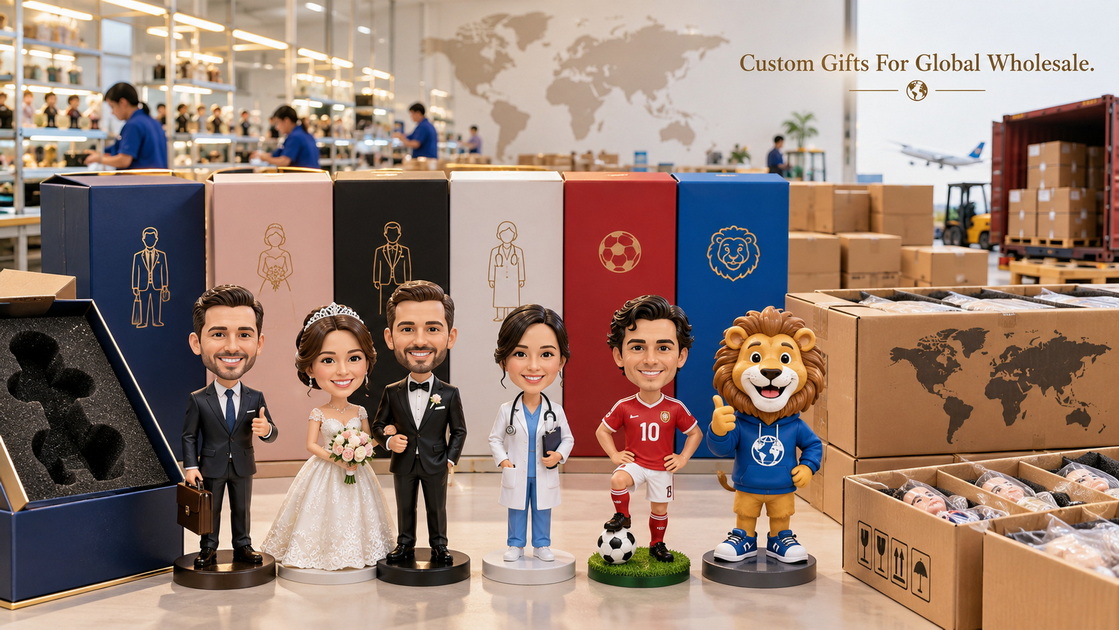
Top Arts & Crafts Co., Ltd. specializes in customized resin crafts and polymer clay gift products for global buyers. We support personalized bobbleheads, photo figurines, custom gifts, promotional crafts, private-label projects, and wholesale orders.
Our production approach focuses on the details that matter in commercial personalization:
- Clear artwork confirmation before production
- Recognizable facial features and customized hairstyles
- Flexible clothing, pose, accessory, and base options
- Resin and polymer clay craftsmanship for gift-focused products
- Custom packaging and branding support for wholesale customers
- Export-oriented quality control and protective packing
- Scalable options for retailers, distributors, and corporate buyers
Whether you need a one-of-a-kind photo gift concept or a repeatable branded figurine line, the right manufacturing method should match your customer's expectations, sales channel, and order quantity.
No. A personalized figurine from photo describes the customization concept: a real person or subject is recreated from images. It may be handmade from polymer clay, produced in resin, sculpted digitally, or made through a hybrid method. A 3D printed figurine specifically refers to the manufacturing method of building an object layer by layer from a digital model.
For gift-focused bobbleheads and caricature figurines, a handmade or artist-led photo figurine often creates a more emotionally pleasing likeness because the artist can interpret expression, hairstyle, and facial proportions. For highly realistic reproduction, a professionally made digital model or 3D scan can provide strong geometric accuracy, provided the source data is high quality.
Not always. A simple unpainted print may be economical, but detailed 3D modeling, high-resolution resin printing, cleaning, curing, sanding, hand painting, and premium packaging can increase cost. Custom handmade photo figurines also vary in price based on complexity, size, accessories, and order quantity.
Customers should provide a clear front-facing headshot, a side-view photo, and full-body images if the pose or clothing should resemble the person. Bright, unfiltered, high-resolution photos produce better results. Close-ups of accessories, uniforms, hairstyles, and special props are also helpful.
They can be durable for normal display use when properly made, cured, assembled, painted, sealed, and packed. However, they are decorative crafts and may crack or break if dropped. Product durability also depends on wall thickness, design structure, shipping protection, and how the end user handles the item.
1. [U.S. Consumer Product Safety Commission: Toy Safety Business Guidance]
2. [U.S. Consumer Product Safety Commission: Toy Safety FAQ]
3. [U.S. Consumer Product Safety Commission: ASTM F963 Requirements Chart]
4. [Intertek: U.S. Mandatory Toy Safety Standard ASTM F963]
5. [The Toy Association: Updated Federal Toy Safety Standard ASTM F963-23]
6. [QIMA: ASTM F963 U.S. Toy Safety Standard and Laboratory Testing]
7. [3DAI Studio: How to Create a 3D Printed Figurine of Yourself]


